
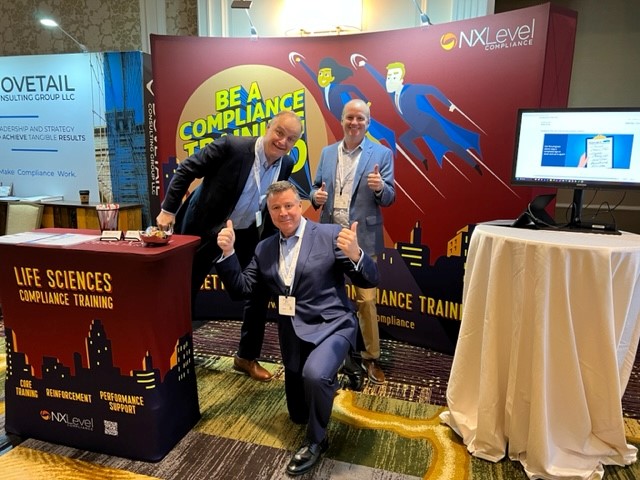
I begin with a personal note. After attending the Pharmaceutical Compliance Congress (PCC) for the last 15 years, the 2023 conference will most likely be my last. For those who have not heard, I plan to retire at the end of June (at least from a full-time position) to spend more of my days visiting my kids in Virginia and California, reading, and writing about something other than life sciences compliance.
With my pending departure from the world of life sciences compliance in mind, I approached the conference sessions with a different mindset. I listened carefully for the concerns and issues that truly stood out as being something “new,” something that compliance professionals should be aware of as they build and update their compliance training curricula.
This year’s conference didn’t disappoint, revealing surprises and twists on some of the common themes we’ve heard about over the years. And so, for the final time, (I think), I present my list of training considerations based on statements I heard at the 2023 PCC. Let me know what you think…but make it quick, the beach awaits!
“Now that you’ve earned a seat at the table, you need to add value.”
After introductory remarks and the annual video review of compliance news, the conference kicked into gear with the Chief Compliance Officer Luminary Panel. (Side note: I am somewhat disappointed that I am exiting this career without ever officially being part of a “luminary” anything. Oh well.)
Anyone who has attended a compliance congress in the last ten years has likely heard the phrase, “seat at the table.” We all know the importance of being present with the business and the risks of the compliance department operating in a silo, separate from the business. But once you’re at that table, what next? Luminaries to the rescue! As one presenter noted, “We’ve been at the table long enough to do more than just listen.” Another continued by stressing the need to “know what the business needs and come to the table with solutions.”
In terms of training, that means partnering with the business on the planning, development, execution, and measurement of the curriculum. What risks do the commercial teams and others need to understand? What does mastery of compliant behavior look like? What topics require reinforcement to help learners reach mastery? How can the training (live and online) help ensure “everyone at the company understands the value of operating with integrity?” When you’re prepared to engage in those discussions and build out a plan to help accomplish the goals and learning objectives, you’re on your way to bringing training value to the table.
“Most people come to work wanting to do the right thing.”
This one came from the same CCO panel. As one presenter sees it, part of the compliance department’s job is to “make it easy for everyone on the commercial team to follow through on their commitment to do the right thing.” Clear, easy-to-understand policies, appropriate and up-to-date technology, and data-tracking platforms are just a few examples referenced for accomplishing that goal.
I couldn’t help but think the same goes for the idea of deploying training that helps them carry through on their instinct to do the right thing. Have you analyzed the topics to determine which ones are confusing or tend to raise more questions? If, for example, “interactions in an HCP office” is a topic rife with questions, consider a follow-up “compliance escape room” workshop or eModule built around common scenarios reps face. In addition, performance support tools like interactive PDFs effectively remind them of key concepts and best practices in the field, when they need it most. In more cases than not, your learners are indeed bringing a sense of integrity to their roles in your company. It’s a great starting point, and now your challenge is to offer them the knowledge and tools necessary to fulfill that mission.
“Self-disclosure truly makes a difference.”
To no surprise, the comments concerning self-disclosure were espoused during the Keynote Enforcement Panel, which featured representatives of the Department of Justice and a representative from the US Attorney’s Office for the District of Massachusetts. It was actually one of the more compelling discussions I’ve heard as to why companies should consider reporting potential compliance violations. The benefits related to the ultimate outcome and possible settlements seem significant and worth noting when violations are identified internally.
The conversation started me thinking about the need for a “spirit of self-disclosure” in training. Have you established a “speak up” culture in your organization and does your training reflect that culture? Simply including a non-retaliation statement in your training is not enough. Adding real-life scenarios to online training, with characters who are rewarded for self-reporting compliance concerns, brings the concept to life. Those same scenarios can also be incorporated into live workshops and games. These are the opportunities to remind learners that the compliance department isn’t there to lord over their every action and mete out punishment for every potential violation. Compliant companies foster just the opposite.
“How can I make my compliance program fit with this product?”
Any regular readers of this blog probably know that I find conference sessions dedicated to small and emerging companies to be among the most valuable from a training information standpoint. Smaller compliance departments are challenged with accomplishing the same objectives and goals as their compatriots from larger companies, with significantly fewer resources and budgets. The panel discussion focused on smaller companies provided valuable tips and suggestions on this topic.
This time, the conversation around the need to “fit” the compliance program to the needs of a new product being launched was especially compelling. In such scenarios, you need to understand the unique areas of risk the commercial team faces for that product. For example, is it a product that involves a patient advocacy group and the potential risks those groups inherently present?
The same need holds true for your training. Your compliance risks are unique to your company’s product(s) and the activities associated with their promotion. Your training needs to be built to fit those risks. Have you conducted the analysis necessary to properly evaluate them? At NXLevel Compliance, we work with clients to map the levels of risk per activity and the frequency with which each activity occurs, to determine the proper level of training necessary to mitigate that risk. It doesn’t have to be a complicated process, but it’s a critical step toward ensuring the effectiveness of training.
“Creating a brand is one way to become a trusted partner for the business.”
When I saw the title for the Novel Approaches to Embedding Compliance into the Business session, I knew it held the potential for something new and exciting. The panelist who recommended the brand idea discussed how it helped create a more proactive relationship in his compliance department as they partnered with the business to reinforce key concepts and messaging. And, of course, creating a brand for the compliance program helps reinforce the messages across the company.
The same is true for a training curriculum. Emphasizing your compliance brand in your curriculum presents opportunities to connect learning to your mission and your company’s values and culture. Look for opportunities to integrate the compliance brand into training components. This isn’t to say all training needs to be built from the ground up. Even the right off-the-shelf compliance training can be customized to incorporate graphics and language reflective of your brand. When your overall program and your training align, retention rises, and learning sticks.
“Make people surprised this is coming from compliance.”
Let’s be honest, life sciences compliance hasn’t exactly been considered a bastion of unexpected creativity throughout the years. I don’t think employees traditionally have waited with bated breath for the rollout of new online compliance training or the hour-long lecture by their chief compliance officer during the annual POA. Fortunately, the industry continues to evolve away from such mundane approaches and the presentation titled, Building a Compliance Program from the Ground Up, showcased exciting examples of that evolution.
Panelists from Sage Therapeutics and Alnylam Pharmaceuticals covered the plethora of methods they use to make their compliance programs, policies, and training more memorable, and it is impressive. As was suggested during the presentation, “You have to challenge yourself to think outside the box.” Sage, for example, actively seeks ways to raise the level of creativity in their training with novel scriptwriting and branding to help learners relate to the content. The themed training materials are clever and engaging and characters appear across different modalities to convey a sense of familiarity. Above all, messaging in the training programs and the other communication reinforce the idea that “they are there to help the employees succeed.” That’s a powerful mission that makes a difference in the uptake and retention of training.
“The updated DOJ guidance calls for tailored and more targeted training programs.”
Not surprisingly, the March 2023 DOJ updates to its guidance on corporate compliance programs were referenced early in the Update on Recent DOJ Pronouncements Affecting Compliance Programs session.
The revised guidance suggests that a well-designed compliance program should include “appropriately” tailored training and communications (something most worthwhile instructional designers and developers should have been recommending for years). If you are not already familiar with the recommendations, it’s worth your time to dig into the details: https://www.justice.gov/criminal-fraud/page/file/937501/download
Suffice it to say the DOJ is expanding its evaluation, and its expectations, of what can be considered effective and engaging compliance training. As an example, the guidance now suggests that effective training includes a process by which employees can ask follow-up questions, no matter the format. The bottom line is that your compliance training needs to evolve ahead of government expectations to be considered effective. Consistent evaluation of the curriculum is necessary to know that you are taking every opportunity to target the training to the risks inherent to your company and its products; to find innovative solutions that continually raise the retention and application of policies and best practices; and to solicit the feedback necessary to address the concerns and questions from your learners.
“What keeps me up at night is what I don’t know.”
The final day of the conference featured the Compliance Across the Organization session, in which members of Sentynl’s Compliance and Commercial areas discussed ideas for how both sides can partner more successfully. They began with a brief conversation about the topics that most concern them and the comment above is an ideal segue for the close of this post.
Anyone tasked with developing an effective compliance training curriculum faces a daunting challenge – building and continually updating that curriculum with the foundational training, reinforcement solutions, and performance support tools necessary to reduce risk across the organization on an ongoing basis. That goal can’t be accomplished in a vacuum, especially considering the life sciences compliance environment is ever-changing and evolving with new policies, guidance, and regulations. It’s enough to keep anyone up at night.
The overarching and perhaps unintended theme of Informa’s 2023 Pharmaceutical Compliance Congress seemed to be one of collaboration. In one session after another, presenters stressed the necessity for compliance professionals to partner with their commercial colleagues and others in their companies to accomplish the goal of creating, optimizing, and maintaining a modern compliance department.
But the need to collaborate and learn from one another doesn’t end within the walls of a company. Conferences such as the PCC offer invaluable opportunities to keep up with enforcement trends and to learn the methods and best practices necessary to succeed. You won’t find a better place to hear from government officials and industry leaders, or to network with your peers, than this conference and PCF’s Compliance Congress in the Fall. And though you may not see me there busily taking notes, my colleagues will continue to be on stage and in the exhibit hall, sharing ideas and our growing array of solutions to help you reduce compliance risk with better training.
Thanks for reading!
Sean Murphy
NXLevel Compliance
.
 Compliance Training Intelligence