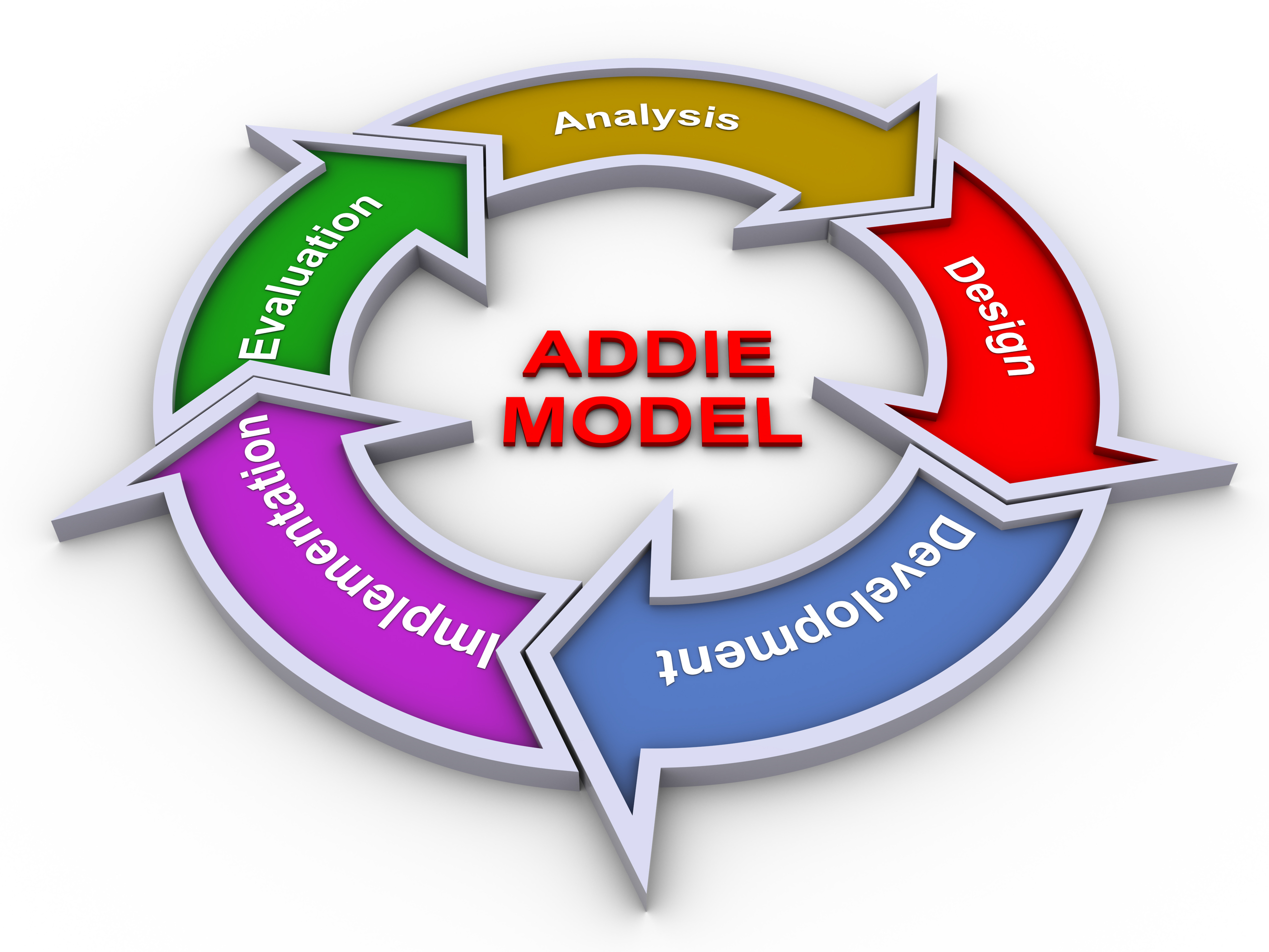
Using the ADDIE Model to Build Better Compliance Training, Part 3: D is Also for Visual Design

For this installment of our series on using the ADDIE model to build better compliance training, I talked to NXLevel’s Senior Art Director, Mike Mandracchia, to get his perspective on the importance of visual design when developing compliance training for the life sciences. Here are the highlights from our discussion.

Why do you think visual design matters for compliance training?
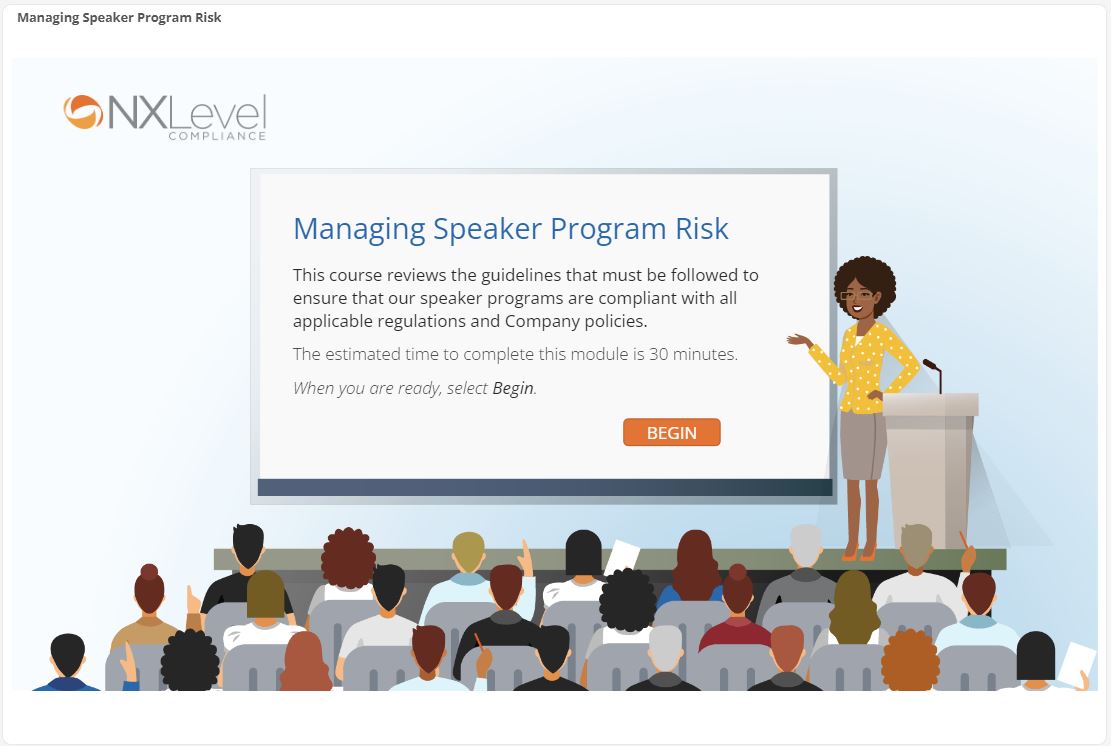
It starts with the learner’s perception. Compliance training isn’t usually something learners look forward to. It’s not like we often hear, “Oh boy, I get to take the compliance training now!” So, we face the challenge of changing their attitude right from the start. And the only way we’re going to do that is to think of visual design as more than just graphics.

It’s how it all comes together. How the on-screen content, the audio narration, and the user interface all align with the graphics in a complete package. It all needs to be visually attractive and easy to digest.

Let’s stay on that idea of “visually attractive.” Do you equate that with a modern approach to design?

I stay away from a term like “modern,” and I try to stick to classic, established concepts of design. That begins with a clean and timeless look. You can look at design from any era and know whether it’s good or not. The year, or even the decade, it was created doesn’t matter. Good design is good design, and we don’t want to run the risk of chasing fads or trends.

You led the push for the use of illustrated characters instead of stock photos or even custom-produced photos in NXLevel’s Compliance Foundations off-the-shelf eLearning courses. Why?
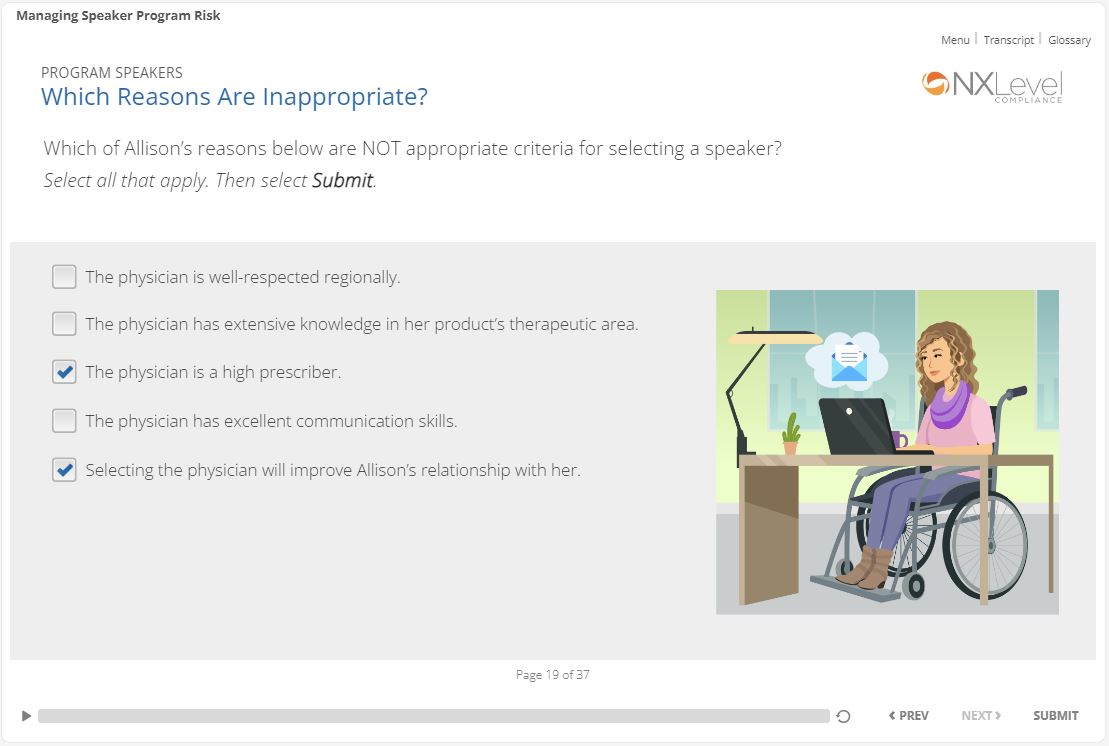
Multiple reasons. From a look and feel standpoint, they add more personality. The characters we use give the training a more light-hearted look, which goes back to my previous point about changing the perception of compliance training. I also recommend the use of illustrated characters because of the flexibility. It’s so much easier to find images that support the key messages and modifying them to fit the content is much simpler.

Stock photos are limited and frankly, they look like stock photos. As for custom photography, that can be expensive and is often not reusable. Illustrated images are more affordable, and you can change anything. And you can make your characters as diverse as the learners that are going to take the training.

Let’s talk about that diversity. How do you address diversity when you are designing a course?

Diversity is about the total human experience. That includes gender, ethnicity, physical appearance, religion, physical abilities, etc. It’s important that people see themselves in the training they take, and that extends to making sure the training reflects their own company too. It’s our job to research details about the company. What is the dress code? What do their buildings look like? The training should look like it came from their company. And that’s easy to modify with illustrations, whether we are customizing our off-the-shelf courses or creating custom training from the ground up.

How do you go about creating the visual design for a training deliverable?

It involves us (me and my design colleagues) working with everyone on the team, from the project managers to the instructional designers and developers and the client. There’s a reason our graphic artists are often part of on-going client meetings. I need to understand the details and regularly talk to the ID and development team to understand the goals of the project, the audience, how the content is going to be organized…whether it’s an electronic course or a workshop. It all helps me think about the learner’s experience.

What should people avoid when designing compliance training?

Well, this isn’t as much about what they should avoid as much as what they should think about. That gets back to your last question. It really matters how the content is presented. Sometimes, less is more. Cramming too much content and too many graphics into the program is a problem. That’s just going to disengage the learner and the training won’t stick.

Your point gets back to the idea of respecting the learner, doesn’t it?

Yes. It also gets back to our conversation about the use of illustrated characters instead of stock photos. The context is more meaningful when the images reflect the reality of their world. Think about it. No one is ever going to be fooled into thinking the stock photos they see in a training course are people from their company. And that’s fine. But, when we use illustrations, we can easily modify the broader details to align with the learners’ reality. For example, if we need a scene with a sales representative meeting with a healthcare professional in a specific type of office setting, we can do that easily and quickly. That type of context is less limiting and pulls the learners into the training. And the more they relate to it, the more they are engaged with it, and the more they will retain. Our goal is to remain as true as possible to that reality and to the content and always value the learner.

If you are interested in seeing some more of the visual design work Mike and his team have created, contact us at info@nxlevelsolutions.com and we’ll be happy to share some examples. Meanwhile, our next blog post turns to the I in ADDIE – Implementation. How you implement your training plan is as important as the plan itself.

Until then, thanks for reading!

Sean Murphy
Marketing Manager
Using ADDIE to Optimize Your Compliance Training Curriculum, Part 2: Design

This is the second post in a series about using the ADDIE learning model as a framework for building a better compliance training curriculum.

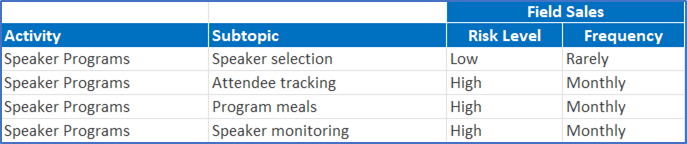
In our last post, we began with the first step in the ADDIE model, A (Analyze), and explored a way to analyze your compliance training needs so you can obtain a clear picture of those needs. The result was a list of the activities your employees engage in that contain some form of compliance risk, with columns indicating the risk level and frequency of each activity for each employee group. For example:

With this information in hand, it’s time to move on to the first D in the ADDIE model – Design. Now that you have identified your training needs, how are you going to meet them? How do you decide whether to create eLearning modules, live workshops, microlearning, performance support tools, etc.?

Several factors should help drive your design decisions.

Activity Risk

Make sure you address high-level risks first. This doesn’t necessarily mean all high-level risks need to receive the same level of resources or attention (other factors are at play), but it does mean that you need to implement a solution that properly addresses each high-level risk activity.

Select the chart to see examples of how various activities might be mapped in terms of risk and frequency.

Activity Frequency

Employees who perform an activity more frequently will tend to remember the steps involved (and the associated compliance guidance), while the opposite will be true of those activities performed less frequently.

For example, sales representatives may call on doctors almost every day. It’s a high-risk activity, but repetition breeds familiarity. However, the same sales representatives may only occasionally plan and host a speaker program. So, a quick reference guide or refresher training to remind them of their responsibilities would be helpful.

Regardless of the frequency of an activity, all learners benefit from a training solution that includes spaced reinforcement and that does not rely on just one crowded learning event. But for less frequent activities, reinforcement and reference materials are even more critical.

Learner Characteristics

Also take into account the characteristics of your learners. Think about these questions:

  • How many people engage in each activity? Some training modalities, like live workshops and coaching, are well suited for smaller populations but may not be practical for larger groups.
  • How many groups engage in the same activity? Are there groups who can receive the same training on a topic?
  • What are your learners’ levels of experience? Foundational training may be more important for new learners, whereas experienced learners may need more reinforcement or training that goes deeper into specific issues.
  • Where are your learners located? In-person training events may not be an option for a dispersed group.

Other Considerations

Here’s a quick review of other factors to consider.

  • Which activities can be addressed through common solutions? For example, can all transfers of value and transparency concerns be addressed through a single learning solution?
  • How stable is the subject matter? Are regulations, policies, or practices changing soon? You may want to hold off on an elaborate learning solution until the dust settles.
  • What resources do you have available? What’s your training budget? How many employees can you dedicate to training initiatives? Some solutions will be more practical and economical than others.

DOJ Recommendations

As you consider your choices, don’t forget to review the training recommendations found in the US Department of Justice’s Evaluation of Corporate Compliance Programs. Along with recommending timely, periodic, risk-based training that is appropriately tailored, the guidance notes that “Other companies have invested in shorter, more targeted training sessions to enable employees to timely identify and raise issues to appropriate compliance, internal audit, or other risk management functions.”

Possible Solutions

Weighing all the factors discussed above should help you narrow down the approaches that would help you best meet your learners’ training needs.

For example, low-risk, low-frequency activities might be best addressed by requiring learners to read the relevant policy and electronically sign an attestation. You can also provide job aids and other performance support tools learners can reference at the point of need, ie, when they are about to engage in the activity.

The Compliance Foundations eLearning module, Compliant Product Promotion, is a great starting point for all sales employees.

Likewise, when training on a high-risk activity, consider blending core training with reinforcement and performance support tools. For example, you could deploy a foundational eLearning module on promotional interactions for all sales employees, supplemented by live Q&A sessions for individual brand teams and micro-learning videos that periodically reinforce of key risks.

And don’t forget the value of communication. Website banners, short emails, and physical posters can all be used to remind employees of important principles and practices.

No Matter the Solution, Follow Good ID

Once you settle on a specific solution, remember to follow sound instructional design principles. Focus on the learning objectives, ie, what people need to know and be able to do, rather than chunks of content. Remember the goal is not to turn your employees into junior compliance experts; it’s to help them perform their jobs in compliance with your company’s policies and procedures and thereby reduce your company’s compliance risk. If nothing else, put yourselves in the learner’s shoes as you make your design decisions.

Conclusion

While this post merely scratches the surface, we hope it’s given you some practical design considerations to think about when creating or refreshing your compliance training curriculum.

In our next post, we’re going to stay with the topic of design a little longer, but this time we’ll discuss visual design and the role it plays in creating effective learning experiences.

Until then, thanks for reading!

Dave Correale
Senior Instructional Designer

Using ADDIE to Optimize Your Compliance Training Curriculum

Part 1: Analysis

This is the first post in our series on using the ADDIE learning model as a framework for building a better compliance training curriculum. We begin with the A (Analysis) stage of the model as a first step for creating or refreshing a curriculum.

With so many compliance concerns piling up in your inbox, it can be hard to take the time to pause and analyze your training needs without rushing towards solutions. But until you have a clear picture of  your needs, how can you be sure the solutions you are deploying really address them?

Whether you are creating your company’s first compliance training plan or working with a mature plan that has evolved over time, don’t skimp on the analysis. Otherwise, you risk creating a convoluted curriculum with redundancies, gaps, and an uneven emphasis on content over risk. And while analysis is an ongoing task, taking the time to conduct a formal analysis that looks at the big picture and gives you a foundation to build (or rebuild) from is important.

Start with the Risks

One way to begin your analysis is to list all of the activities your employees engage in that contain some form of compliance risk. After all, if your ultimate goal is to reduce risk, why not put those risks front and center in your planning?

We’re all familiar with the annual risk assessments that virtually all life science companies perform. They provide an overview of macro areas of risk and are therefore good overall guidance for compliance professionals. However, it is important to also consider the “risks within the risks.” The key here is to be granular enough so that you build an informative picture of the risks your company faces – one that gives you the flexibility to address risks that apply to different audiences, in different ways, and at different frequencies.

For example, to simply list “speaker programs” as a risk glosses over the individual activities involved in a speaker program that expose different people to various types, levels, and frequencies of risk. These could include speaker selection, attendee tracking, program meals, and the handling off-label questions.

Identify Your Learners

Next, it’s time to identify the groups of individuals who are potentially exposed to the risks you have listed. You could create these groups as columns that bisect your rows of risk activities. Again, it’s important to achieve the right level of specificity. Under the commercial umbrella, for example, you’ll want to break out field sales, sales operations, marketing, etc. so you can recognize the different needs for each function.

Add Risk Levels and Frequency

Not all risks are created equal; nor do they occur with the same frequency for the same groups of employees. It’s important to recognize both of these factors when analyzing your training needs.

The value of distinguishing activities that present higher levels of risk is obvious, but frequency is just as important. Someone who engages in a high-risk activity on a frequent basis has a different learning need than someone who engages in the same activity on a less frequent basis.

Since risk level and frequency can vary for each learner group, you can further divide your columns and assign risk levels and frequency, as shown in this example.

Next Step: Design

Completing the activity described above is not necessarily a quick and easy task, and you may need input from others to ensure its completeness and accuracy, but it’s a critical first step toward designing (or redesigning) a better compliance training curriculum to help you reduce risk across your company. And that will be the topic of our next blog post as we move on to the D in the ADDIE model, Design.

In the meantime, if you’d like a complimentary template of the spreadsheet described in this post, which we call the Compliance Curriculum Analysis Tool (CCAT), email us at info@pharmacertify.com. We’ll be happy to show you the tool and ideas on how to use it.

Thanks for reading!

Dave Correale
Senior Instructional Designer

Using ADDIE to Keep Your Compliance Resolutions

In this week’s post, Dave Correale, a Senior Instructional Designer at NXLevel Solutions, introduces a new blog series on using the ADDIE model to help build a better compliance training curriculum.

Now that the relatives have gone home, the ill-advised presents have been returned, and the eggnog in the back of the fridge has spoiled, it’s time to consider a New Year’s resolution to refresh and revive your compliance training strategy.

But getting your arms around your compliance training needs and developing a plan to address them can seem overwhelming. One tool that can help is the ADDIE model. In the training industry, we use ADDIE as a model for developing individual training solutions, but it can also be an effective tool for organizing your approach to a broader training strategy. Over the next several blog posts, we’ll use the ADDIE model as a framework for helping you build a compliance training plan worth celebrating.

Analysis – In this post, we’ll provide practical tips on how you can identify and prioritize your training needs. There are a lot of factors to consider, and we’ll discuss concepts and tools you can use to bring order out of the chaos.

Design – This post will be a two-parter. In Part 1, we’ll look at instructional design and how to design solutions to meet the training needs identified in the analysis stage. How do you choose whether to create eLearning modules, live workshops, microlearning, performance support tools, etc.?

In Part 2, we’ll discuss visual design and the role it plays in creating effective learning experiences. Do your training solutions look generic, or do they reflect your organization’s culture? Do your visual choices support or distract from your learning objectives?

Development – After design, it’s time to develop. But what do you develop first? And do you build it in-house or use a vendor? Is there an off-the-shelf solution you could use? Do you have existing assets that just need a refresh? We’ll explore the thought process that goes into deciding how to best use the resources you have available.

Implementation – How you implement your training plan is as important as the plan itself. Planning, timing, communication, support from the business, and getting the most out of your available learning platforms are just some of the elements we’ll examine in this post.

Evaluation – Finally, how effective is your compliance training? How can you tell? This post explores ways to determine whether your training is having an impact.

So, clean out the fridge, put the decorations away, and stay tuned for more tips on how to reduce risk through better compliance training.