
Anyone who’s paid attention to DOJ or OIG guidance the last few years knows that both agencies are looking for more than just policies and procedures when evaluating the effectiveness of a company’s compliance program. Both want to see evidence of a culture of ethics and compliance — one that encourages and rewards employees for doing the right thing.
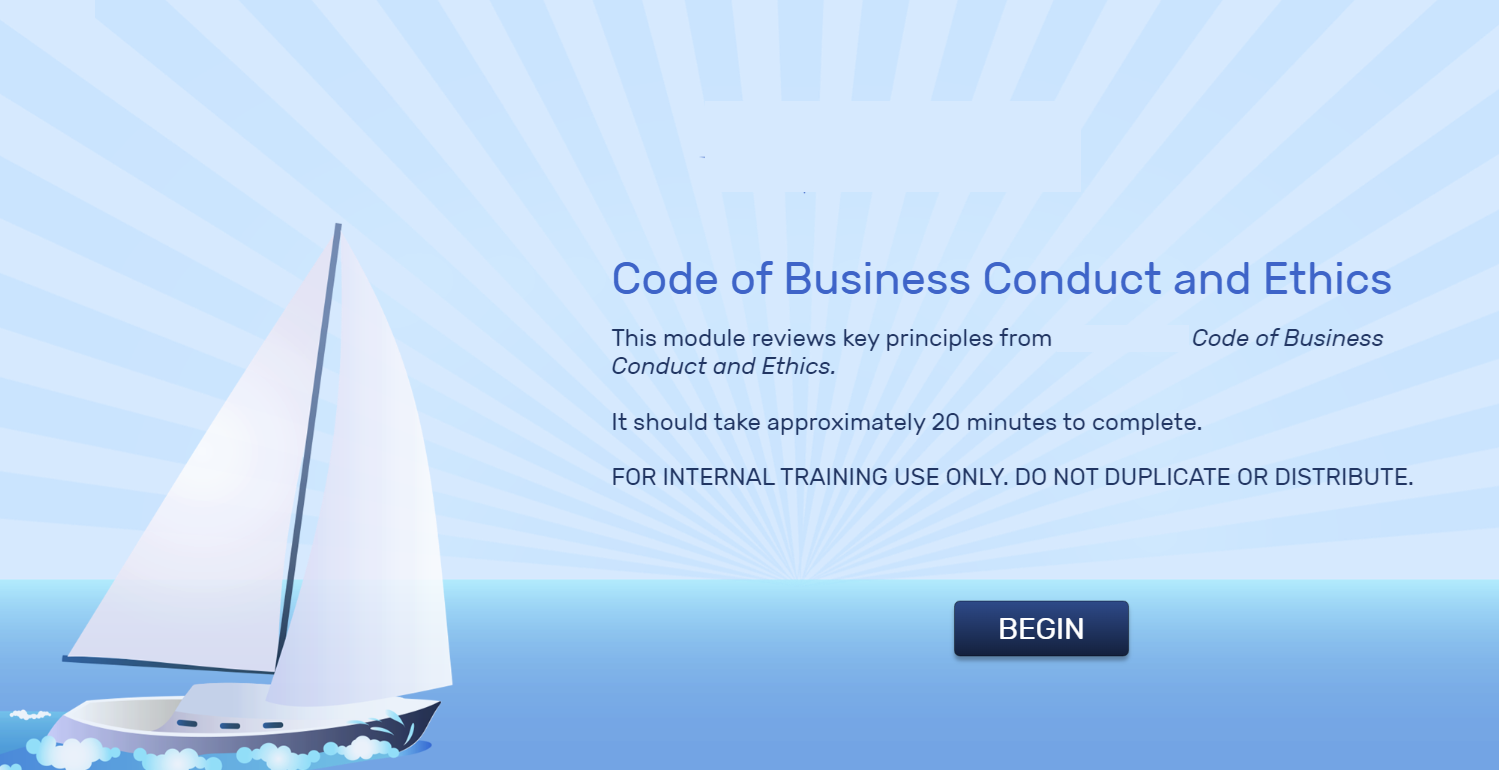
A foundational part of that culture is a company’s code of conduct. It is a declaration of a company’s values and expectations for all of its employees.
How well a company trains its employees on its code directly impacts how far those employees will go in embracing and acting on its values.
A company’s code of conduct training should be the jewel in the crown of its compliance training program, not just because of the size of its audience, but because of the importance of its objectives.
So, how do you create effective code training?
Make it engaging.
First and foremost, do not let your code training devolve into an exercise where you are reading the code to your employees. Require your employees to read the code on their own and use the code training to bring your code to life.
Keep the tone conversational and positive. Remember that people want to do the right thing and work for a company they can be proud of. Speak to the positive outcomes everyone wants to achieve – specifically how doing the right thing ultimately benefits patients.

Consider using leading questions, where an employee needs to first consider their own opinion about a topic before covering how that topic is addressed in your code. This helps prime their attention for the information that follows.
Make it contextual.
Help employees understand how the code is applicable to their jobs. Include exercises that ask them to apply its principles to real life situations. However, while these situations should be realistic, they should also be broad enough so that they are accessible to everyone. This is easier to achieve when you remember to emphasize the principles over the details.
Try to anticipate questions employees may have and address them head on. Provide concrete examples whenever possible, again avoiding details that only a narrow audience would appreciate.
Make it continuous.
Do not ask your employees to take the exact same code training year after year. For example, you can create a foundational training that covers your entire code and have all employees complete that training the first year. This training could be between 20-30 minutes in length.

Then, in subsequent years, you can have employees take shorter (5-10 min) refresher training modules that remind them of key principles. Or you can modify your foundational training each year to focus on different aspects of the code or include different situations and examples.
The important thing is to keep it fresh. Asking your employees to repeat the same code training every year sends the wrong message – that it is not a priority for them or your company.
You can also help keep the spirit of your code alive throughout the year by deploying short videos, micro modules, and intranet banners that reinforce key points, like speaking up, avoiding conflicts of interest, or protecting confidential information.
Consider how the code is published.
Finally, you may even want to consider how the code itself is published. Instead of an expensive, glossy booklet that gets thrown in a drawer or a bland, static PDF that requires a lot of scrolling, your code can be published as an interactive, visually appealing, engaging online experience (a microsite) that can even include exercises that turn the code itself into a learning tool.
There are many strategies you can adopt to help bring your code to life and nurture the culture of ethics and compliance that the DOJ and OIG are consistently pointing to. Whichever strategy you think may work for your company, NXLevel is here to help. To learn more, contact us at compliance@nxlevelsolutions.com.
Thanks for reading.
 Compliance Training Intelligence