Social media compliance training can be tricky. On the one hand, you want your employees to follow your company’s official social media channels and share their enthusiasm for your company online.
On the other hand, you don’t want employees accidentally sharing confidential company information, unintentionally engaging in inappropriate product promotion, or otherwise presenting themselves as official company spokespersons when posting on their personal social media accounts.
If your training comes across too heavy-handed, your employees might be too scared to ever like a company post. But if your training is too vague, you could leave them confused, or worse, they could feel like they can post or comment on just about anything.
So how do you hit the sweet spot? Here are a few tips.
1) Know your audience. If your social media training is being assigned to all your employees, don’t weigh it down with rules that only apply to the people who can post to your company’s official social media channels. Handle their training needs separately. Your employee-wide training should focus more on the do’s and don’ts of personal social media use.
2) Include lots of examples. Be sure to include enough examples to illustrate your social media rules. Are there some company posts that employees can comment on and others they should not? Show at least one realistic example of each.
3) Explain the “why.” Remind employees why your company has a social media policy in the first place. It’s not just because regulations apply to the information your company shares. Patients, healthcare professionals, investors, job candidates, and other stakeholders rely on accurate and clear information about your products and your company.
4) Tell them who to ask. No matter how great your training is, people will have questions. Make it clear who employees can reach out to with questions.
5) Take a continuous learning approach. Just like any training, your social media training won’t stick without some sort of reinforcement. Consider sending out short follow-up videos or occasional email blasts that reinforce key guidance.
I’m sure you’ve noticed that all these rules apply to any training subject. But social media training can be a slippery slope, partly because it addresses non-work activities and partly because government and industry guidance is not as robust as it is for other areas.
To help your employees understand how they can appropriately engage with company-related social media content, NXLevel Compliance has just released a new training module, Social Media Matters. If you are interested in more information about this module, contact us at info@nxlevelsolutions.com.
In the meantime, we hope you find these tips helpful as you continue your journey as a compliance training hero!
In our last post, we covered the training highlights found in the OIG’s new General Compliance Program Guidance and noted the agency’s suggestion that “education should not be limited to annual formal training requirements.” In this post, we dive into detail about the different solutions you can use to build a curriculum that addresses the OIG’s guidance and effectively battles the “forgetting problem” inherent with a one-and-done approach to compliance training.
Reinforcement Staples
Micro-Modules Deploying microlearning modules to reinforce on topics previously covered in foundational training is a great start toward an optimized curriculum. For example, if MSL and commercial interactions are a particular cause for confusion, a short module with fresh content, or even content repurposed from foundational training, keeps critical points fresh in the learner’s mind and helps reduce the risk those interactions present.
Reinforcement Videos A range of modern software programs allow for the rapid and efficient development of high-quality, animated videos ideal for reinforcing key concepts across your organization. For example, a 90-second reminder on good communication practices can be delivered through a link in an email, or it can be playing on monitors in public spaces located across your company. We’re creating a library of videos for a number of our clients, which they can deploy strategically and provide as references on their intranet.
Creative Workshops Whether delivered in-person or virtually, a creatively designed workshop brings compliance guidelines to life and lets your learners practice applying their knowledge in a “safe” environment. Two of our favorites are our Compliance Reality Challenge and Compliance Escape Room workshops, where individuals and teams explore real-life scenarios and compete against one another using online, interactive tools.
Compliance Games If you want your learners to remember their training, play a game. When deployed in a live/virtual setting, or through an online system, well-designed games are yet another tool to help reinforce critical compliance guardrails. Keep the gameplay fun and, if possible, keep it familiar. Our Compliance JEOPARDY! game, for example, is the only officially licensed JEOPARDY game on the market and features immediately recognizable graphics and music to pull participants into the learning.
Think Outside the Box
Enhanced learning can be supported by a wide range of creative solutions – not just the more common ones mentioned above. And making training stick isn’t always about creating more training. The right communication tools can reinforce key concepts and messages.
Comic Strips A number of our clients have used comic panels as a fun way to carry messages across different formats and support their unique company and compliance culture. If, for example, you create characters as part of a theme for your code of conduct training, why not recreate illustrated versions of those same characters in print? The comic panels can be displayed on posters or digitally on company platforms, and you can even create graphic novels that can be distributed to employees.
Digital Banners Banners posted across electronic platforms such as your intranet can help reinforce training messages and remind learners of key events. Have you stressed a “speak up” culture in your core compliance training? Add digital banners across different platforms to boost that message using the same visual design employed in the training. Do you celebrate Compliance & Ethics Week with live events? A digital banner can remind attendees of the dates.
Compliance Avatars and GIFs A common refrain heard at compliance congresses is the need to boost the perception of compliance as a business partner. Creating avatar versions of key compliance personnel is a fun way to “put a face” on compliance and make compliance seem less intimidating. You can even develop GIFs with messaging using these avatars and push them out through internal messaging platforms like Slack.
Keep it Continuous and Keep it Fluid
A truly effective continuous compliance training curriculum is a journey, not a destination. Successful companies are always looking for ways to enhance their curricula with solutions that creatively extend learning beyond a yearly event, and we have only touched on a few ideas. Keep an eye on our LinkedIn showcase page for examples of the tools we help our clients utilize to reduce their compliance risk.
Like many of you, we’ve been reading the new General Compliance Program Guidance the OIG released this week. And of course, we jumped right to the section on training! Before we discuss the OIG’s new training guidance, we should note that this guidance applies to the healthcare industry as a whole, not pharmaceutical manufacturers specifically. However, the OIG has announced its intent to continue to publish separate guidelines for specific industry sectors and we can expect to see new and revised versions of those guidelines in the future.
With that caveat in mind, how does the training guidance in the OIG’s new General Compliance Program Guidance compare to what’s stated in the OIG’s existing Compliance Program Guidance for Pharmaceutical Manufacturers? Essentially, the message is the same, but there are new points of emphasis.
One of the most striking statements in the new guidance is, “Education should not be limited to annual formal training requirements. The compliance officer should seek and develop opportunities to provide education on compliance topics and risks throughout the year.”
This follows a trend many companies have already embraced. More companies are supplementing their formal compliance training events with micro-modules, short videos, brief communications, games, quick reference guides, and other less formal solutions that are deployed over the course of the year. The result is a learning ecosystem designed to reinforce and reenergize key compliance behaviors and messages. The OIG guidance calls out examples such as those mentioned above.
Other new points in the guidance jump out as well. The document:
Explicitly states that compliance officers should develop annual training plans that include the training topics to be delivered and the target audience for each topic
Provides a list of suggested topics to cover when training employees on your company’s compliance program
Emphasizes the need to provide targeted compliance training to board members
Stresses that compliance training should be made accessible to all learners (for example, by making it available in different languages)
Provides guidance on allowing training waivers for contractors
Obviously, there’s more than just training guidance to be found in the OIG’s new document, and we’ll be combing over it looking for more nuggets to share here and on the NXLevel Compliance LinkedIn page. In the meantime, feel free to reach out to info@nxlevelsolutions.com to learn how we can help you reduce risk and be a compliance hero!
Don’t forget to visit the crazy NXLevel Compliance team at their booth to talk training and see demos!
This year’s conference is October 25-27 and NXLevel Compliance will be there, as usual. We’re excited to see our clients and colleagues and discuss how we can help reduce risk through better compliance training.
Also, Dan O’Connor, our senior VP, will be moderating a panel of CCOs on the topic of developing compliance leaders at 8:00 AM on Thursday the 26th. Grab your coffee and breakfast and join them for ideas and practical approaches you can use to help develop your team and yourself.
Here are ten other sessions we find to be compelling, especially from a training perspective:
Mini Summit 1: Compliance Primer and How to Make the Most of Your Time at the PCF Congress Although this session is tilted those new to life sciences compliance, expect it to be valuable for everyone as Terra Buckley shares tips for maximizing your learning and networking time at the conference.
Mini Summit 3: Insights from Medical Device Corporate Integrity Agreements Corporate integrity agreements are sure to hold keys for the expectations of regulatory bodies such as the OIG and point to the appropriate focus for any medical device compliance training curriculum.
Mini Summit 5: The Latest in Social Media Enforcements If you’re concerned about what your company’s employees might be posting or sharing (and you should be), you don’t miss this one. Side note: stop by our booth to see a demo of our new Social Media Matters Compliance Foundations module.
11:50 am Networking Luncheon In Exhibit Hall And Luncheon Mini Summits You don’t want to miss the opportunity to network with the vendors, especially at Booth 212, where we’ll be sharing demos of our newest compliance training solutions, including our Compliance QuickTakes. Then head into Luncheon Mini Summit 23: Is the “No Patient Left Behind” Approach to Patient Support Programs Viable? to hear the tips for safeguarding against the risks inherent with patient programs.
Keynote: OIG Update This year, Mary E. Riordan, Senior Counsel for the OIG, is joined by Robert K. DeConti, Chief Counsel to the Inspector General, so the annual look back at recent settlements and preview of the agency’s 2024 workplan should be even more enlightening.
US DOJ Keynote Lisa Miller, Deputy Assistant Attorney General for the Criminal Division of the Department of Justice, is up next and just like the OIG presentation, this is a can’t miss session for anyone interested in knowing where the DOJ’s attention is focused, especially considering the updates to the agency’s Evaluation of Corporate Compliance Programs guidance in March of this year.
Prosecutor’s Roundtable The prosecutor’s roundtable never disappoints in terms of the tips and suggestions panelists share regarding the government’s focus and what the industry should expect on the enforcement front.
Mini Summit 31: Annual FCPA Update All is quiet on the FCPA front…or is it? Mark this one in your calendar to hear the latest in enforcement and trends, then plan to modify your 2024 global anti-corruption training accordingly. (We have a training module for that!)
Mini Summit 51: Compliance Experts Address Concerns on Emerging Risk Areas We’re fast approaching the end of 2023 and the start of a new year of compliance training. New risks are emerging. This session should be a great starting point for your review process as panelists discuss the new topics you’ll want to emphasize in your curriculum.
Mini Summit 52: Compliance Considerations for Rare Disease Sessions targeted to this growing segment of the industry can offer valuable content related to the training needs of that segment. Expect Tiffany Damiani from Insmed and Michael Hercz of Sentynl to do just that for the rare disease group.
Conference Registration Discount We’ve only scratched the surface of the fifty-three mini summits and multiple plenary sessions in the agenda. The Pharmaceutical and Medical Device Ethics and Compliance Congress remains one of the few opportunities for you to network with leaders in the field as they share their experiences and best practices building and maintaining an effective compliance program. No matter your industry or your company’s product focus, you’ll want to be there. If you haven’t already registered, contact us at info@nxlevelsolutions.com for our sponsor discount.
Thanks for reading, we hope to see you in Maryland!
For this installment of our series on using ADDIE to build better compliance training, I interviewed one of NXLevel’s Senior Project Managers, Pam Dorini, to hear her tips and suggestions for successfully implementing a compliance training program. According to Pam, a successful launch is built around one idea: begin with the end in mind.
Here are the highlights of our conversation.
As a project manager for custom and off-the-shelf compliance training projects, when do you start thinking about implementation?
Absolutely from the start of the project. The instructional designers, writers, and clients need to think about what we want the learners to know and be able to do as a result of the training. Then, we need to proactively think about the factors that are going to contribute to the learners doing that.
There are so many components to a successful launch, and so many stakeholders that need to be involved, implementation has to be a critical part of the plan from the start of the project. And how well that implementation goes is ultimately driven by the earlier steps in ADDIE – analysis, design, and development.
What do you see clients overlooking or underestimating in terms of implementation?
We are all pressed for time, so I think where clients go amiss is that they want to get going, get the training done, meet the immediate needs, and move onto the next project. If you don’t take the time to think through all the issues at the start, you’ll run into problems at implementation because that is where it all comes together. The time it takes to implement the training is usually quite short compared to the other stages, but implementation is where all those other stages come together, and it has to be planned as carefully.
Often, the analysis, design, and development stages are driven by the implementation date and that can lead to issues, especially when that development window is compressed, and clients are rushed to meet the deadline.
What is important for clients to consider regarding their LMS?
They need to think about the obvious and the not-so-obvious technical specifications. I will ask the client lead if he or she has released something on their LMS that is similar to what we are developing, and in most cases, we prefer to deliver a protype module for testing.
Time allocation needs to be top of mind. For example, does the LMS team have enough time to complete testing and remediation?
When we are working with a new LMS or authoring tool, testing conducted in tandem with module development is a good practice that has helped us avoid pitfalls or delays late in the process (i.e., implementation). As a company, we have integrated training into just about every LMS imaginable and there are idiosyncrasies from one to another. In some cases, we even uncover things we couldn’t have anticipated otherwise, like a font that doesn’t display correctly in a client’s system.
Are some timeframes better than others for launching compliance training?
They can be. Keeping the needs of learners at the forefront of decision making is critical. Timeframes need to be considered in correlation to the amount of time learners are given to complete the training and what other training is expected of them during that same period. Many of our clients tend to avoid launching big training initiatives over July and August because that’s when employees are often on vacation. Another challenging time can be late Autumn into the end of year as holidays and company shutdowns approach. We seem to get a lot of requests for launches in the Spring or in September and early October.
Can you share an example of a client who you think does a really good job with the implementation of training and talk about why?
I am thinking of one in particular who takes the time to understand all the various organizational goals. We always spend a lot of time planning with her and her team. She understands the capabilities and limitations of her LMS, and she engages with the business to get input on what they feel their learners need. She also understands the need for consistent communication with internal stakeholders and with us. By the time we get to the implementation point, everyone knows what to expect.
What type of changes have you seen in recent years related to implementation?
While the LMS is still the primary modality for compliance training, our clients are delving into other formats to better provide ongoing learning, reinforcement, and performance support. In addition to modules, we are developing infographics, quick reference guides, digital assets, games, and videos, which are made available in various ways. As an example, I’ve seen several clients build a library of compliance micro videos and set them up on their company SharePoint or intranet platform, then announce and link to them via email.
Conclusion
As Pam emphasized throughout our discussion, the implementation stage of compliance training drives all stages of a project. Always considering who will be taking the training, how they will be taking it, and when they will be taking it is key to making your training more effective. To roll out training that reduces risk across your company, begin with the end in mind, and keep it in mind from project start to finish.
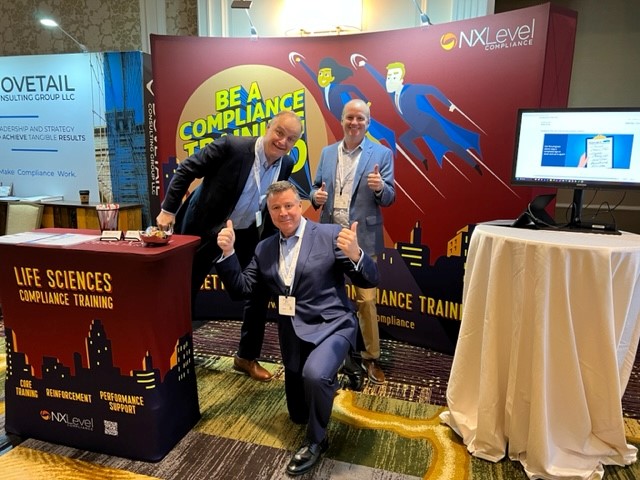
Sean Murphy, Dan O’Connor, and Paul Nash entertaining colleagues, clients, and themselves at the NXLevel Compliance booth.
I begin with a personal note. After attending the Pharmaceutical Compliance Congress (PCC) for the last 15 years, the 2023 conference will most likely be my last. For those who have not heard, I plan to retire at the end of June (at least from a full-time position) to spend more of my days visiting my kids in Virginia and California, reading, and writing about something other than life sciences compliance.
With my pending departure from the world of life sciences compliance in mind, I approached the conference sessions with a different mindset. I listened carefully for the concerns and issues that truly stood out as being something “new,” something that compliance professionals should be aware of as they build and update their compliance training curricula.
This year’s conference didn’t disappoint, revealing surprises and twists on some of the common themes we’ve heard about over the years. And so, for the final time, (I think), I present my list of training considerations based on statements I heard at the 2023 PCC. Let me know what you think…but make it quick, the beach awaits!
“Now that you’ve earned a seat at the table, you need to add value.”
After introductory remarks and the annual video review of compliance news, the conference kicked into gear with the Chief Compliance Officer Luminary Panel. (Side note: I am somewhat disappointed that I am exiting this career without ever officially being part of a “luminary” anything. Oh well.)
Anyone who has attended a compliance congress in the last ten years has likely heard the phrase, “seat at the table.” We all know the importance of being present with the business and the risks of the compliance department operating in a silo, separate from the business. But once you’re at that table, what next? Luminaries to the rescue! As one presenter noted, “We’ve been at the table long enough to do more than just listen.” Another continued by stressing the need to “know what the business needs and come to the table with solutions.”
In terms of training, that means partnering with the business on the planning, development, execution, and measurement of the curriculum. What risks do the commercial teams and others need to understand? What does mastery of compliant behavior look like? What topics require reinforcement to help learners reach mastery? How can the training (live and online) help ensure “everyone at the company understands the value of operating with integrity?” When you’re prepared to engage in those discussions and build out a plan to help accomplish the goals and learning objectives, you’re on your way to bringing training value to the table.
“Most people come to work wanting to do the right thing.”
This one came from the same CCO panel. As one presenter sees it, part of the compliance department’s job is to “make it easy for everyone on the commercial team to follow through on their commitment to do the right thing.” Clear, easy-to-understand policies, appropriate and up-to-date technology, and data-tracking platforms are just a few examples referenced for accomplishing that goal.
I couldn’t help but think the same goes for the idea of deploying training that helps them carry through on their instinct to do the right thing. Have you analyzed the topics to determine which ones are confusing or tend to raise more questions? If, for example, “interactions in an HCP office” is a topic rife with questions, consider a follow-up “compliance escape room” workshop or eModule built around common scenarios reps face. In addition, performance support tools like interactive PDFs effectively remind them of key concepts and best practices in the field, when they need it most. In more cases than not, your learners are indeed bringing a sense of integrity to their roles in your company. It’s a great starting point, and now your challenge is to offer them the knowledge and tools necessary to fulfill that mission.
“Self-disclosure truly makes a difference.”
To no surprise, the comments concerning self-disclosure were espoused during the Keynote Enforcement Panel, which featured representatives of the Department of Justice and a representative from the US Attorney’s Office for the District of Massachusetts. It was actually one of the more compelling discussions I’ve heard as to why companies should consider reporting potential compliance violations. The benefits related to the ultimate outcome and possible settlements seem significant and worth noting when violations are identified internally.
The conversation started me thinking about the need for a “spirit of self-disclosure” in training. Have you established a “speak up” culture in your organization and does your training reflect that culture? Simply including a non-retaliation statement in your training is not enough. Adding real-life scenarios to online training, with characters who are rewarded for self-reporting compliance concerns, brings the concept to life. Those same scenarios can also be incorporated into live workshops and games. These are the opportunities to remind learners that the compliance department isn’t there to lord over their every action and mete out punishment for every potential violation. Compliant companies foster just the opposite.
“How can I make my compliance program fit with this product?”
Any regular readers of this blog probably know that I find conference sessions dedicated to small and emerging companies to be among the most valuable from a training information standpoint. Smaller compliance departments are challenged with accomplishing the same objectives and goals as their compatriots from larger companies, with significantly fewer resources and budgets. The panel discussion focused on smaller companies provided valuable tips and suggestions on this topic.
This time, the conversation around the need to “fit” the compliance program to the needs of a new product being launched was especially compelling. In such scenarios, you need to understand the unique areas of risk the commercial team faces for that product. For example, is it a product that involves a patient advocacy group and the potential risks those groups inherently present?
The same need holds true for your training. Your compliance risks are unique to your company’s product(s) and the activities associated with their promotion. Your training needs to be built to fit those risks. Have you conducted the analysis necessary to properly evaluate them? At NXLevel Compliance, we work with clients to map the levels of risk per activity and the frequency with which each activity occurs, to determine the proper level of training necessary to mitigate that risk. It doesn’t have to be a complicated process, but it’s a critical step toward ensuring the effectiveness of training.
“Creating a brand is one way to become a trusted partner for the business.”
When I saw the title for the Novel Approaches to Embedding Compliance into the Business session, I knew it held the potential for something new and exciting. The panelist who recommended the brand idea discussed how it helped create a more proactive relationship in his compliance department as they partnered with the business to reinforce key concepts and messaging. And, of course, creating a brand for the compliance program helps reinforce the messages across the company.
The same is true for a training curriculum. Emphasizing your compliance brand in your curriculum presents opportunities to connect learning to your mission and your company’s values and culture. Look for opportunities to integrate the compliance brand into training components. This isn’t to say all training needs to be built from the ground up. Even the right off-the-shelf compliance training can be customized to incorporate graphics and language reflective of your brand. When your overall program and your training align, retention rises, and learning sticks.
“Make people surprised this is coming from compliance.”
Let’s be honest, life sciences compliance hasn’t exactly been considered a bastion of unexpected creativity throughout the years. I don’t think employees traditionally have waited with bated breath for the rollout of new online compliance training or the hour-long lecture by their chief compliance officer during the annual POA. Fortunately, the industry continues to evolve away from such mundane approaches and the presentation titled, Building a Compliance Program from the Ground Up, showcased exciting examples of that evolution.
Panelists from Sage Therapeutics and Alnylam Pharmaceuticals covered the plethora of methods they use to make their compliance programs, policies, and training more memorable, and it is impressive. As was suggested during the presentation, “You have to challenge yourself to think outside the box.” Sage, for example, actively seeks ways to raise the level of creativity in their training with novel scriptwriting and branding to help learners relate to the content. The themed training materials are clever and engaging and characters appear across different modalities to convey a sense of familiarity. Above all, messaging in the training programs and the other communication reinforce the idea that “they are there to help the employees succeed.” That’s a powerful mission that makes a difference in the uptake and retention of training.
“The updated DOJ guidance calls for tailored and more targeted training programs.”
Not surprisingly, the March 2023 DOJ updates to its guidance on corporate compliance programs were referenced early in the Update on Recent DOJ Pronouncements Affecting Compliance Programs session.
The revised guidance suggests that a well-designed compliance program should include “appropriately” tailored training and communications (something most worthwhile instructional designers and developers should have been recommending for years). If you are not already familiar with the recommendations, it’s worth your time to dig into the details: https://www.justice.gov/criminal-fraud/page/file/937501/download
Suffice it to say the DOJ is expanding its evaluation, and its expectations, of what can be considered effective and engaging compliance training. As an example, the guidance now suggests that effective training includes a process by which employees can ask follow-up questions, no matter the format. The bottom line is that your compliance training needs to evolve ahead of government expectations to be considered effective. Consistent evaluation of the curriculum is necessary to know that you are taking every opportunity to target the training to the risks inherent to your company and its products; to find innovative solutions that continually raise the retention and application of policies and best practices; and to solicit the feedback necessary to address the concerns and questions from your learners.
“What keeps me up at night is what I don’t know.”
The final day of the conference featured the Compliance Across the Organization session, in which members of Sentynl’s Compliance and Commercial areas discussed ideas for how both sides can partner more successfully. They began with a brief conversation about the topics that most concern them and the comment above is an ideal segue for the close of this post.
Anyone tasked with developing an effective compliance training curriculum faces a daunting challenge – building and continually updating that curriculum with the foundational training, reinforcement solutions, and performance support tools necessary to reduce risk across the organization on an ongoing basis. That goal can’t be accomplished in a vacuum, especially considering the life sciences compliance environment is ever-changing and evolving with new policies, guidance, and regulations. It’s enough to keep anyone up at night.
The overarching and perhaps unintended theme of Informa’s 2023 Pharmaceutical Compliance Congress seemed to be one of collaboration. In one session after another, presenters stressed the necessity for compliance professionals to partner with their commercial colleagues and others in their companies to accomplish the goal of creating, optimizing, and maintaining a modern compliance department.
But the need to collaborate and learn from one another doesn’t end within the walls of a company. Conferences such as the PCC offer invaluable opportunities to keep up with enforcement trends and to learn the methods and best practices necessary to succeed. You won’t find a better place to hear from government officials and industry leaders, or to network with your peers, than this conference and PCF’s Compliance Congress in the Fall. And though you may not see me there busily taking notes, my colleagues will continue to be on stage and in the exhibit hall, sharing ideas and our growing array of solutions to help you reduce compliance risk with better training.
This is the second post in a series about using the ADDIE learning model as a framework for building a better compliance training curriculum.
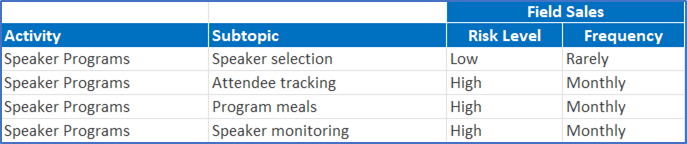
In our last post, we began with the first step in the ADDIE model, A (Analyze), and explored a way to analyze your compliance training needs so you can obtain a clear picture of those needs. The result was a list of the activities your employees engage in that contain some form of compliance risk, with columns indicating the risk level and frequency of each activity for each employee group. For example:
With this information in hand, it’s time to move on to the first D in the ADDIE model – Design. Now that you have identified your training needs, how are you going to meet them? How do you decide whether to create eLearning modules, live workshops, microlearning, performance support tools, etc.?
Several factors should help drive your design decisions.
Activity Risk
Make sure you address high-level risks first. This doesn’t necessarily mean all high-level risks need to receive the same level of resources or attention (other factors are at play), but it does mean that you need to implement a solution that properly addresses each high-level risk activity.
Select the chart to see examples of how various activities might be mapped in terms of risk and frequency.
Activity Frequency
Employees who perform an activity more frequently will tend to remember the steps involved (and the associated compliance guidance), while the opposite will be true of those activities performed less frequently.
For example, sales representatives may call on doctors almost every day. It’s a high-risk activity, but repetition breeds familiarity. However, the same sales representatives may only occasionally plan and host a speaker program. So, a quick reference guide or refresher training to remind them of their responsibilities would be helpful.
Regardless of the frequency of an activity, all learners benefit from a training solution that includes spaced reinforcement and that does not rely on just one crowded learning event. But for less frequent activities, reinforcement and reference materials are even more critical.
Learner Characteristics
Also take into account the characteristics of your learners. Think about these questions:
How many people engage in each activity? Some training modalities, like live workshops and coaching, are well suited for smaller populations but may not be practical for larger groups.
How many groups engage in the same activity? Are there groups who can receive the same training on a topic?
What are your learners’ levels of experience? Foundational training may be more important for new learners, whereas experienced learners may need more reinforcement or training that goes deeper into specific issues.
Where are your learners located? In-person training events may not be an option for a dispersed group.
Other Considerations
Here’s a quick review of other factors to consider.
Which activities can be addressed through common solutions? For example, can all transfers of value and transparency concerns be addressed through a single learning solution?
How stable is the subject matter? Are regulations, policies, or practices changing soon? You may want to hold off on an elaborate learning solution until the dust settles.
What resources do you have available? What’s your training budget? How many employees can you dedicate to training initiatives? Some solutions will be more practical and economical than others.
DOJ Recommendations
As you consider your choices, don’t forget to review the training recommendations found in the US Department of Justice’s Evaluation of Corporate Compliance Programs. Along with recommending timely, periodic, risk-based training that is appropriately tailored, the guidance notes that “Other companies have invested in shorter, more targeted training sessions to enable employees to timely identify and raise issues to appropriate compliance, internal audit, or other risk management functions.”
Possible Solutions
Weighing all the factors discussed above should help you narrow down the approaches that would help you best meet your learners’ training needs.
For example, low-risk, low-frequency activities might be best addressed by requiring learners to read the relevant policy and electronically sign an attestation. You can also provide job aids and other performance support tools learners can reference at the point of need, ie, when they are about to engage in the activity.
The Compliance Foundations eLearning module, Compliant Product Promotion, is a great starting point for all sales employees.
Likewise, when training on a high-risk activity, consider blending core training with reinforcement and performance support tools. For example, you could deploy a foundational eLearning module on promotional interactions for all sales employees, supplemented by live Q&A sessions for individual brand teams and micro-learning videos that periodically reinforce of key risks.
And don’t forget the value of communication. Website banners, short emails, and physical posters can all be used to remind employees of important principles and practices.
No Matter the Solution, Follow Good ID
Once you settle on a specific solution, remember to follow sound instructional design principles. Focus on the learning objectives, ie, what people need to know and be able to do, rather than chunks of content. Remember the goal is not to turn your employees into junior compliance experts; it’s to help them perform their jobs in compliance with your company’s policies and procedures and thereby reduce your company’s compliance risk. If nothing else, put yourselves in the learner’s shoes as you make your design decisions.
Conclusion
While this post merely scratches the surface, we hope it’s given you some practical design considerations to think about when creating or refreshing your compliance training curriculum.
In our next post, we’re going to stay with the topic of design a little longer, but this time we’ll discuss visual design and the role it plays in creating effective learning experiences.
This is the first post in our series on using the ADDIE learning model as a framework for building a better compliance training curriculum. We begin with the A (Analysis) stage of the model as a first step for creating or refreshing a curriculum.
With so many compliance concerns piling up in your inbox, it can be hard to take the time to pause and analyze your training needs without rushing towards solutions. But until you have a clear picture of your needs, how can you be sure the solutions you are deploying really address them?
Whether you are creating your company’s first compliance training plan or working with a mature plan that has evolved over time, don’t skimp on the analysis. Otherwise, you risk creating a convoluted curriculum with redundancies, gaps, and an uneven emphasis on content over risk. And while analysis is an ongoing task, taking the time to conduct a formal analysis that looks at the big picture and gives you a foundation to build (or rebuild) from is important.
Start with the Risks
One way to begin your analysis is to list all of the activities your employees engage in that contain some form of compliance risk. After all, if your ultimate goal is to reduce risk, why not put those risks front and center in your planning?
We’re all familiar with the annual risk assessments that virtually all life science companies perform. They provide an overview of macro areas of risk and are therefore good overall guidance for compliance professionals. However, it is important to also consider the “risks within the risks.” The key here is to be granular enough so that you build an informative picture of the risks your company faces – one that gives you the flexibility to address risks that apply to different audiences, in different ways, and at different frequencies.
For example, to simply list “speaker programs” as a risk glosses over the individual activities involved in a speaker program that expose different people to various types, levels, and frequencies of risk. These could include speaker selection, attendee tracking, program meals, and the handling off-label questions.
Identify Your Learners
Next, it’s time to identify the groups of individuals who are potentially exposed to the risks you have listed. You could create these groups as columns that bisect your rows of risk activities. Again, it’s important to achieve the right level of specificity. Under the commercial umbrella, for example, you’ll want to break out field sales, sales operations, marketing, etc. so you can recognize the different needs for each function.
Add Risk Levels and Frequency
Not all risks are created equal; nor do they occur with the same frequency for the same groups of employees. It’s important to recognize both of these factors when analyzing your training needs.
The value of distinguishing activities that present higher levels of risk is obvious, but frequency is just as important. Someone who engages in a high-risk activity on a frequent basis has a different learning need than someone who engages in the same activity on a less frequent basis.
Since risk level and frequency can vary for each learner group, you can further divide your columns and assign risk levels and frequency, as shown in this example.
Next Step: Design
Completing the activity described above is not necessarily a quick and easy task, and you may need input from others to ensure its completeness and accuracy, but it’s a critical first step toward designing (or redesigning) a better compliance training curriculum to help you reduce risk across your company. And that will be the topic of our next blog post as we move on to the D in the ADDIE model, Design.
In the meantime, if you’d like a complimentary template of the spreadsheet described in this post, which we call the Compliance Curriculum Analysis Tool (CCAT), email us at info@pharmacertify.com. We’ll be happy to show you the tool and ideas on how to use it.
Inthis week’s post, Dave Correale, a Senior Instructional Designer at NXLevel Solutions, introduces a new blog series on using the ADDIE model to help build a better compliance training curriculum.
Now that the relatives have gone home, the ill-advised presents have been returned, and the eggnog in the back of the fridge has spoiled, it’s time to consider a New Year’s resolution to refresh and revive your compliance training strategy.
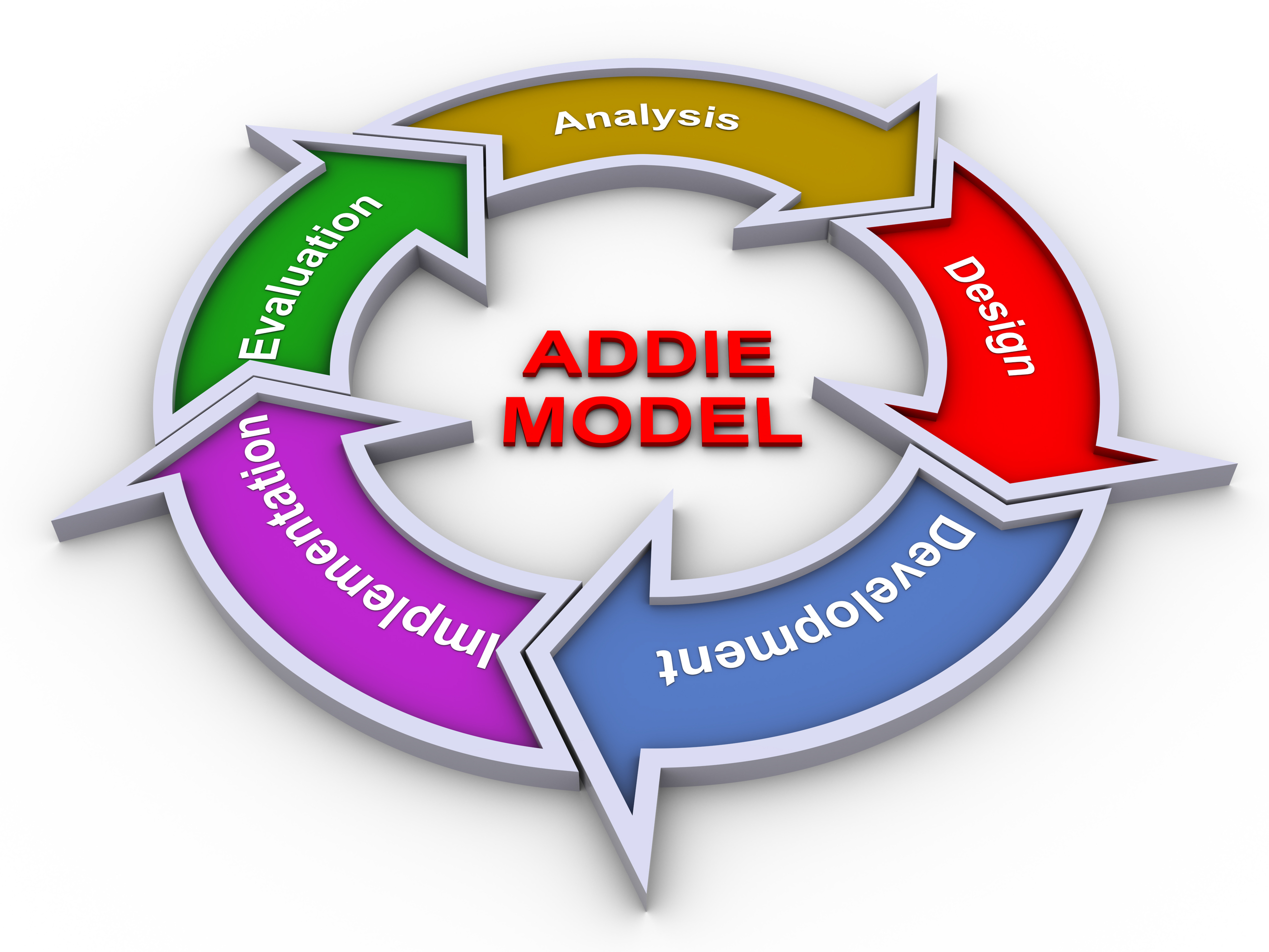
But getting your arms around your compliance training needs and developing a plan to address them can seem overwhelming. One tool that can help is the ADDIE model. In the training industry, we use ADDIE as a model for developing individual training solutions, but it can also be an effective tool for organizing your approach to a broader training strategy. Over the next several blog posts, we’ll use the ADDIE model as a framework for helping you build a compliance training plan worth celebrating.
Analysis – In this post, we’ll provide practical tips on how you can identify and prioritize your training needs. There are a lot of factors to consider, and we’ll discuss concepts and tools you can use to bring order out of the chaos.
Design – This post will be a two-parter. In Part 1, we’ll look at instructional design and how to design solutions to meet the training needs identified in the analysis stage. How do you choose whether to create eLearning modules, live workshops, microlearning, performance support tools, etc.?
In Part 2, we’ll discuss visual design and the role it plays in creating effective learning experiences. Do your training solutions look generic, or do they reflect your organization’s culture? Do your visual choices support or distract from your learning objectives?
Development – After design, it’s time to develop. But what do you develop first? And do you build it in-house or use a vendor? Is there an off-the-shelf solution you could use? Do you have existing assets that just need a refresh? We’ll explore the thought process that goes into deciding how to best use the resources you have available.
Implementation – How you implement your training plan is as important as the plan itself. Planning, timing, communication, support from the business, and getting the most out of your available learning platforms are just some of the elements we’ll examine in this post.
Evaluation – Finally, how effective is your compliance training? How can you tell? This post explores ways to determine whether your training is having an impact.
So, clean out the fridge, put the decorations away, and stay tuned for more tips on how to reduce risk through better compliance training.
Great news! Connie the Compliance Training Director has emerged from her self-imposed quarantine and returned to the North American Headquarters of PharmaCertify. For her first post-pandemic post, Connie answers a question about the appropriate compliance training mix for product launch…
Dear Connie,
Connie the Compliance Training Director
I’ve read the recent post on this blog about the formula for a better compliance training curriculum, and I completely agree with the rationale for a combination of foundational training, reinforcement, and performance support. I am a compliance officer for a pharmaceutical company in the Northeast and my company is rapidly approaching our PDUFA date (fingers crossed) for a new product.
We’ll soon be hiring a new field team that is highly experienced in the industry. Do you have suggestions for the tools to use along each step of the continuous training rollout? I want to make sure I get this right, so that we have a successful launch while being sure our team stays compliant.
Sincerely,
Skittish in Schenectady
Dear Skittish,
I understand your concern! Product launch is a time fraught with compliance risk. Whether this is your company’s first product, or one of many, the risk of not fully preparing a new sales team can keep you up at night. But as opposed to being skittish about this, I dare say you should view a product launch as a terrific opportunity to ramp up the compliance knowledge in the company and build your reputation as a compliance training hero! Here’s how:
Build a Solid Foundation
From a foundational standpoint, I suggest you start with training on interactions with health care professionals to refresh the reps on topics such as the rules around gifts, meals, and consulting arrangements. If you’re doing speaker programs, you’ll also want to cover guidance around those on a comprehensive level. Enforcement around the programs continues to be a focus, with the most recent settlement costing the company $900 million in settlements…yikes! And don’t forget to include your policy on virtual meetings now that they’ve become more commonplace. (By the way, my friends at PharmaCertify have added Managing Speaker Program Risk to their list of customizable off-the-shelf eLearning modules. It’s worth a look, so email them at info@pharmacertify.com to see a demo.)
Launch Screen from the Compliance Foundations Module, Interactions with Healthcare Professionals
Make sure regulations, such as the Anti-Kickback Statute and False Claims Act, are covered in general terms and in context of what they mean for the reps as they interact with HCPs. You could even shape some of the foundational training around the tenets of the PhRMA Code – it’s always a reliable starting point.
You might also think about converting your code of conduct from a static document you hope they read now and then, to a learning tool that reminds them of the core tenets of how they are expected to conduct themselves. And rote repetition of the code in electronic form does not rise to the level of effective training. A well-designed and fresh course will help familiarize the new reps with specifics of your code. (FYI – the PharmaCertify team has lots of fun ideas for how to bring your Code to life!)
One final note on foundational training: the rest of your staff (i.e., your non-commercial employees) need a basic understanding of the health care compliance principles that govern how you do business, so they will need training, too. In this time of increasing enforcement, you need to be able to demonstrate that everyone in your company has received essential compliance training.
Reinforce and Refresh
The possibilities for on-going refresher training don’t stop at the code of conduct though. Consider integrating microlearning modules (PharmaCertify calls them QuickTakes) covering topics pulled from your larger training programs into a curriculum campaign. For example, since gifts and meals present a high level of risk, a five-minute module focused on items of minimal value, cash and cash equivalents, as well as in-office meals, out-of-office meals, and meals at third-party events, is a great way to keep the rules top of mind.
Also, too many people fall into the trap of thinking microlearning just means “short.” My buddies at PharmaCertify take a different view. They define microlearning as any training component designed to reinforce foundational training as part of a continuous learning plan. The formats could include live-action or animated video, workshops, and game-based training, and even strategically delivered quizzes and assessments. The idea is to keep the training nuggets flowing for higher risk areas, which increases retention and enhances learning.
On the live training front, think about games to ramp up learning. If you’ve ever been in front of a group of reps playing any game, you know how they like to compete! As Gordon Gecko said in the movie, Wall Street, “Competition is good.” I know, he really said “Greed is good,” but I got your attention with that one, didn’t I?
This is JEOPARDY! In fact, it’s the only officially licensed JEOPARDY game on the market.
Look for games that have a familiarity to them. A Jeopardy game is great and if you’re interested, I can get you a demo for the only officially licensed compliance Jeopardy game on the market. It’s also easy to customize, so you can add the categories and topics you need to reinforce.
You can take the event to another level by pitting regional teams against each other and adding music, sound effects, and prizes to the mix. If done right, the games will have the participants saying, “that was the best compliance training event I ever attended!” Trust me, I’ve heard it.
There is a trend toward more creative live and virtual compliance workshops, and in my opinion, it is long overdue. Simply having a representative from the compliance department speak to a PowerPoint deck might not cut it in the view of regulatory bodies, and it certainly is not going to accomplish any worthwhile learning objectives.
An image from the virtual Compliance Escape Room Workshop
I even saw a virtual escape room utilized during one recent workshop. In this case, participants solved clues about three scenarios as they competed in teams to “escape” the rooms. It was a big hit at the national sales meeting and won a gold award for Best Advance in Compliance Training from the prestigious Brandon Hall organization.
Support Their Performance
If there’s one element of the formula for effective compliance training that is most neglected, it’s performance support. Throughout my career in compliance training, I have too often seen training viewed through a myopic lens that is only focused on foundational training and occasional reinforcement. Performance support tools broaden the scope of your training campaign and provide just-in-time guidance.
Support materials can be as varied as interactive PDFs launched on the learning management system, animated video played through the corporate intranet, or an interactive microsite for sharing policy and code information. In addition, tip sheets and reminders about best practices and policies can also be sent directly to reps’ phones or iPads to support them with the information they need in the field.
Summary
I wish you well with your efforts and good luck with that PDUFA date! Product launch may, at first glance, be nerve-racking from a compliance standpoint, but when you take the time to analyze your current training against your risk, then develop a continuous curriculum to be delivered across your reps’ timelines, you’ll be surprised at how seamless it can be. Just keep that formula for an effective curriculum (foundational + reinforcement + performance support) at the forefront of your planning and I guarantee you’ll sleep much better at night.







 Compliance Training Intelligence