Social media compliance training can be tricky. On the one hand, you want your employees to follow your company’s official social media channels and share their enthusiasm for your company online.
On the other hand, you don’t want employees accidentally sharing confidential company information, unintentionally engaging in inappropriate product promotion, or otherwise presenting themselves as official company spokespersons when posting on their personal social media accounts.
If your training comes across too heavy-handed, your employees might be too scared to ever like a company post. But if your training is too vague, you could leave them confused, or worse, they could feel like they can post or comment on just about anything.
So how do you hit the sweet spot? Here are a few tips.
1) Know your audience. If your social media training is being assigned to all your employees, don’t weigh it down with rules that only apply to the people who can post to your company’s official social media channels. Handle their training needs separately. Your employee-wide training should focus more on the do’s and don’ts of personal social media use.
2) Include lots of examples. Be sure to include enough examples to illustrate your social media rules. Are there some company posts that employees can comment on and others they should not? Show at least one realistic example of each.
3) Explain the “why.” Remind employees why your company has a social media policy in the first place. It’s not just because regulations apply to the information your company shares. Patients, healthcare professionals, investors, job candidates, and other stakeholders rely on accurate and clear information about your products and your company.
4) Tell them who to ask. No matter how great your training is, people will have questions. Make it clear who employees can reach out to with questions.
5) Take a continuous learning approach. Just like any training, your social media training won’t stick without some sort of reinforcement. Consider sending out short follow-up videos or occasional email blasts that reinforce key guidance.
I’m sure you’ve noticed that all these rules apply to any training subject. But social media training can be a slippery slope, partly because it addresses non-work activities and partly because government and industry guidance is not as robust as it is for other areas.
To help your employees understand how they can appropriately engage with company-related social media content, NXLevel Compliance has just released a new training module, Social Media Matters. If you are interested in more information about this module, contact us at info@nxlevelsolutions.com.
In the meantime, we hope you find these tips helpful as you continue your journey as a compliance training hero!
In our last post, we covered the training highlights found in the OIG’s new General Compliance Program Guidance and noted the agency’s suggestion that “education should not be limited to annual formal training requirements.” In this post, we dive into detail about the different solutions you can use to build a curriculum that addresses the OIG’s guidance and effectively battles the “forgetting problem” inherent with a one-and-done approach to compliance training.
Reinforcement Staples
Micro-Modules Deploying microlearning modules to reinforce on topics previously covered in foundational training is a great start toward an optimized curriculum. For example, if MSL and commercial interactions are a particular cause for confusion, a short module with fresh content, or even content repurposed from foundational training, keeps critical points fresh in the learner’s mind and helps reduce the risk those interactions present.
Reinforcement Videos A range of modern software programs allow for the rapid and efficient development of high-quality, animated videos ideal for reinforcing key concepts across your organization. For example, a 90-second reminder on good communication practices can be delivered through a link in an email, or it can be playing on monitors in public spaces located across your company. We’re creating a library of videos for a number of our clients, which they can deploy strategically and provide as references on their intranet.
Creative Workshops Whether delivered in-person or virtually, a creatively designed workshop brings compliance guidelines to life and lets your learners practice applying their knowledge in a “safe” environment. Two of our favorites are our Compliance Reality Challenge and Compliance Escape Room workshops, where individuals and teams explore real-life scenarios and compete against one another using online, interactive tools.
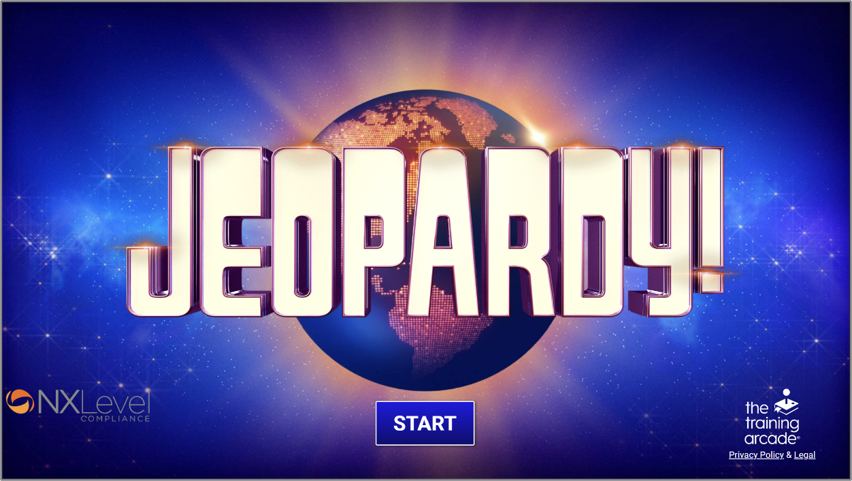
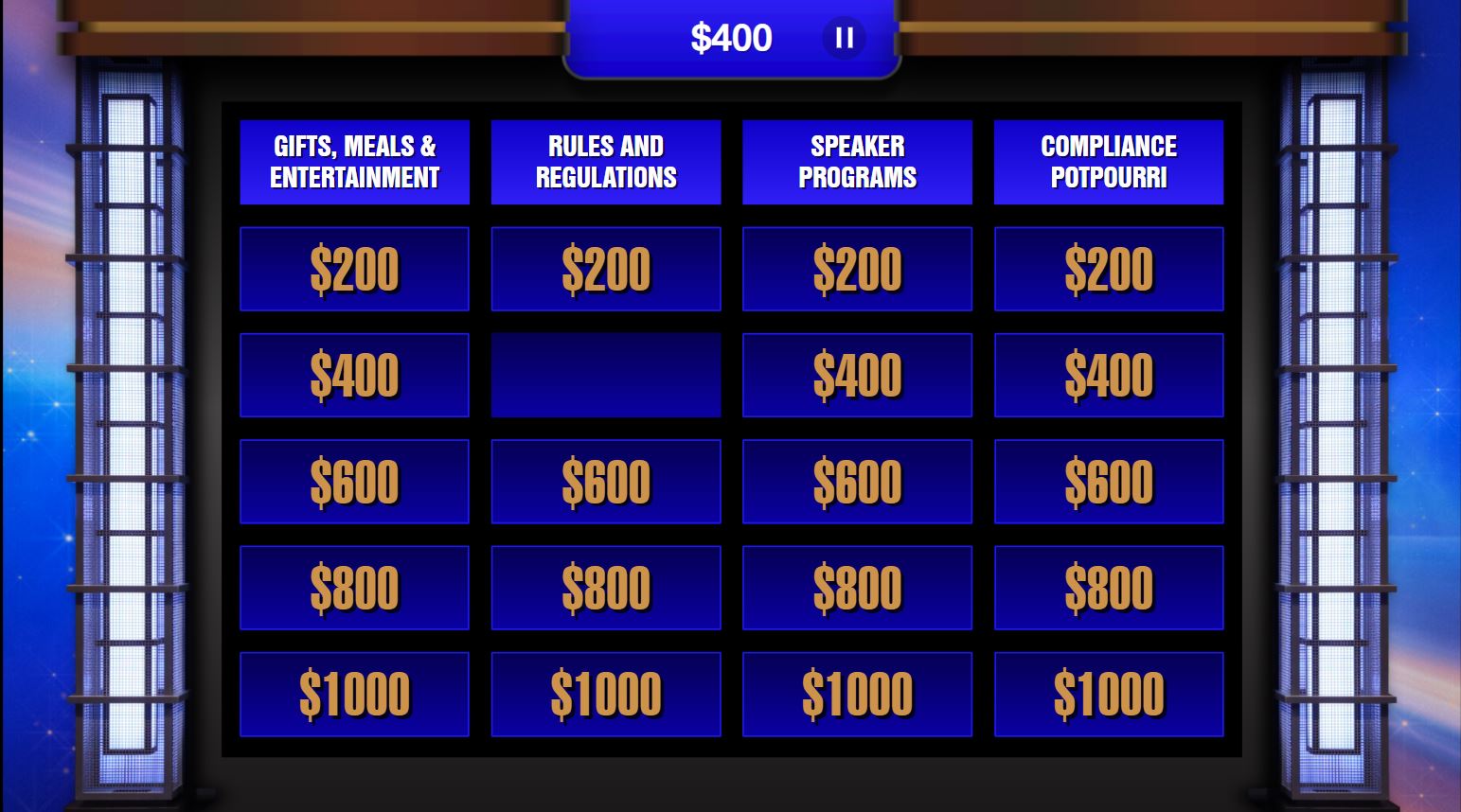
Compliance Games If you want your learners to remember their training, play a game. When deployed in a live/virtual setting, or through an online system, well-designed games are yet another tool to help reinforce critical compliance guardrails. Keep the gameplay fun and, if possible, keep it familiar. Our Compliance JEOPARDY! game, for example, is the only officially licensed JEOPARDY game on the market and features immediately recognizable graphics and music to pull participants into the learning.
Think Outside the Box
Enhanced learning can be supported by a wide range of creative solutions – not just the more common ones mentioned above. And making training stick isn’t always about creating more training. The right communication tools can reinforce key concepts and messages.
Comic Strips A number of our clients have used comic panels as a fun way to carry messages across different formats and support their unique company and compliance culture. If, for example, you create characters as part of a theme for your code of conduct training, why not recreate illustrated versions of those same characters in print? The comic panels can be displayed on posters or digitally on company platforms, and you can even create graphic novels that can be distributed to employees.
Digital Banners Banners posted across electronic platforms such as your intranet can help reinforce training messages and remind learners of key events. Have you stressed a “speak up” culture in your core compliance training? Add digital banners across different platforms to boost that message using the same visual design employed in the training. Do you celebrate Compliance & Ethics Week with live events? A digital banner can remind attendees of the dates.
Compliance Avatars and GIFs A common refrain heard at compliance congresses is the need to boost the perception of compliance as a business partner. Creating avatar versions of key compliance personnel is a fun way to “put a face” on compliance and make compliance seem less intimidating. You can even develop GIFs with messaging using these avatars and push them out through internal messaging platforms like Slack.
Keep it Continuous and Keep it Fluid
A truly effective continuous compliance training curriculum is a journey, not a destination. Successful companies are always looking for ways to enhance their curricula with solutions that creatively extend learning beyond a yearly event, and we have only touched on a few ideas. Keep an eye on our LinkedIn showcase page for examples of the tools we help our clients utilize to reduce their compliance risk.
“Lately it occurs to me, what a long, strange trip it’s been.” Truckin’, The Grateful Dead
In case you haven’t heard, I’m trading the canal towpath alongside NXLevel’s headquarters for the beach, where I will be contemplating the meaning of life and writing about something besides life sciences compliance. In other words, I’m retiring.
While I will still be “virtually” hanging around NXLevel Compliance on a part-time basis and even contributing to this blog, my journey in the world of life sciences’ compliance training is coming to an end. And it has certainly been a long, interesting trip.
That’s 16 years of custom and off-the-shelf eLearning modules and a plethora of workshops and games all intended to help companies reduce risk and help their employees conduct business in a more compliant manner. Some were produced by us at NXLevel, some by in-house resources at industry companies, and some, based on the quality of the work, by vendors who had no business developing training, let alone expecting clients to pay for it.
So, the time has come to pack my bags and to ruminate on the evolution of compliance training I have witnessed during my professional journey. I leave impressed with the progress (albeit not always with the pace of that progress) and hope for a brighter future of reduced risk through better training.
Where We’ve Been
All those years ago, when I first joined NXLevel Compliance (then known as PharmaCertify), compliance training was somewhat in its infancy. To be more exact, “effective” compliance training was in its infancy. Slots reserved for compliance during POA meetings were often filled with representatives of the compliance department speaking to a PowerPoint deck. And even if the slides were created with some sense of creativity and imagination, little to no thought was given to engagement and instructional design…or heaven forbid, fun! After all, this was compliance, we had to be serious. Fortunately, that notion has faded.
Online eLearning offered opportunities to raise the engagement level and impact of the learning, but off-the-shelf “industry-generic” modules from large vendors were commonplace back then, and nothing will send a life sciences learner into a haze of disinterest more quickly than seeing an ethics scenario featuring characters from an insurance company. When modules were targeted to the industry, they were often developed by vendors whose primary business was focused on consulting, and they lacked the instructional and visual design necessary to improve the retention of policies and key concepts.
Not all training was dark, dreary, and dull back then though. There were leaders on the industry side who recognized early on that training needed to do more than just check-the-box in case the regulators came calling. As a vendor, I had the opportunity to call a number of these individuals my clients, and their steadfast commitment to raising the training bar was refreshing and presented us with a welcomed challenge.
Where We Are Now
Eventually, that commitment started to permeate the industry and the light at the end of the learning tunnel grew brighter. Instructional design concepts like adult learning principles became more than a buzz phrase and companies realized that training needed to be relevant to be effective.
Today, our clients come to the table knowing that training, whether off-the-shelf or custom, needs to be targeted to a learner’s role and feature up-to-date content designed in a manner that optimizes learning. Even the government is getting on board, with recent guidance highlighting the need for “shorter, relevant” training programs.
The bar has been raised on design as well. Simply put, it’s easy to see that compliance training looks better across the life sciences landscape. Many of our clients are even asking for more thematic training, with the imagery and verbiage being carried across the entire curriculum and the communications plan. (By the way, you really should contact my colleague, Dan O’Connor, to see examples of the award-winning “pulp magazine” concept we helped one client create and execute. It’s cool stuff they’re using to great success.)
And fun is no longer a dirty word! In addition to asking us to develop bolder concepts for online training, clients utilize our workshop frameworks like the Compliance Escape Room, and the series of games we offer through the Training Arcade, including the always popular JEOPARDY! game (check out the demo here).
At long last, compliance training industry professionals seem to finally be catching up with the colleagues on the sales training side of the business in terms of creativity, engagement, and instructional design. It was a tall hill to climb, and we are getting there. The future looks bright, now all we need to do is mix a little science into the formula.
Where We Are Going (Or Should Be Going)
“Science is magic that works.” Kurt Vonnegut
A few years back, I wrote on this blog about the German scientist, Herman Ebbinghaus, and his well-established “forgetting curve,” which essentially demonstrates that the amount of information humans remember after a learning event drops precipitously after the completion of the of that event. Our colleague, Steven Just, Ed.D., a leader in the field of learning science explains Professor Ebbinghaus’ theory this way, “The secret to long-term learning is to retrieve the memory from long-term memory, bring it into working memory, process it, and then re-encode it into long-term memory.”
So, the future of training isn’t virtual reality, as the faddists would have you believe, it’s in the continuous reinforcement of key concepts and the on-going delivery of training no matter the format. And for the compliance professionals wise enough to understand that reviewing training materials at regular intervals (spaced repetition) leads to better learning, the future is now.
Beware though, micro doesn’t just mean shorter. In addition to mini modules, learning nuggets like quizzes and gaming, deployed over time all heighten retention as well. Spacing the delivery of those components is the key to ensuring the proper guidance and best practices remain top of mind as employees conduct their business. It’s why the team at NXLevel Compliance emphasizes the use of foundational, or core, training, reinforcement solutions (quizzes, games, assessment, etc.) and performance support tools (interactive PDFs, posters, videos, etc.) to continuously “encode” concepts into the learners’ memories. Continuous learning leads to lasting results. It’s not magic, it’s science.
That’s a Wrap!
Over the last 16 years, I have had the pleasure of working with great clients, subject matter experts, and associates. I have learned from all of you. As you continue your compliance journey, I urge you to keep reading this blog and even more so, stay in touch with my colleagues at NXLevel. I know I am biased, but they truly are at the cutting edge of training design, and they bring a sense of professionalism and dedication to every project, no matter how large or small. I have been fortunate to work with them.
Thanks for reading everyone. I will see you down the road!
In the final installment in this series, we look at the E in ADDIE and discuss a less obvious, but effective, way to evaluate the effectiveness of your compliance training.
The last “E” in ADDIE, evaluation, is often the most overlooked. With so many demands on your time, it’s easy to feel that evaluation is a form of looking back, a luxury that you don’t have the time for. The truth is evaluation is all about the future and focusing on how to make your next training program more effective.
Most compliance training includes an assessment at the end that is meant to measure how well the learner achieved the objectives of the training. But as we know, measuring learning objectives immediately after training is completed is not a good indicator of how well the learner will transfer that training to their job. The forgetting curve slope can be fast and steep.
A better way to evaluate the effectiveness of a training program is to assess your learners a few weeks or even a few months after they have completed the training. But most learners view assessments with the same level of joy as a visit to the dentist, and not all assessments provide useful information. So how to assess learning without using an assessment? Play a game!
Recently, NXLevel worked with a client to evaluate the effectiveness of their annual compliance training by using the JEOPARDY! game from our suite of compliance training games.
JEOPARDY! is a proven and popular learning format employees are genuinely excited to play, and our version provides detailed reporting that allows you to drill down to see how employees responded to individual questions. It’s also the only licensed JEOPARDY! game on the market, so it features the same graphics, music, and gameplay as the television version.
Working with the client, we developed a series of role-specific JEOPARDY! games with questions that focused on critical topics pulled from their current compliance training. We configured each game so learners could play it on their own in about 10-15 minutes.
The client identified a representative subset of employees for each role and emailed each of them a link to their game.
No one was required to play, but employees could earn points towards their company’s rewards program for completing the game and more points for being high scorers. Through their company’s rewards program, employees redeem points for merchandise, gift cards, and other items.
The games were a big success! Employees appreciated that they were short, fun, and engaging. More importantly, the client obtained valuable data on how employees responded to each question, and they are now using that data to help determine how to revise their compliance training. By looking at questions where employees scored well, where employees seemed to struggle, and which incorrect answers were chosen, the client has a clearer picture of their compliance learning needs. Such practices also align well with the DOJ’s increased emphasis on a data-driven approach to compliance.
And with that, we’ve returned to the first step in ADDIE, analysis. We’re ending this blog series on using the ADDIE model where we began, because learning never ends and each step in the ADDIE model informs and interacts with the others.
Thanks for reading. We hope you’ve found the entire series informative and helpful. As always, any and all feedback is welcome!
For this installment of our series on using ADDIE to build better compliance training, I interviewed one of NXLevel’s Senior Project Managers, Pam Dorini, to hear her tips and suggestions for successfully implementing a compliance training program. According to Pam, a successful launch is built around one idea: begin with the end in mind.
Here are the highlights of our conversation.
As a project manager for custom and off-the-shelf compliance training projects, when do you start thinking about implementation?
Absolutely from the start of the project. The instructional designers, writers, and clients need to think about what we want the learners to know and be able to do as a result of the training. Then, we need to proactively think about the factors that are going to contribute to the learners doing that.
There are so many components to a successful launch, and so many stakeholders that need to be involved, implementation has to be a critical part of the plan from the start of the project. And how well that implementation goes is ultimately driven by the earlier steps in ADDIE – analysis, design, and development.
What do you see clients overlooking or underestimating in terms of implementation?
We are all pressed for time, so I think where clients go amiss is that they want to get going, get the training done, meet the immediate needs, and move onto the next project. If you don’t take the time to think through all the issues at the start, you’ll run into problems at implementation because that is where it all comes together. The time it takes to implement the training is usually quite short compared to the other stages, but implementation is where all those other stages come together, and it has to be planned as carefully.
Often, the analysis, design, and development stages are driven by the implementation date and that can lead to issues, especially when that development window is compressed, and clients are rushed to meet the deadline.
What is important for clients to consider regarding their LMS?
They need to think about the obvious and the not-so-obvious technical specifications. I will ask the client lead if he or she has released something on their LMS that is similar to what we are developing, and in most cases, we prefer to deliver a protype module for testing.
Time allocation needs to be top of mind. For example, does the LMS team have enough time to complete testing and remediation?
When we are working with a new LMS or authoring tool, testing conducted in tandem with module development is a good practice that has helped us avoid pitfalls or delays late in the process (i.e., implementation). As a company, we have integrated training into just about every LMS imaginable and there are idiosyncrasies from one to another. In some cases, we even uncover things we couldn’t have anticipated otherwise, like a font that doesn’t display correctly in a client’s system.
Are some timeframes better than others for launching compliance training?
They can be. Keeping the needs of learners at the forefront of decision making is critical. Timeframes need to be considered in correlation to the amount of time learners are given to complete the training and what other training is expected of them during that same period. Many of our clients tend to avoid launching big training initiatives over July and August because that’s when employees are often on vacation. Another challenging time can be late Autumn into the end of year as holidays and company shutdowns approach. We seem to get a lot of requests for launches in the Spring or in September and early October.
Can you share an example of a client who you think does a really good job with the implementation of training and talk about why?
I am thinking of one in particular who takes the time to understand all the various organizational goals. We always spend a lot of time planning with her and her team. She understands the capabilities and limitations of her LMS, and she engages with the business to get input on what they feel their learners need. She also understands the need for consistent communication with internal stakeholders and with us. By the time we get to the implementation point, everyone knows what to expect.
What type of changes have you seen in recent years related to implementation?
While the LMS is still the primary modality for compliance training, our clients are delving into other formats to better provide ongoing learning, reinforcement, and performance support. In addition to modules, we are developing infographics, quick reference guides, digital assets, games, and videos, which are made available in various ways. As an example, I’ve seen several clients build a library of compliance micro videos and set them up on their company SharePoint or intranet platform, then announce and link to them via email.
Conclusion
As Pam emphasized throughout our discussion, the implementation stage of compliance training drives all stages of a project. Always considering who will be taking the training, how they will be taking it, and when they will be taking it is key to making your training more effective. To roll out training that reduces risk across your company, begin with the end in mind, and keep it in mind from project start to finish.
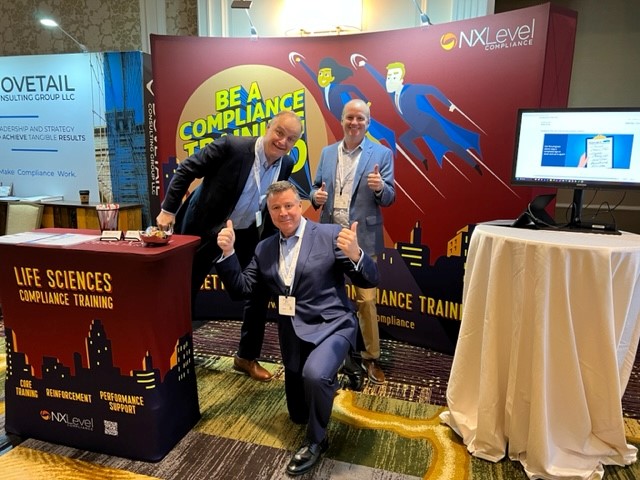
Sean Murphy, Dan O’Connor, and Paul Nash entertaining colleagues, clients, and themselves at the NXLevel Compliance booth.
I begin with a personal note. After attending the Pharmaceutical Compliance Congress (PCC) for the last 15 years, the 2023 conference will most likely be my last. For those who have not heard, I plan to retire at the end of June (at least from a full-time position) to spend more of my days visiting my kids in Virginia and California, reading, and writing about something other than life sciences compliance.
With my pending departure from the world of life sciences compliance in mind, I approached the conference sessions with a different mindset. I listened carefully for the concerns and issues that truly stood out as being something “new,” something that compliance professionals should be aware of as they build and update their compliance training curricula.
This year’s conference didn’t disappoint, revealing surprises and twists on some of the common themes we’ve heard about over the years. And so, for the final time, (I think), I present my list of training considerations based on statements I heard at the 2023 PCC. Let me know what you think…but make it quick, the beach awaits!
“Now that you’ve earned a seat at the table, you need to add value.”
After introductory remarks and the annual video review of compliance news, the conference kicked into gear with the Chief Compliance Officer Luminary Panel. (Side note: I am somewhat disappointed that I am exiting this career without ever officially being part of a “luminary” anything. Oh well.)
Anyone who has attended a compliance congress in the last ten years has likely heard the phrase, “seat at the table.” We all know the importance of being present with the business and the risks of the compliance department operating in a silo, separate from the business. But once you’re at that table, what next? Luminaries to the rescue! As one presenter noted, “We’ve been at the table long enough to do more than just listen.” Another continued by stressing the need to “know what the business needs and come to the table with solutions.”
In terms of training, that means partnering with the business on the planning, development, execution, and measurement of the curriculum. What risks do the commercial teams and others need to understand? What does mastery of compliant behavior look like? What topics require reinforcement to help learners reach mastery? How can the training (live and online) help ensure “everyone at the company understands the value of operating with integrity?” When you’re prepared to engage in those discussions and build out a plan to help accomplish the goals and learning objectives, you’re on your way to bringing training value to the table.
“Most people come to work wanting to do the right thing.”
This one came from the same CCO panel. As one presenter sees it, part of the compliance department’s job is to “make it easy for everyone on the commercial team to follow through on their commitment to do the right thing.” Clear, easy-to-understand policies, appropriate and up-to-date technology, and data-tracking platforms are just a few examples referenced for accomplishing that goal.
I couldn’t help but think the same goes for the idea of deploying training that helps them carry through on their instinct to do the right thing. Have you analyzed the topics to determine which ones are confusing or tend to raise more questions? If, for example, “interactions in an HCP office” is a topic rife with questions, consider a follow-up “compliance escape room” workshop or eModule built around common scenarios reps face. In addition, performance support tools like interactive PDFs effectively remind them of key concepts and best practices in the field, when they need it most. In more cases than not, your learners are indeed bringing a sense of integrity to their roles in your company. It’s a great starting point, and now your challenge is to offer them the knowledge and tools necessary to fulfill that mission.
“Self-disclosure truly makes a difference.”
To no surprise, the comments concerning self-disclosure were espoused during the Keynote Enforcement Panel, which featured representatives of the Department of Justice and a representative from the US Attorney’s Office for the District of Massachusetts. It was actually one of the more compelling discussions I’ve heard as to why companies should consider reporting potential compliance violations. The benefits related to the ultimate outcome and possible settlements seem significant and worth noting when violations are identified internally.
The conversation started me thinking about the need for a “spirit of self-disclosure” in training. Have you established a “speak up” culture in your organization and does your training reflect that culture? Simply including a non-retaliation statement in your training is not enough. Adding real-life scenarios to online training, with characters who are rewarded for self-reporting compliance concerns, brings the concept to life. Those same scenarios can also be incorporated into live workshops and games. These are the opportunities to remind learners that the compliance department isn’t there to lord over their every action and mete out punishment for every potential violation. Compliant companies foster just the opposite.
“How can I make my compliance program fit with this product?”
Any regular readers of this blog probably know that I find conference sessions dedicated to small and emerging companies to be among the most valuable from a training information standpoint. Smaller compliance departments are challenged with accomplishing the same objectives and goals as their compatriots from larger companies, with significantly fewer resources and budgets. The panel discussion focused on smaller companies provided valuable tips and suggestions on this topic.
This time, the conversation around the need to “fit” the compliance program to the needs of a new product being launched was especially compelling. In such scenarios, you need to understand the unique areas of risk the commercial team faces for that product. For example, is it a product that involves a patient advocacy group and the potential risks those groups inherently present?
The same need holds true for your training. Your compliance risks are unique to your company’s product(s) and the activities associated with their promotion. Your training needs to be built to fit those risks. Have you conducted the analysis necessary to properly evaluate them? At NXLevel Compliance, we work with clients to map the levels of risk per activity and the frequency with which each activity occurs, to determine the proper level of training necessary to mitigate that risk. It doesn’t have to be a complicated process, but it’s a critical step toward ensuring the effectiveness of training.
“Creating a brand is one way to become a trusted partner for the business.”
When I saw the title for the Novel Approaches to Embedding Compliance into the Business session, I knew it held the potential for something new and exciting. The panelist who recommended the brand idea discussed how it helped create a more proactive relationship in his compliance department as they partnered with the business to reinforce key concepts and messaging. And, of course, creating a brand for the compliance program helps reinforce the messages across the company.
The same is true for a training curriculum. Emphasizing your compliance brand in your curriculum presents opportunities to connect learning to your mission and your company’s values and culture. Look for opportunities to integrate the compliance brand into training components. This isn’t to say all training needs to be built from the ground up. Even the right off-the-shelf compliance training can be customized to incorporate graphics and language reflective of your brand. When your overall program and your training align, retention rises, and learning sticks.
“Make people surprised this is coming from compliance.”
Let’s be honest, life sciences compliance hasn’t exactly been considered a bastion of unexpected creativity throughout the years. I don’t think employees traditionally have waited with bated breath for the rollout of new online compliance training or the hour-long lecture by their chief compliance officer during the annual POA. Fortunately, the industry continues to evolve away from such mundane approaches and the presentation titled, Building a Compliance Program from the Ground Up, showcased exciting examples of that evolution.
Panelists from Sage Therapeutics and Alnylam Pharmaceuticals covered the plethora of methods they use to make their compliance programs, policies, and training more memorable, and it is impressive. As was suggested during the presentation, “You have to challenge yourself to think outside the box.” Sage, for example, actively seeks ways to raise the level of creativity in their training with novel scriptwriting and branding to help learners relate to the content. The themed training materials are clever and engaging and characters appear across different modalities to convey a sense of familiarity. Above all, messaging in the training programs and the other communication reinforce the idea that “they are there to help the employees succeed.” That’s a powerful mission that makes a difference in the uptake and retention of training.
“The updated DOJ guidance calls for tailored and more targeted training programs.”
Not surprisingly, the March 2023 DOJ updates to its guidance on corporate compliance programs were referenced early in the Update on Recent DOJ Pronouncements Affecting Compliance Programs session.
The revised guidance suggests that a well-designed compliance program should include “appropriately” tailored training and communications (something most worthwhile instructional designers and developers should have been recommending for years). If you are not already familiar with the recommendations, it’s worth your time to dig into the details: https://www.justice.gov/criminal-fraud/page/file/937501/download
Suffice it to say the DOJ is expanding its evaluation, and its expectations, of what can be considered effective and engaging compliance training. As an example, the guidance now suggests that effective training includes a process by which employees can ask follow-up questions, no matter the format. The bottom line is that your compliance training needs to evolve ahead of government expectations to be considered effective. Consistent evaluation of the curriculum is necessary to know that you are taking every opportunity to target the training to the risks inherent to your company and its products; to find innovative solutions that continually raise the retention and application of policies and best practices; and to solicit the feedback necessary to address the concerns and questions from your learners.
“What keeps me up at night is what I don’t know.”
The final day of the conference featured the Compliance Across the Organization session, in which members of Sentynl’s Compliance and Commercial areas discussed ideas for how both sides can partner more successfully. They began with a brief conversation about the topics that most concern them and the comment above is an ideal segue for the close of this post.
Anyone tasked with developing an effective compliance training curriculum faces a daunting challenge – building and continually updating that curriculum with the foundational training, reinforcement solutions, and performance support tools necessary to reduce risk across the organization on an ongoing basis. That goal can’t be accomplished in a vacuum, especially considering the life sciences compliance environment is ever-changing and evolving with new policies, guidance, and regulations. It’s enough to keep anyone up at night.
The overarching and perhaps unintended theme of Informa’s 2023 Pharmaceutical Compliance Congress seemed to be one of collaboration. In one session after another, presenters stressed the necessity for compliance professionals to partner with their commercial colleagues and others in their companies to accomplish the goal of creating, optimizing, and maintaining a modern compliance department.
But the need to collaborate and learn from one another doesn’t end within the walls of a company. Conferences such as the PCC offer invaluable opportunities to keep up with enforcement trends and to learn the methods and best practices necessary to succeed. You won’t find a better place to hear from government officials and industry leaders, or to network with your peers, than this conference and PCF’s Compliance Congress in the Fall. And though you may not see me there busily taking notes, my colleagues will continue to be on stage and in the exhibit hall, sharing ideas and our growing array of solutions to help you reduce compliance risk with better training.
Welcome to the next installment of our series on using ADDIE to build better compliance training. So far, we’ve discussed how to analyze your training needs, and best practices to apply when approaching the design process. Now we move onto the second D, development, and for this post, we focus on the development of online training (eLearning), though this process can be applied no matter the deliverables.
Once all the groundwork has been completed and you’re ready to start the development process, the five development phases detailed below will help avoid errors along the way and ensure your training meets the expectations you’ve established and the quality your learners deserve. You will notice there is overlap with elements of the design process, but to present development absent this context would be like building a house without referring to the blueprint.
Phase 1: Discovery
It begins with a discovery phase, when you set aside time with all the stakeholders, including management and any potential vendors, to finalize the instructional goals, learning objectives, content scope, and duration of the individual training program. In addition to communicating the overall concepts and designs, this is the time to ensure a comprehensive project plan, with a timeline detailing the completion of all deliverables, is established and approved by all involved in the project.
Phase 2: Outline Development
Before a complete storyboard with narration, on-screen text, and graphic elements is developed, we suggest you create a content outline to list the overarching topics, and, if possible, subtopics. This is the time for the instructional designer to dig into your content source documents and interview your subject matter experts. If you’re working with an outside vendor, look for one that brings a background in instructional design combined with a familiarity with life sciences compliance. Trust me, you don’t want a vendor over-relying on you for compliance expertise when you are busy 8+ hours a day with your day job.
Phase 3: Storyboard Development
The storyboard is a screen-by-screen guide for the programmer and graphic artist to follow when creating the course. Once the initial storyboard is completed, you should have the opportunity to make modifications in “tracked changes” and consult with the instructional designer to resolve any changes you request. Upon completion, you will be asked to “sign off” on the content and give approval to move forward. There should be no surprises or remaining questions for the development team once the storyboard is completed and approved. It should clearly delineate all content and creative requirements for the module, as well as the production notes necessary to guide the decisions made by the developer.
Phase 4: Alpha Course Build
Any reliable vendor or in-house developer should also offer you the opportunity to review an alpha version of the course, without audio added. Think of it as the “rough cut.” During this phase, you’ll ideally review the course, usually on a secure portal, and log comments for anything that looks incorrect or not up to the approach discussed and the specifications in the storyboard. Although there should be no surprises after the storyboard approval, seeing the course in its “close to” final form can sometimes reveal nuances you may have missed earlier. Don’t be afraid to ask for minor changes. It’s why the alpha stage exists.
Phase 5: Beta Course Build
You’re in the homestretch! During the beta build, your team (internal or vendor) will finalize any remaining changes from the alpha review and incorporate any remaining elements, including narration, into the course. You should still expect to review the beta course and request minor changes, but the changes should be rare at this stage. The development team will also conduct a final quality assurance (QA) check upon your final approval, and before the start of the implementation stage…which, by the way, will be the subject for our next post.
Conclusion
The development stage of eLearning development is wrought with the potential for pitfalls and mistakes. Beware the temptations of shortcuts in the schedule and the resources. There are no shortcuts to success and the path to less risk requires numerous checkpoints along the way. Better compliance training demands diligence and by using the process detailed above, you’ll be one step closer to launching training that reduces risk across your company. And who knows, it may even solidify your organizational reputation as a compliance training hero.
For this installment of our series on using the ADDIE model to build better compliance training, I talked to NXLevel’s Senior Art Director, Mike Mandracchia, to get his perspective on the importance of visual design when developing compliance training for the life sciences. Here are the highlights from our discussion.
Why do you think visual design matters for compliance training?
It starts with the learner’s perception. Compliance training isn’t usually something learners look forward to. It’s not like we often hear, “Oh boy, I get to take the compliance training now!” So, we face the challenge of changing their attitude right from the start. And the only way we’re going to do that is to think of visual design as more than just graphics.
It’s how it all comes together. How the on-screen content, the audio narration, and the user interface all align with the graphics in a complete package. It all needs to be visually attractive and easy to digest.
Let’s stay on that idea of “visually attractive.” Do you equate that with a modern approach to design?
I stay away from a term like “modern,” and I try to stick to classic, established concepts of design. That begins with a clean and timeless look. You can look at design from any era and know whether it’s good or not. The year, or even the decade, it was created doesn’t matter. Good design is good design, and we don’t want to run the risk of chasing fads or trends.
You led the push for the use of illustrated characters instead of stock photos or even custom-produced photos in NXLevel’s Compliance Foundations off-the-shelf eLearning courses. Why?
Multiple reasons. From a look and feel standpoint, they add more personality. The characters we use give the training a more light-hearted look, which goes back to my previous point about changing the perception of compliance training. I also recommend the use of illustrated characters because of the flexibility. It’s so much easier to find images that support the key messages and modifying them to fit the content is much simpler.
Stock photos are limited and frankly, they look like stock photos. As for custom photography, that can be expensive and is often not reusable. Illustrated images are more affordable, and you can change anything. And you can make your characters as diverse as the learners that are going to take the training.
Let’s talk about that diversity. How do you address diversity when you are designing a course?
Diversity is about the total human experience. That includes gender, ethnicity, physical appearance, religion, physical abilities, etc. It’s important that people see themselves in the training they take, and that extends to making sure the training reflects their own company too. It’s our job to research details about the company. What is the dress code? What do their buildings look like? The training should look like it came from their company. And that’s easy to modify with illustrations, whether we are customizing our off-the-shelf courses or creating custom training from the ground up.
How do you go about creating the visual design for a training deliverable?
It involves us (me and my design colleagues) working with everyone on the team, from the project managers to the instructional designers and developers and the client. There’s a reason our graphic artists are often part of on-going client meetings. I need to understand the details and regularly talk to the ID and development team to understand the goals of the project, the audience, how the content is going to be organized…whether it’s an electronic course or a workshop. It all helps me think about the learner’s experience.
What should people avoid when designing compliance training?
Well, this isn’t as much about what they should avoid as much as what they should think about. That gets back to your last question. It really matters how the content is presented. Sometimes, less is more. Cramming too much content and too many graphics into the program is a problem. That’s just going to disengage the learner and the training won’t stick.
Your point gets back to the idea of respecting the learner, doesn’t it?
Yes. It also gets back to our conversation about the use of illustrated characters instead of stock photos. The context is more meaningful when the images reflect the reality of their world. Think about it. No one is ever going to be fooled into thinking the stock photos they see in a training course are people from their company. And that’s fine. But, when we use illustrations, we can easily modify the broader details to align with the learners’ reality. For example, if we need a scene with a sales representative meeting with a healthcare professional in a specific type of office setting, we can do that easily and quickly. That type of context is less limiting and pulls the learners into the training. And the more they relate to it, the more they are engaged with it, and the more they will retain. Our goal is to remain as true as possible to that reality and to the content and always value the learner.
If you are interested in seeing some more of the visual design work Mike and his team have created, contact us at info@nxlevelsolutions.com and we’ll be happy to share some examples. Meanwhile, our next blog post turns to the I in ADDIE – Implementation. How you implement your training plan is as important as the plan itself.
This is the second post in a series about using the ADDIE learning model as a framework for building a better compliance training curriculum.
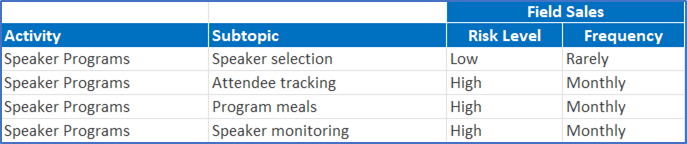
In our last post, we began with the first step in the ADDIE model, A (Analyze), and explored a way to analyze your compliance training needs so you can obtain a clear picture of those needs. The result was a list of the activities your employees engage in that contain some form of compliance risk, with columns indicating the risk level and frequency of each activity for each employee group. For example:
With this information in hand, it’s time to move on to the first D in the ADDIE model – Design. Now that you have identified your training needs, how are you going to meet them? How do you decide whether to create eLearning modules, live workshops, microlearning, performance support tools, etc.?
Several factors should help drive your design decisions.
Activity Risk
Make sure you address high-level risks first. This doesn’t necessarily mean all high-level risks need to receive the same level of resources or attention (other factors are at play), but it does mean that you need to implement a solution that properly addresses each high-level risk activity.
Select the chart to see examples of how various activities might be mapped in terms of risk and frequency.
Activity Frequency
Employees who perform an activity more frequently will tend to remember the steps involved (and the associated compliance guidance), while the opposite will be true of those activities performed less frequently.
For example, sales representatives may call on doctors almost every day. It’s a high-risk activity, but repetition breeds familiarity. However, the same sales representatives may only occasionally plan and host a speaker program. So, a quick reference guide or refresher training to remind them of their responsibilities would be helpful.
Regardless of the frequency of an activity, all learners benefit from a training solution that includes spaced reinforcement and that does not rely on just one crowded learning event. But for less frequent activities, reinforcement and reference materials are even more critical.
Learner Characteristics
Also take into account the characteristics of your learners. Think about these questions:
How many people engage in each activity? Some training modalities, like live workshops and coaching, are well suited for smaller populations but may not be practical for larger groups.
How many groups engage in the same activity? Are there groups who can receive the same training on a topic?
What are your learners’ levels of experience? Foundational training may be more important for new learners, whereas experienced learners may need more reinforcement or training that goes deeper into specific issues.
Where are your learners located? In-person training events may not be an option for a dispersed group.
Other Considerations
Here’s a quick review of other factors to consider.
Which activities can be addressed through common solutions? For example, can all transfers of value and transparency concerns be addressed through a single learning solution?
How stable is the subject matter? Are regulations, policies, or practices changing soon? You may want to hold off on an elaborate learning solution until the dust settles.
What resources do you have available? What’s your training budget? How many employees can you dedicate to training initiatives? Some solutions will be more practical and economical than others.
DOJ Recommendations
As you consider your choices, don’t forget to review the training recommendations found in the US Department of Justice’s Evaluation of Corporate Compliance Programs. Along with recommending timely, periodic, risk-based training that is appropriately tailored, the guidance notes that “Other companies have invested in shorter, more targeted training sessions to enable employees to timely identify and raise issues to appropriate compliance, internal audit, or other risk management functions.”
Possible Solutions
Weighing all the factors discussed above should help you narrow down the approaches that would help you best meet your learners’ training needs.
For example, low-risk, low-frequency activities might be best addressed by requiring learners to read the relevant policy and electronically sign an attestation. You can also provide job aids and other performance support tools learners can reference at the point of need, ie, when they are about to engage in the activity.
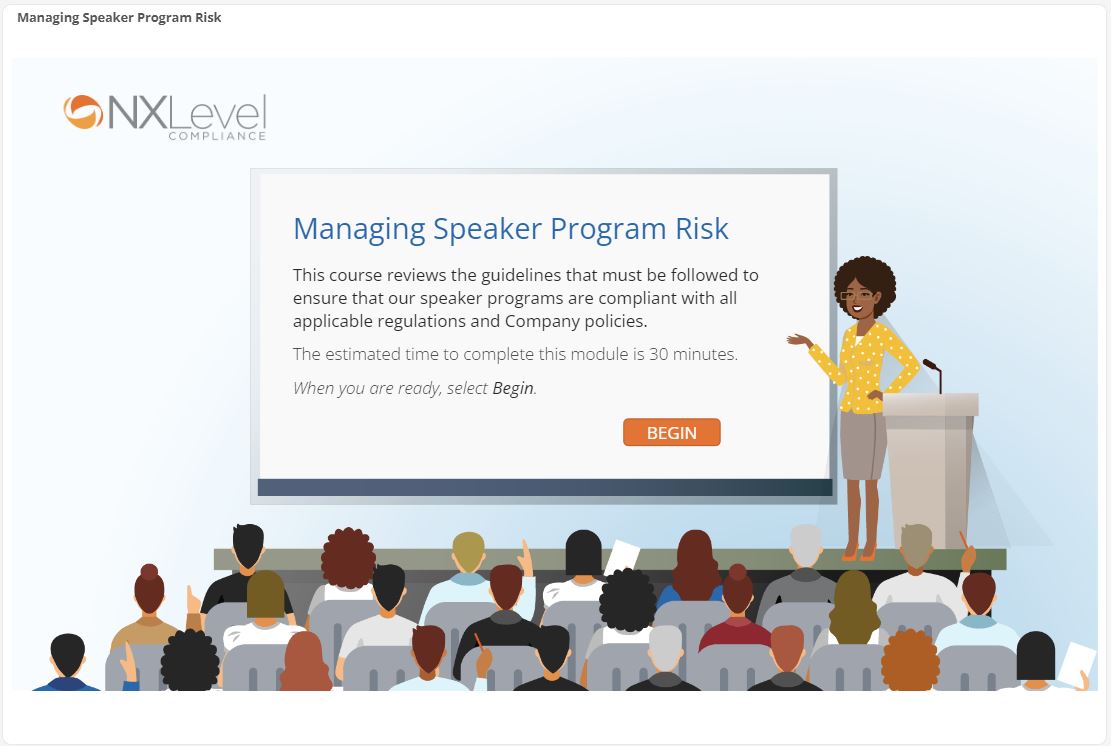
The Compliance Foundations eLearning module, Compliant Product Promotion, is a great starting point for all sales employees.
Likewise, when training on a high-risk activity, consider blending core training with reinforcement and performance support tools. For example, you could deploy a foundational eLearning module on promotional interactions for all sales employees, supplemented by live Q&A sessions for individual brand teams and micro-learning videos that periodically reinforce of key risks.
And don’t forget the value of communication. Website banners, short emails, and physical posters can all be used to remind employees of important principles and practices.
No Matter the Solution, Follow Good ID
Once you settle on a specific solution, remember to follow sound instructional design principles. Focus on the learning objectives, ie, what people need to know and be able to do, rather than chunks of content. Remember the goal is not to turn your employees into junior compliance experts; it’s to help them perform their jobs in compliance with your company’s policies and procedures and thereby reduce your company’s compliance risk. If nothing else, put yourselves in the learner’s shoes as you make your design decisions.
Conclusion
While this post merely scratches the surface, we hope it’s given you some practical design considerations to think about when creating or refreshing your compliance training curriculum.
In our next post, we’re going to stay with the topic of design a little longer, but this time we’ll discuss visual design and the role it plays in creating effective learning experiences.
This is the first post in our series on using the ADDIE learning model as a framework for building a better compliance training curriculum. We begin with the A (Analysis) stage of the model as a first step for creating or refreshing a curriculum.
With so many compliance concerns piling up in your inbox, it can be hard to take the time to pause and analyze your training needs without rushing towards solutions. But until you have a clear picture of your needs, how can you be sure the solutions you are deploying really address them?
Whether you are creating your company’s first compliance training plan or working with a mature plan that has evolved over time, don’t skimp on the analysis. Otherwise, you risk creating a convoluted curriculum with redundancies, gaps, and an uneven emphasis on content over risk. And while analysis is an ongoing task, taking the time to conduct a formal analysis that looks at the big picture and gives you a foundation to build (or rebuild) from is important.
Start with the Risks
One way to begin your analysis is to list all of the activities your employees engage in that contain some form of compliance risk. After all, if your ultimate goal is to reduce risk, why not put those risks front and center in your planning?
We’re all familiar with the annual risk assessments that virtually all life science companies perform. They provide an overview of macro areas of risk and are therefore good overall guidance for compliance professionals. However, it is important to also consider the “risks within the risks.” The key here is to be granular enough so that you build an informative picture of the risks your company faces – one that gives you the flexibility to address risks that apply to different audiences, in different ways, and at different frequencies.
For example, to simply list “speaker programs” as a risk glosses over the individual activities involved in a speaker program that expose different people to various types, levels, and frequencies of risk. These could include speaker selection, attendee tracking, program meals, and the handling off-label questions.
Identify Your Learners
Next, it’s time to identify the groups of individuals who are potentially exposed to the risks you have listed. You could create these groups as columns that bisect your rows of risk activities. Again, it’s important to achieve the right level of specificity. Under the commercial umbrella, for example, you’ll want to break out field sales, sales operations, marketing, etc. so you can recognize the different needs for each function.
Add Risk Levels and Frequency
Not all risks are created equal; nor do they occur with the same frequency for the same groups of employees. It’s important to recognize both of these factors when analyzing your training needs.
The value of distinguishing activities that present higher levels of risk is obvious, but frequency is just as important. Someone who engages in a high-risk activity on a frequent basis has a different learning need than someone who engages in the same activity on a less frequent basis.
Since risk level and frequency can vary for each learner group, you can further divide your columns and assign risk levels and frequency, as shown in this example.
Next Step: Design
Completing the activity described above is not necessarily a quick and easy task, and you may need input from others to ensure its completeness and accuracy, but it’s a critical first step toward designing (or redesigning) a better compliance training curriculum to help you reduce risk across your company. And that will be the topic of our next blog post as we move on to the D in the ADDIE model, Design.
In the meantime, if you’d like a complimentary template of the spreadsheet described in this post, which we call the Compliance Curriculum Analysis Tool (CCAT), email us at info@pharmacertify.com. We’ll be happy to show you the tool and ideas on how to use it.







 Compliance Training Intelligence