Compliance Training Considerations from the 2023 Pharmaceutical Compliance Congress!

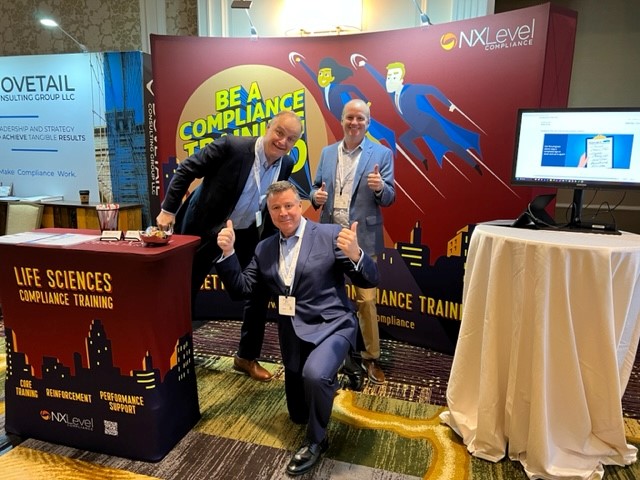
Sean Murphy, Dan O’Connor, and Paul Nash entertaining colleagues, clients, and themselves at the NXLevel Compliance booth.

I begin with a personal note. After attending the Pharmaceutical Compliance Congress (PCC) for the last 15 years, the 2023 conference will most likely be my last. For those who have not heard, I plan to retire at the end of June (at least from a full-time position) to spend more of my days visiting my kids in Virginia and California, reading, and writing about something other than life sciences compliance.  

With my pending departure from the world of life sciences compliance in mind, I approached the conference sessions with a different mindset. I listened carefully for the concerns and issues that truly stood out as being something “new,” something that compliance professionals should be aware of as they build and update their compliance training curricula.

This year’s conference didn’t disappoint, revealing surprises and twists on some of the common themes we’ve heard about over the years. And so, for the final time, (I think), I present my list of training considerations based on statements I heard at the 2023 PCC. Let me know what you think…but make it quick, the beach awaits!

“Now that you’ve earned a seat at the table, you need to add value.”

After introductory remarks and the annual video review of compliance news, the conference kicked into gear with the Chief Compliance Officer Luminary Panel. (Side note: I am somewhat disappointed that I am exiting this career without ever officially being part of a “luminary” anything. Oh well.)

Anyone who has attended a compliance congress in the last ten years has likely heard the phrase, “seat at the table.” We all know the importance of being present with the business and the risks of the compliance department operating in a silo, separate from the business. But once you’re at that table, what next? Luminaries to the rescue! As one presenter noted, “We’ve been at the table long enough to do more than just listen.” Another continued by stressing the need to “know what the business needs and come to the table with solutions.”

In terms of training, that means partnering with the business on the planning, development, execution, and measurement of the curriculum. What risks do the commercial teams and others need to understand? What does mastery of compliant behavior look like? What topics require reinforcement to help learners reach mastery? How can the training (live and online) help ensure “everyone at the company understands the value of operating with integrity?” When you’re prepared to engage in those discussions and build out a plan to help accomplish the goals and learning objectives, you’re on your way to bringing training value to the table.

“Most people come to work wanting to do the right thing.”

This one came from the same CCO panel. As one presenter sees it, part of the compliance department’s job is to “make it easy for everyone on the commercial team to follow through on their commitment to do the right thing.” Clear, easy-to-understand policies, appropriate and up-to-date technology, and data-tracking platforms are just a few examples referenced for accomplishing that goal.

I couldn’t help but think the same goes for the idea of deploying training that helps them carry through on their instinct to do the right thing. Have you analyzed the topics to determine which ones are confusing or tend to raise more questions? If, for example, “interactions in an HCP office” is a topic rife with questions, consider a follow-up “compliance escape room” workshop or eModule built around common scenarios reps face. In addition, performance support tools like interactive PDFs effectively remind them of key concepts and best practices in the field, when they need it most. In more cases than not, your learners are indeed bringing a sense of integrity to their roles in your company. It’s a great starting point, and now your challenge is to offer them the knowledge and tools necessary to fulfill that mission.

“Self-disclosure truly makes a difference.”

To no surprise, the comments concerning self-disclosure were espoused during the Keynote Enforcement Panel, which featured representatives of the Department of Justice and a representative from the US Attorney’s Office for the District of Massachusetts. It was actually one of the more compelling discussions I’ve heard as to why companies should consider reporting potential compliance violations. The benefits related to the ultimate outcome and possible settlements seem significant and worth noting when violations are identified internally.

The conversation started me thinking about the need for a “spirit of self-disclosure” in training. Have you established a “speak up” culture in your organization and does your training reflect that culture? Simply including a non-retaliation statement in your training is not enough. Adding real-life scenarios to online training, with characters who are rewarded for self-reporting compliance concerns, brings the concept to life. Those same scenarios can also be incorporated into live workshops and games. These are the opportunities to remind learners that the compliance department isn’t there to lord over their every action and mete out punishment for every potential violation. Compliant companies foster just the opposite.  

“How can I make my compliance program fit with this product?”

Any regular readers of this blog probably know that I find conference sessions dedicated to small and emerging companies to be among the most valuable from a training information standpoint. Smaller compliance departments are challenged with accomplishing the same objectives and goals as their compatriots from larger companies, with significantly fewer resources and budgets. The panel discussion focused on smaller companies provided valuable tips and suggestions on this topic.

This time, the conversation around the need to “fit” the compliance program to the needs of a new product being launched was especially compelling. In such scenarios, you need to understand the unique areas of risk the commercial team faces for that product. For example, is it a product that involves a patient advocacy group and the potential risks those groups inherently present?  

The same need holds true for your training. Your compliance risks are unique to your company’s product(s) and the activities associated with their promotion. Your training needs to be built to fit those risks. Have you conducted the analysis necessary to properly evaluate them? At NXLevel Compliance, we work with clients to map the levels of risk per activity and the frequency with which each activity occurs, to determine the proper level of training necessary to mitigate that risk. It doesn’t have to be a complicated process, but it’s a critical step toward ensuring the effectiveness of training.

“Creating a brand is one way to become a trusted partner for the business.”

When I saw the title for the Novel Approaches to Embedding Compliance into the Business session, I knew it held the potential for something new and exciting. The panelist who recommended the brand idea discussed how it helped create a more proactive relationship in his compliance department as they partnered with the business to reinforce key concepts and messaging. And, of course, creating a brand for the compliance program helps reinforce the messages across the company.

The same is true for a training curriculum. Emphasizing your compliance brand in your curriculum presents opportunities to connect learning to your mission and your company’s values and culture. Look for opportunities to integrate the compliance brand into training components. This isn’t to say all training needs to be built from the ground up. Even the right off-the-shelf compliance training can be customized to incorporate graphics and language reflective of your brand. When your overall program and your training align, retention rises, and learning sticks.  

“Make people surprised this is coming from compliance.”

Let’s be honest, life sciences compliance hasn’t exactly been considered a bastion of unexpected creativity throughout the years. I don’t think employees traditionally have waited with bated breath for the rollout of new online compliance training or the hour-long lecture by their chief compliance officer during the annual POA. Fortunately, the industry continues to evolve away from such mundane approaches and the presentation titled, Building a Compliance Program from the Ground Up, showcased exciting examples of that evolution.

Panelists from Sage Therapeutics and Alnylam Pharmaceuticals covered the plethora of methods they use to make their compliance programs, policies, and training more memorable, and it is impressive. As was suggested during the presentation, “You have to challenge yourself to think outside the box.” Sage, for example, actively seeks ways to raise the level of creativity in their training with novel scriptwriting and branding to help learners relate to the content. The themed training materials are clever and engaging and characters appear across different modalities to convey a sense of familiarity. Above all, messaging in the training programs and the other communication reinforce the idea that “they are there to help the employees succeed.” That’s a powerful mission that makes a difference in the uptake and retention of training.

“The updated DOJ guidance calls for tailored and more targeted training programs.”

Not surprisingly, the March 2023 DOJ updates to its guidance on corporate compliance programs were referenced early in the Update on Recent DOJ Pronouncements Affecting Compliance Programs session.

The revised guidance suggests that a well-designed compliance program should include “appropriately” tailored training and communications (something most worthwhile instructional designers and developers should have been recommending for years). If you are not already familiar with the recommendations, it’s worth your time to dig into the details: https://www.justice.gov/criminal-fraud/page/file/937501/download

Suffice it to say the DOJ is expanding its evaluation, and its expectations, of what can be considered effective and engaging compliance training. As an example, the guidance now suggests that effective training includes a process by which employees can ask follow-up questions, no matter the format. The bottom line is that your compliance training needs to evolve ahead of government expectations to be considered effective. Consistent evaluation of the curriculum is necessary to know that you are taking every opportunity to target the training to the risks inherent to your company and its products; to find innovative solutions that continually raise the retention and application of policies and best practices; and to solicit the feedback necessary to address the concerns and questions from your learners.   

“What keeps me up at night is what I don’t know.”

The final day of the conference featured the Compliance Across the Organization session, in which members of Sentynl’s Compliance and Commercial areas discussed ideas for how both sides can partner more successfully. They began with a brief conversation about the topics that most concern them and the comment above is an ideal segue for the close of this post.

Anyone tasked with developing an effective compliance training curriculum faces a daunting challenge – building and continually updating that curriculum with the foundational training, reinforcement solutions, and performance support tools necessary to reduce risk across the organization on an ongoing basis. That goal can’t be accomplished in a vacuum, especially considering the life sciences compliance environment is ever-changing and evolving with new policies, guidance, and regulations. It’s enough to keep anyone up at night.

The overarching and perhaps unintended theme of Informa’s 2023 Pharmaceutical Compliance Congress seemed to be one of collaboration. In one session after another, presenters stressed the necessity for compliance professionals to partner with their commercial colleagues and others in their companies to accomplish the goal of creating, optimizing, and maintaining a modern compliance department.

But the need to collaborate and learn from one another doesn’t end within the walls of a company. Conferences such as the PCC offer invaluable opportunities to keep up with enforcement trends and to learn the methods and best practices necessary to succeed. You won’t find a better place to hear from government officials and industry leaders, or to network with your peers, than this conference and PCF’s Compliance Congress in the Fall. And though you may not see me there busily taking notes, my colleagues will continue to be on stage and in the exhibit hall, sharing ideas and our growing array of solutions to help you reduce compliance risk with better training.

Thanks for reading!

Sean Murphy
NXLevel Compliance

.

Using the ADDIE Model to Build Better Compliance Training, Part 4: The Second D is for Development

Welcome to the next installment of our series on using ADDIE to build better compliance training. So far, we’ve discussed how to analyze your training needs, and best practices to apply when approaching the design process. Now we move onto the second D, development, and for this post, we focus on the development of online training (eLearning), though this process can be applied no matter the deliverables.

Once all the groundwork has been completed and you’re ready to start the development process, the five development phases detailed below will help avoid errors along the way and ensure your training meets the expectations you’ve established and the quality your learners deserve. You will notice there is overlap with elements of the design process, but to present development absent this context would be like building a house without referring to the blueprint.

Phase 1: Discovery

It begins with a discovery phase, when you set aside time with all the stakeholders, including management and any potential vendors, to finalize the instructional goals, learning objectives, content scope, and duration of the individual training program. In addition to communicating the overall concepts and designs, this is the time to ensure a comprehensive project plan, with a timeline detailing the completion of all deliverables, is established and approved by all involved in the project.

Phase 2: Outline Development

Before a complete storyboard with narration, on-screen text, and graphic elements is developed, we suggest you create a content outline to list the overarching topics, and, if possible, subtopics. This is the time for the instructional designer to dig into your content source documents and interview your subject matter experts. If you’re working with an outside vendor, look for one that brings a background in instructional design combined with a familiarity with life sciences compliance. Trust me, you don’t want a vendor over-relying on you for compliance expertise when you are busy 8+ hours a day with your day job.

Phase 3: Storyboard Development

The storyboard is a screen-by-screen guide for the programmer and graphic artist to follow when creating the course. Once the initial storyboard is completed, you should have the opportunity to make modifications in “tracked changes” and consult with the instructional designer to resolve any changes you request. Upon completion, you will be asked to “sign off” on the content and give approval to move forward. There should be no surprises or remaining questions for the development team once the storyboard is completed and approved. It should clearly delineate all content and creative requirements for the module, as well as the production notes necessary to guide the decisions made by the developer.

Phase 4: Alpha Course Build

Any reliable vendor or in-house developer should also offer you the opportunity to review an alpha version of the course, without audio added. Think of it as the “rough cut.” During this phase, you’ll ideally review the course, usually on a secure portal, and log comments for anything that looks incorrect or not up to the approach discussed and the specifications in the storyboard. Although there should be no surprises after the storyboard approval, seeing the course in its “close to” final form can sometimes reveal nuances you may have missed earlier. Don’t be afraid to ask for minor changes. It’s why the alpha stage exists.

Phase 5: Beta Course Build

You’re in the homestretch! During the beta build, your team (internal or vendor) will finalize any remaining changes from the alpha review and incorporate any remaining elements, including narration, into the course. You should still expect to review the beta course and request minor changes, but the changes should be rare at this stage. The development team will also conduct a final quality assurance (QA) check upon your final approval, and before the start of the implementation stage…which, by the way, will be the subject for our next post.

Conclusion

The development stage of eLearning development is wrought with the potential for pitfalls and mistakes. Beware the temptations of shortcuts in the schedule and the resources. There are no shortcuts to success and the path to less risk requires numerous checkpoints along the way. Better compliance training demands diligence and by using the process detailed above, you’ll be one step closer to launching training that reduces risk across your company. And who knows, it may even solidify your organizational reputation as a compliance training hero.

Soar on hero, soar on!

                                                                                                                        Sean Murphy
                                                                                                                        NXLevel Compliance

A Preview of the 2023 Pharmaceutical Compliance Congress!

Visit the NXLevel Compliance Booth at PCC to see our training demos!

Springtime at last! It’s time to take off our winter jackets and head to Virginia! The 2023 Pharmaceutical Compliance Congress, next week in Tyson’s Corner, has a slew of great sessions that will inform and energize your compliance program. Here are a few sessions that pique our interest from a compliance training perspective.

Day 1: Tuesday April 25th

9:15 am: The Chief Compliance Officer Luminary Panel
11:10 am: Keynote Enforcement Panel

11:00 am: Workshop 4 – Update on Recent DOJ Pronouncements Affecting Compliance Programs, Investigations, and Self-Disclosure

These two presentations offer opportunities to hear what top compliance officers and government officials are focused on today and thinking about for tomorrow. This is a chance to see how well your compliance training aligns with their priorities.

1:40 pm: FDA Keynote Address

Much like the sessions above, this is an opportunity to hear what the FDA’s Office of Prescription Drug Promotion is focusing on – straight from the Director herself! Plus, Catherine Gray is a dynamite speaker.

4:00 pm: Breakouts by Company Type

The day ends with three breakout paths that let you select from sessions targeted to small and emerging companies, mid to large-size companies, and medical device companies. This is a great way to hear people speaking more directly to your company’s specific situation. We’ve always been partial to hearing the innovative ways small and emerging companies meet their compliance training needs with reduced resources.

Day 2: Wednesday April 26th

8:30 am: Workshop 1 – Building a Compliance Program from the Ground Up

We’ve worked with the folks at Sage Therapeutics who are presenting this session, and they are a creative, engaged, and innovative group. If you are building or restarting your compliance program, don’t miss this session.

8:30 am: Workshop 3 – Senior Compliance Leadership Symposium

If you qualify as a senior compliance leader (see the program agenda for details), this session run by Terra Buckley is an excellent place to problem-solve with other leaders. Terra is Vice President, Head of Compliance Advisory Services, at MedPro Systems and one of the most knowledgeable and experienced compliance leaders around today.

In this session you can hear how other companies have aligned their programs with recent DOJ guidance updates and discuss the implications for training.

1:30 pm: Rethinking and Revolutionizing the Compliance Officer Role

We’ve long advocated for taking a risk-based approach to compliance training and this session agenda had us at its first bullet: “Generate a roadmap for transforming compliance to a risk-based profession.”

3:30 pm: Practical Guidance for Developing Tomorrow’s Compliance Leaders

Our own Dan O’Connor, Senior Vice President at NXLevel Compliance, leads this workshop with compliance leaders from three different biopharmaceutical companies. They’ll discuss how you can develop your own team into tomorrow’s compliance leaders.

Day 3: Thursday April 27th

9:00 am: Partnering with Patients and Patient Organization Engagements
9:00 am: Speaker Programs and HCP Engagements

The third morning offers two simultaneous sessions that speak to core compliance training topics. This is a great reason why companies should send more than one person to these congresses. Divide and conquer!

1:30 pm: Patient Story Luminary Address

Don’t miss this chance to hear firsthand patient stories. It’s easy to forget that patients are the reason we do what we do.

2:00 pm: Compliance Across the Organization

What does it mean to “partner with the business?” This presentation should go a long way in answering that question. Better compliance training requires input and support from our business colleagues. Help us to help you!

Networking Opportunities

Finally, don’t forget to take advantage of the networking opportunities to connect with old friends, make new ones, and check out the vendor booths. Be sure to stop by and visit us at the NXLevel Compliance booth to say “hello” and see demos of our newest compliance training modules, workshops, and games!

See you in Virginia! (If you can’t make it there this year, check back here for our thoughts and notes soon after the conference concludes.)

The NXLevel Compliance Team

Using the ADDIE Model to Build Better Compliance Training, Part 3: D is Also for Visual Design

For this installment of our series on using the ADDIE model to build better compliance training, I talked to NXLevel’s Senior Art Director, Mike Mandracchia, to get his perspective on the importance of visual design when developing compliance training for the life sciences. Here are the highlights from our discussion.

Why do you think visual design matters for compliance training?

It starts with the learner’s perception. Compliance training isn’t usually something learners look forward to. It’s not like we often hear, “Oh boy, I get to take the compliance training now!” So, we face the challenge of changing their attitude right from the start. And the only way we’re going to do that is to think of visual design as more than just graphics.

It’s how it all comes together. How the on-screen content, the audio narration, and the user interface all align with the graphics in a complete package. It all needs to be visually attractive and easy to digest.

Let’s stay on that idea of “visually attractive.” Do you equate that with a modern approach to design?

I stay away from a term like “modern,” and I try to stick to classic, established concepts of design. That begins with a clean and timeless look. You can look at design from any era and know whether it’s good or not. The year, or even the decade, it was created doesn’t matter. Good design is good design, and we don’t want to run the risk of chasing fads or trends.

You led the push for the use of illustrated characters instead of stock photos or even custom-produced photos in NXLevel’s Compliance Foundations off-the-shelf eLearning courses. Why?

Multiple reasons. From a look and feel standpoint, they add more personality. The characters we use give the training a more light-hearted look, which goes back to my previous point about changing the perception of compliance training. I also recommend the use of illustrated characters because of the flexibility. It’s so much easier to find images that support the key messages and modifying them to fit the content is much simpler.

Stock photos are limited and frankly, they look like stock photos. As for custom photography, that can be expensive and is often not reusable. Illustrated images are more affordable, and you can change anything. And you can make your characters as diverse as the learners that are going to take the training.

Let’s talk about that diversity. How do you address diversity when you are designing a course?

Diversity is about the total human experience. That includes gender, ethnicity, physical appearance, religion, physical abilities, etc. It’s important that people see themselves in the training they take, and that extends to making sure the training reflects their own company too. It’s our job to research details about the company. What is the dress code? What do their buildings look like? The training should look like it came from their company. And that’s easy to modify with illustrations, whether we are customizing our off-the-shelf courses or creating custom training from the ground up.

How do you go about creating the visual design for a training deliverable?

It involves us (me and my design colleagues) working with everyone on the team, from the project managers to the instructional designers and developers and the client. There’s a reason our graphic artists are often part of on-going client meetings. I need to understand the details and regularly talk to the ID and development team to understand the goals of the project, the audience, how the content is going to be organized…whether it’s an electronic course or a workshop. It all helps me think about the learner’s experience.

What should people avoid when designing compliance training?

Well, this isn’t as much about what they should avoid as much as what they should think about. That gets back to your last question. It really matters how the content is presented. Sometimes, less is more. Cramming too much content and too many graphics into the program is a problem. That’s just going to disengage the learner and the training won’t stick.

Your point gets back to the idea of respecting the learner, doesn’t it?

Yes. It also gets back to our conversation about the use of illustrated characters instead of stock photos. The context is more meaningful when the images reflect the reality of their world. Think about it. No one is ever going to be fooled into thinking the stock photos they see in a training course are people from their company. And that’s fine. But, when we use illustrations, we can easily modify the broader details to align with the learners’ reality. For example, if we need a scene with a sales representative meeting with a healthcare professional in a specific type of office setting, we can do that easily and quickly. That type of context is less limiting and pulls the learners into the training. And the more they relate to it, the more they are engaged with it, and the more they will retain. Our goal is to remain as true as possible to that reality and to the content and always value the learner.

If you are interested in seeing some more of the visual design work Mike and his team have created, contact us at info@nxlevelsolutions.com and we’ll be happy to share some examples. Meanwhile, our next blog post turns to the I in ADDIE – Implementation. How you implement your training plan is as important as the plan itself.

Until then, thanks for reading!

Sean Murphy
Marketing Manager

Using ADDIE to Optimize Your Compliance Training Curriculum, Part 2: Design

This is the second post in a series about using the ADDIE learning model as a framework for building a better compliance training curriculum.

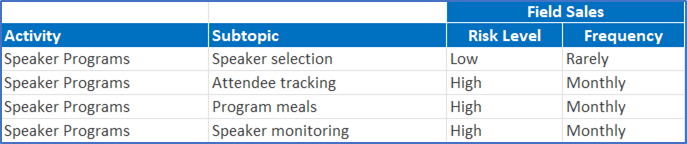
In our last post, we began with the first step in the ADDIE model, A (Analyze), and explored a way to analyze your compliance training needs so you can obtain a clear picture of those needs. The result was a list of the activities your employees engage in that contain some form of compliance risk, with columns indicating the risk level and frequency of each activity for each employee group. For example:

With this information in hand, it’s time to move on to the first D in the ADDIE model – Design. Now that you have identified your training needs, how are you going to meet them? How do you decide whether to create eLearning modules, live workshops, microlearning, performance support tools, etc.?

Several factors should help drive your design decisions.

Activity Risk

Make sure you address high-level risks first. This doesn’t necessarily mean all high-level risks need to receive the same level of resources or attention (other factors are at play), but it does mean that you need to implement a solution that properly addresses each high-level risk activity.

Select the chart to see examples of how various activities might be mapped in terms of risk and frequency.

Activity Frequency

Employees who perform an activity more frequently will tend to remember the steps involved (and the associated compliance guidance), while the opposite will be true of those activities performed less frequently.

For example, sales representatives may call on doctors almost every day. It’s a high-risk activity, but repetition breeds familiarity. However, the same sales representatives may only occasionally plan and host a speaker program. So, a quick reference guide or refresher training to remind them of their responsibilities would be helpful.

Regardless of the frequency of an activity, all learners benefit from a training solution that includes spaced reinforcement and that does not rely on just one crowded learning event. But for less frequent activities, reinforcement and reference materials are even more critical.

Learner Characteristics

Also take into account the characteristics of your learners. Think about these questions:

  • How many people engage in each activity? Some training modalities, like live workshops and coaching, are well suited for smaller populations but may not be practical for larger groups.
  • How many groups engage in the same activity? Are there groups who can receive the same training on a topic?
  • What are your learners’ levels of experience? Foundational training may be more important for new learners, whereas experienced learners may need more reinforcement or training that goes deeper into specific issues.
  • Where are your learners located? In-person training events may not be an option for a dispersed group.

Other Considerations

Here’s a quick review of other factors to consider.

  • Which activities can be addressed through common solutions? For example, can all transfers of value and transparency concerns be addressed through a single learning solution?
  • How stable is the subject matter? Are regulations, policies, or practices changing soon? You may want to hold off on an elaborate learning solution until the dust settles.
  • What resources do you have available? What’s your training budget? How many employees can you dedicate to training initiatives? Some solutions will be more practical and economical than others.

DOJ Recommendations

As you consider your choices, don’t forget to review the training recommendations found in the US Department of Justice’s Evaluation of Corporate Compliance Programs. Along with recommending timely, periodic, risk-based training that is appropriately tailored, the guidance notes that “Other companies have invested in shorter, more targeted training sessions to enable employees to timely identify and raise issues to appropriate compliance, internal audit, or other risk management functions.”

Possible Solutions

Weighing all the factors discussed above should help you narrow down the approaches that would help you best meet your learners’ training needs.

For example, low-risk, low-frequency activities might be best addressed by requiring learners to read the relevant policy and electronically sign an attestation. You can also provide job aids and other performance support tools learners can reference at the point of need, ie, when they are about to engage in the activity.

The Compliance Foundations eLearning module, Compliant Product Promotion, is a great starting point for all sales employees.

Likewise, when training on a high-risk activity, consider blending core training with reinforcement and performance support tools. For example, you could deploy a foundational eLearning module on promotional interactions for all sales employees, supplemented by live Q&A sessions for individual brand teams and micro-learning videos that periodically reinforce of key risks.

And don’t forget the value of communication. Website banners, short emails, and physical posters can all be used to remind employees of important principles and practices.

No Matter the Solution, Follow Good ID

Once you settle on a specific solution, remember to follow sound instructional design principles. Focus on the learning objectives, ie, what people need to know and be able to do, rather than chunks of content. Remember the goal is not to turn your employees into junior compliance experts; it’s to help them perform their jobs in compliance with your company’s policies and procedures and thereby reduce your company’s compliance risk. If nothing else, put yourselves in the learner’s shoes as you make your design decisions.

Conclusion

While this post merely scratches the surface, we hope it’s given you some practical design considerations to think about when creating or refreshing your compliance training curriculum.

In our next post, we’re going to stay with the topic of design a little longer, but this time we’ll discuss visual design and the role it plays in creating effective learning experiences.

Until then, thanks for reading!

Dave Correale
Senior Instructional Designer

Using ADDIE to Optimize Your Compliance Training Curriculum

Part 1: Analysis

This is the first post in our series on using the ADDIE learning model as a framework for building a better compliance training curriculum. We begin with the A (Analysis) stage of the model as a first step for creating or refreshing a curriculum.

With so many compliance concerns piling up in your inbox, it can be hard to take the time to pause and analyze your training needs without rushing towards solutions. But until you have a clear picture of  your needs, how can you be sure the solutions you are deploying really address them?

Whether you are creating your company’s first compliance training plan or working with a mature plan that has evolved over time, don’t skimp on the analysis. Otherwise, you risk creating a convoluted curriculum with redundancies, gaps, and an uneven emphasis on content over risk. And while analysis is an ongoing task, taking the time to conduct a formal analysis that looks at the big picture and gives you a foundation to build (or rebuild) from is important.

Start with the Risks

One way to begin your analysis is to list all of the activities your employees engage in that contain some form of compliance risk. After all, if your ultimate goal is to reduce risk, why not put those risks front and center in your planning?

We’re all familiar with the annual risk assessments that virtually all life science companies perform. They provide an overview of macro areas of risk and are therefore good overall guidance for compliance professionals. However, it is important to also consider the “risks within the risks.” The key here is to be granular enough so that you build an informative picture of the risks your company faces – one that gives you the flexibility to address risks that apply to different audiences, in different ways, and at different frequencies.

For example, to simply list “speaker programs” as a risk glosses over the individual activities involved in a speaker program that expose different people to various types, levels, and frequencies of risk. These could include speaker selection, attendee tracking, program meals, and the handling off-label questions.

Identify Your Learners

Next, it’s time to identify the groups of individuals who are potentially exposed to the risks you have listed. You could create these groups as columns that bisect your rows of risk activities. Again, it’s important to achieve the right level of specificity. Under the commercial umbrella, for example, you’ll want to break out field sales, sales operations, marketing, etc. so you can recognize the different needs for each function.

Add Risk Levels and Frequency

Not all risks are created equal; nor do they occur with the same frequency for the same groups of employees. It’s important to recognize both of these factors when analyzing your training needs.

The value of distinguishing activities that present higher levels of risk is obvious, but frequency is just as important. Someone who engages in a high-risk activity on a frequent basis has a different learning need than someone who engages in the same activity on a less frequent basis.

Since risk level and frequency can vary for each learner group, you can further divide your columns and assign risk levels and frequency, as shown in this example.

Next Step: Design

Completing the activity described above is not necessarily a quick and easy task, and you may need input from others to ensure its completeness and accuracy, but it’s a critical first step toward designing (or redesigning) a better compliance training curriculum to help you reduce risk across your company. And that will be the topic of our next blog post as we move on to the D in the ADDIE model, Design.

In the meantime, if you’d like a complimentary template of the spreadsheet described in this post, which we call the Compliance Curriculum Analysis Tool (CCAT), email us at info@pharmacertify.com. We’ll be happy to show you the tool and ideas on how to use it.

Thanks for reading!

Dave Correale
Senior Instructional Designer

Using ADDIE to Keep Your Compliance Resolutions

In this week’s post, Dave Correale, a Senior Instructional Designer at NXLevel Solutions, introduces a new blog series on using the ADDIE model to help build a better compliance training curriculum.

Now that the relatives have gone home, the ill-advised presents have been returned, and the eggnog in the back of the fridge has spoiled, it’s time to consider a New Year’s resolution to refresh and revive your compliance training strategy.

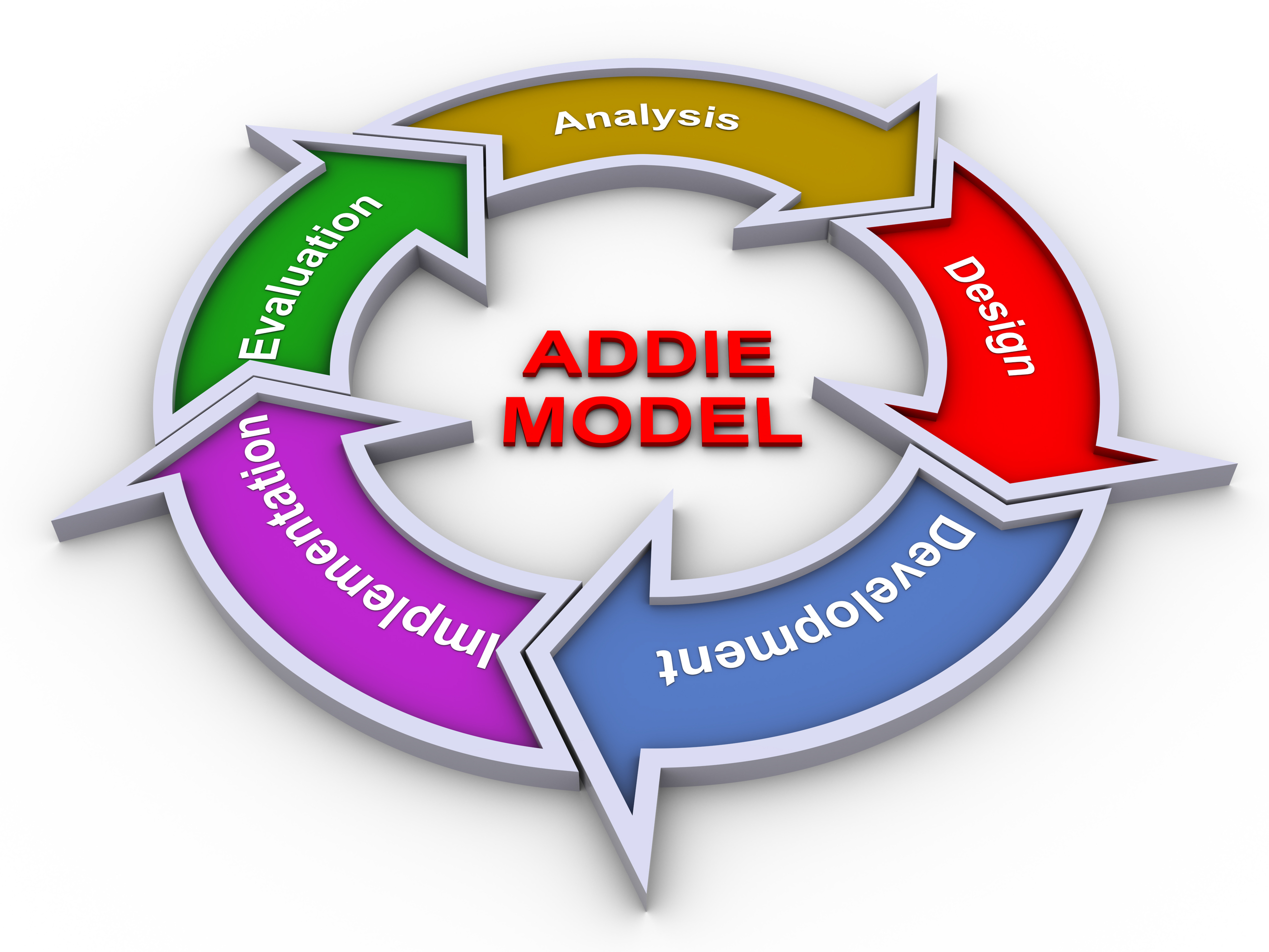
But getting your arms around your compliance training needs and developing a plan to address them can seem overwhelming. One tool that can help is the ADDIE model. In the training industry, we use ADDIE as a model for developing individual training solutions, but it can also be an effective tool for organizing your approach to a broader training strategy. Over the next several blog posts, we’ll use the ADDIE model as a framework for helping you build a compliance training plan worth celebrating.

Analysis – In this post, we’ll provide practical tips on how you can identify and prioritize your training needs. There are a lot of factors to consider, and we’ll discuss concepts and tools you can use to bring order out of the chaos.

Design – This post will be a two-parter. In Part 1, we’ll look at instructional design and how to design solutions to meet the training needs identified in the analysis stage. How do you choose whether to create eLearning modules, live workshops, microlearning, performance support tools, etc.?

In Part 2, we’ll discuss visual design and the role it plays in creating effective learning experiences. Do your training solutions look generic, or do they reflect your organization’s culture? Do your visual choices support or distract from your learning objectives?

Development – After design, it’s time to develop. But what do you develop first? And do you build it in-house or use a vendor? Is there an off-the-shelf solution you could use? Do you have existing assets that just need a refresh? We’ll explore the thought process that goes into deciding how to best use the resources you have available.

Implementation – How you implement your training plan is as important as the plan itself. Planning, timing, communication, support from the business, and getting the most out of your available learning platforms are just some of the elements we’ll examine in this post.

Evaluation – Finally, how effective is your compliance training? How can you tell? This post explores ways to determine whether your training is having an impact.

So, clean out the fridge, put the decorations away, and stay tuned for more tips on how to reduce risk through better compliance training.

Training-Related Reflections on PCF’s 23rd Compliance Congress, Part 3

The Changing Field Medical Maze

Welcome to my third post on the 23rd Annual Pharmaceutical and Medical Device Ethics and Compliance Congress. Through these posts, I have been reviewing some of the key topics covered during the conference and providing my reactions, as well as related tips and suggestions for creating better a compliance training curriculum.

This week, I touch on key points raised concerning the special relationship between field medical and commercial teams, and the training needs created by that relationship. Spoiler alert: the more things change, the more your sales representatives need to understand the role of your medical team.  

Ghosts of Conferences Past

In past years, presenters at compliance congresses would be quick to emphasize the need to draw a hard line between the actions of medical and commercial personnel. Medical was siloed into the communication of science, and product promotion was left to the commercial team — and never the twain shall meet … well, except for the joint interactions during which their separate permissible actions were clearly delineated.

The safest path was to ensure the actions of the medical team were laser-focused on science and external interactions only occurred at the request of healthcare professionals. And the easiest (and most straight-forward) path to compliance by both teams was through role-based training that made clear the appropriate actions for each –‘Sales reps, you can do this, and MSLs, you can do that’ (and vice versa).

Ghosts of Conferences Present

Well, in recent years, “the times, they are a changing.” As presenters in the Medical Affairs Today: Managing Evolving Risks session and the Recent Federal and State Enforcement Actions session noted, a shift is underway in the industry. Now some medical personnel are quicker to proactively provide information to HCPs, rather than just in response to a medical information request. Or, as it was said in the Recent Federal and State Enforcement Actions session, “Companies are shifting to a patient-centric focus, and that’s creating a sense of one company … that’s causing us to see a lot of creative ideas by medical, which poses some challenges.”

In terms of enforcement, one could understand why the industry would be lulled into a false sense of security. After all, recent corporate integrity agreements have hardly focused on the relationship between commercial and medical. But, as was highlighted in the Recent Federal and State Enforcement Actions session, some recent CIAs do include provisions relating to that relationship and the sharing of information. In addition, enforcement actions are typically lagging in nature, and settlements follow a few years after the actual conduct.

Promotion is Promotion, No Matter the Source

Presenters in both sessions made clear that the government doesn’t care what your role is. While collaboration across the two groups can have the noblest of intentions, sales reps and medical personnel must consider the potential risks of their actions. Guardrails are needed from the outset and the mistaken belief that the medical team’s actions and words cannot be interpreted as promotional just because of their job titles must be exposed for the dangerous fallacy that it is. To borrow a phrase from the Medical Affairs Today session, the medical team “cannot be driving towards promotional claims and they cannot be salesy.”  Both teams need to be reminded of this on a regular basis through a multitude of touchpoints throughout their schedules – in other words, through continuous reinforcement and performance support.

Take the Role-Based Fork in the Road Carefully

By now, you may be asking how you should adjust your medical personnel’s compliance training in response to this industry shift, but that should not be your only concern. The training plan for your commercial team may need to be evaluated and modified as well. More than ever, sales representatives must understand the role of medical personnel, and what medical personnel are and are not permitted to do during joint interactions with HCPs.

An effective and modern commercial training plan includes a broad understanding and overview of the field medical role. Do your reps understand the role of field medical personnel? Are they continuously reminded of the need to keep the medical and commercial roles distinct? To appropriately prepare sales reps for their interactions with HCPs, their training should cover the need for the field medical role, its purpose, examples of typical field medical activities, and the principles behind them.  

Joint Interactions Need Joint Training

Presenters in the Medical Affairs Today session touched on the need for collaboration between medical and commercial and the number of situations where their paths can cross, including HCP introductions, payor communications, speaker programs, and medical congresses. These interactions are filled with risk, so the divide between the two roles, and how each team can navigate that divide needs to be emphasized continuously in training.   

Foundational training on joint interactions doesn’t need to be divided into multiple modules to effectively cover the requirements of each team. A successful collaboration demands the sharing of knowledge that can only be achieved through a collaborative training initiative.

On the reinforcement front, opportunities to remind those involved in joint interactions abound.  For example, shortly before the start of a conference, you could deploy a microlearning that covers the rules for commercial vs. medical/scientific booths. Or a virtual live JEOPARDY game, for example, can be populated with questions related to HCP/MSL introductions, senior-level interactions, and interactions with payors. (By the way, we offer the only officially licensed JEOPARDY game on the market. It’s cool, it’s a great learning tool, and it’s easily customized with your content. Visit our website for a demo.)

Finally, it’s not all about interactions with HCPs. Both teams should be regularly reminded of the guardrails around internal interactions, too (eg, medical is not permitted to share an HCP’s response to an off-label question with commercial).

Summary  

While the perception of the field medical role may be changing, the need to educate both your medical and commercial teams about each other’s purpose and functions has not.

The end of the year is a good time to re-evaluate your training plan to ensure your commercial and field medical curricula feature the foundational training, reinforcement solutions, and performance support tools necessary to establish and maintain a sense of compliance across both teams. If you’d like to see demos of the custom and off-the-shelf training courses we have helped your peers deploy in the life sciences industry, please contact us at info@pharmacertify.com.

Thanks for reading! Happy holidays and best wishes for an even more compliant 2023!

Sean Murphy
PharmaCertify by NXLevel Solutions         

Training-Related Reflections on PCF’s 23rd Compliance Congress

Part 2
Social Media: What’s Not to Like?

Welcome to the second post reflecting on the 23rd Annual Pharmaceutical and Medical Device Ethics and Compliance Congress. In each post, I review some of the key topics covered during the conference and provide my reactions, as well as related tips and suggestions for maximizing the effectiveness of your compliance training curriculum.

This time around I delve into the ever popular (and somewhat confusing) topic of social media and, in particular, the session titled, MINI SUMMIT 5: Social Media — Auditing and Monitoring to Promote Compliance in this Rapidly Evolving Landscape.

If you attended the conference and missed this session, it’s worth the time to watch it online. And don’t be fooled by the title, the discussion wasn’t limited to auditing and monitoring. Training was mentioned early and often. Here are some of the key ideas shared during the session:

Follow the FDA (and the FTC)

The tone of the presentation, as well as the industry’s attitude towards social media, was best summarized with this quote from one speaker, “In some respects social media is heavily regulated, and … it’s the wild, wild west.” The rules and regulations are evolving and still somewhat undefined, but the risks continue to grow.

The presenters emphasized that the FDA’s regulations related to product promotion also apply to social media (staying on-label, not making unsubstantiated claims, avoiding promotional claims without risk information, etc.). The FTC has also issued a series of guidance documents on social media. Subsequently, the social media ground rules and principles established by both agencies need to be incorporated into your curriculum. Employing a continuous learning approach, with reinforcement solutions and performance tools blended into your plan, is the most effective way to ensure your team remembers and applies those rules and principles.

For example, you could deploy a foundational training module that covers your social media policy and then later follow up with a scenario-based microlearning module that specifically focuses on the proper way to respond when encountering product misinformation online. In terms of performance support, intranet banners and strategically placed posters are also a great way to consistently reinforce important tips and reminders.

Influencing the Influencers

The FTC’s guidance documents also cover the increasing use of social media influencers. According to the presenters, the FTC is particularly focused on “establishing a connection between the advertising and the influencer.” The agency has even established a preferred list of hashtags to help influencers identify themselves as paid spokespersons (#sponsored, #ad, #paid).

What does it mean for your social media training? You need to consider external as well as internal audiences, including any potential influencers involved in the promotion of your products on platforms such as Twitter and Instagram. Who is training your influencers? How often do they receive training? What form of training do they receive? How is it being tracked? You’ll sleep better if you have deployed on-going training that emphasizes compliant behavior to those in a position to influence the promotion of your products.

The Same Rules Apply to MSLs, Executives, and Outside Agencies, Too

The presenters often cited the distinction between promotional social media posts and those related to corporate communications. Each type follows a different set of rules. This difference does not depend on one’s job role, but rather the nature of the post itself. Whether an individual is part of the medical team, the C-suite, or even with an outside agency, that does not give them carte blanche to post content without regard to the rules.

Once again, it is important to evaluate your training audiences inside and outside your organization. What are the risks? Do the same risks apply across the board? Should all topics be covered at the same frequency? Are you making any risky assumptions based on job titles? Such audience/risk analysis is the starting point for effective social media training and a compliance training curriculum in general. 

The More Examples, the Better

One of the more interesting comments in the session centered on the potential risks of training itself. One presenter said, “We did so much training, it actually scared the staff.” She continued by saying the training they deployed was generic in nature and lacked the specificity and examples necessary to make it stick. In her company’s case, they made the training more effective by adding examples of what employees can and can’t like or share. That’s an excellent idea that could be further enhanced by examining the training deployment calendar.

For instance, you could create a “training series” in which the foundational training establishes the “what” and “why” of your social media policy, and follow-up with microlearning, games, mini assessments and other learning nuggets that focus on specific social media examples. When training is spaced across a learner’s timeline, learning has been scientifically proven to increase and the retention of those examples will grow.

In addition, workshops and training games offer more opportunities to reinforce the good and bad of social media activity. When deployed live or virtually, the sessions foster a dialogue in which examples can be discussed and participants can cite their own examples of what they have seen online.

Summary

At the start of this mini summit, presenters referred to a quote by the former director of the Office of Prescription Drug Promotion, Tom Abrams, “It’s the message and not the medium, so we expect the same regulations to apply to social media…” Platforms will change and evolve, but the messages your learners post, like, or share need to adhere to the good foundational compliance practices the government, HCPs, and patients expect.

Thanks for reading! If you’d like to see examples of foundational or reinforcement training solutions to address the risks of tricky subjects such as social media, contact us at info@pharmacertify.com to speak to one of our compliance training specialists.

Sean Murphy
Product and Marketing Manager
PharmaCertify

Training-Related Reflections on PCF’s 23rd Compliance Congress

Part 1:
Off-the-Shelf Training: The Good, the Bad, and How to Spot the Difference

The PharmaCertify team stands ready to greet friends and clients in the Exhibit Hall at PCF’s Compliance Congress!

Welcome to the first of several posts reflecting on the 23rd Annual Pharmaceutical and Medical Device Ethics and Compliance Congress. In each post, I will review some of the key topics covered during the conference and provide my reactions, as well as related tips and suggestions for maximizing the effectiveness of your training curriculum. After all, helping you roll out better life sciences compliance training is the aim of this blog, and it’s our mission at PharmaCertify.

I often find sessions focused on emerging, or early-stage, companies to be compelling because smaller companies face the same risks as their larger counterparts, but with smaller budgets and fewer resources. That’s why two sessions from this year’s conference caught my attention – Mini Summit 9: Compliance & Ethics in Emerging Companies, and Mini Summit 14: General Corporate Compliance in an Early-Stage Company and Shared Learnings for Larger Companies.

Neither session disappointed, as presenters detailed their experiences in overcoming the challenges smaller companies face (e.g., the techniques necessary to gain buy-in and resources from leadership, and the need for “ruthless prioritization” to determine which tasks to tackle first).

While I was pleasantly surprised to hear much of the conversation during Mini Summit 14 to be focused on training, I was dismayed to hear about most of the presenters’ poor experiences with off-the-shelf training solutions. As a result, many were quick to dismiss off-the-shelf eLearning as “too generic to be effective,” or, “not current enough to be relevant.”

The sad truth is there is a fair share of bad off-the-shelf training available to the life sciences industry. And there is no better way to torpedo the effectiveness of training than to roll out outdated training with generic content that is not targeted to your learners. But dismissing off-the-shelf training as ineffective or a waste of money overlooks the advantages of high-quality (and customizable) off-the-shelf training for emerging and early-stage companies.

Let’s review some of the comments from the session:

  • “We were used to seeing off-the-shelf training that looked like it was created in 1992.”

If a training vendor’s demos look like they were created 30 years ago, run (don’t walk) away immediately. Content and design age quickly, and learners evolve. Training, whether custom-built or off-the-shelf, needs to evolve with them to capture their attention and enhance learning results.

Visual design matters and plays a critical role in making learning memorable. Quality training uses a modern and fresh visual design. Beware of the tell-tale signs of poor design, such as the overuse of trite stock photos to portray sales representatives and healthcare professionals. (I call that the “shiny, happy doctor look.”)

  • “Totally generic training just doesn’t resonate.”

Look for training that is targeted to the life sciences industry and customizable to your company’s culture and its risks. Just do an Internet search for “pharmaceutical (or medical device) compliance training,” and you’ll find plenty of options. Considering today’s eLearning development tools, customization doesn’t need to be cumbersome or expensive. Ask vendors about the process for modifying their modules. Can they be easily branded with your logo? Can you add role-specific scenarios? Is it easy to add your policies and contact information? Look for training that is instructionally designed for seamless and easy customization. “Generic” should never be necessary, no matter how the term is defined.

  • “You can use off-the-shelf at large companies, but it doesn’t work at smaller companies.”

This caught my attention because it’s not what I have heard over the last 15 years. As mentioned above, emerging companies face the same risks as their larger counterparts – but with smaller budgets and fewer resources.

Off-the-shelf training, when priced on a per-learner basis, offers an affordable alternative to custom solutions when a company has a smaller number of learners. Even in situations with larger numbers of learners, off-the-shelf training may be more affordable – and it’s far less time-intensive for compliance officers to implement. And quality does not have to be sacrificed. So, if your field force is still small, and you need to train them on the risks associated with HCP interactions, a targeted off-the-shelf training module may be the right fit.

Summary

The Interactions with Healthcare Professionals customizable off-the-shelf eLearning Module

Don’t give up. There is effective compliance training out there for life sciences companies. And effective off-the-shelf training works just as well for emerging companies as it does for more established companies. Most importantly, effective off-the-shelf training has the power to help you reduce risk across your company, especially when it is blended with reinforcement microlearning, live workshops, targeted communications, and other components in a continuous flow of learning for your employees.

If you’d like to see demos of effective life sciences compliance training, including our Compliance Foundations off-the-shelf library, contact us at info@pharmacertify.com to speak to our team.

Thanks for reading!

Sean Murphy
Product and Marketing Manager
PharmaCertify