In case you haven’t noticed, this year’s Pharmaceutical and Medical Device Ethics and Compliance Congress is right around the corner (October 28-30, in Washington, DC)! And for 25 years now, the congress has always presented the same challenge: so many great sessions and so little time.
The plenary sessions are easy since we’re all gathered together in the same room. Once again, we’ll be listening hard to updates from OIG and FDA representatives, and taking detailed notes during the other plenary discussions, too. We’re particularly looking forward to “The Implications of AI for Lifesciences Ethics and Compliance Programs” on Day 1.
But deciding which mini summits to attend during the rest of the congress is a bit trickier. While they all will provide valuable insights, we’ve narrowed down our list to a manageable, “Magnificent 7” that we will be sure not to miss (queue theme music).
Day 1
8:00-8:50 Mini Summit 1: Federal Criminal and Civil Enforcement: Recent Highlights and Emerging Issues – A former US Attorney and former DOJ Deputy Assistant Attorney General will discuss recent DOJ actions impacting the pharma and med device industries, along with emerging issues.
9:00-9:50 Mini Summit 8: Update on Medical Device Regulatory and Enforcement Actions – A great follow-on from the previous session, this panel discussion takes aim squarely at the medical device industry and its evolving landscape of regulations and recent enforcement actions.
10:00-10:50 Mini Summit 13: Hot Topics and Compliance Oversight in the Research and Development Area – This session looks to shed more light on an area that may not always receive the compliance attention that it deserves.
11:00-11:50 Mini Summit 18: Compliance Training on the Digital Frontier – OK. Guilty. It’s a session moderated by NXLevel Compliance Sr. VP Dan O’Connor. But it’s also a place to hear from your colleagues and how they’ve delivered effective compliance training to “digital natives” and “digital immigrants” alike, using approaches and tools that are readily available in your company.
Day 2
9:00-9:50 Mini Summit 35: Privacy Top-Ten: Strategies and Tactics to Address Operational Impacts of the Evolving Privacy Landscape – Yet another session looking to address a crucial compliance topic in motion (this time, privacy).
10:00-10:50 Mini Summit 44: Evolving Risks in Medical Affairs – As many companies ask more of their Medical Affairs teams, the risks that those teams are exposed to have grown. This session will discuss how you can stay ahead of those risks.
11:00-11:50 Mini Summit 51: Negotiating DOJ expectations and business challenges while creating a “Culture of Compliance” – The title says it all. In fact, it may be a good job description for a compliance officer.
That’s our Magnificent 7, but you couldn’t go wrong attending any session at this congress.
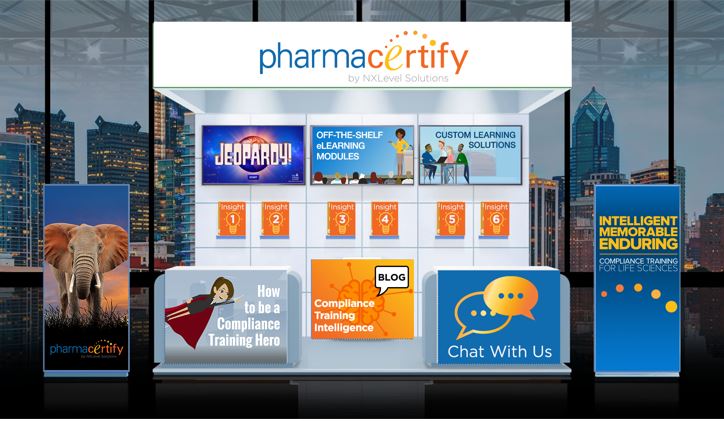
And if you go, feel free to visit our shiny new booth in the Exhibit Hall. We will have examples of our latest compliance training solutions to share and are eager to catch up with old friends and make new ones.
Visit the NXLevel Compliance Booth at PCC to see our training demos!
Springtime at last! It’s time to take off our winter jackets and head to Virginia! The 2023 Pharmaceutical Compliance Congress, next week in Tyson’s Corner, has a slew of great sessions that will inform and energize your compliance program. Here are a few sessions that pique our interest from a compliance training perspective.
11:00 am: Workshop 4 – Update on Recent DOJ Pronouncements Affecting Compliance Programs, Investigations, and Self-Disclosure
These two presentations offer opportunities to hear what top compliance officers and government officials are focused on today and thinking about for tomorrow. This is a chance to see how well your compliance training aligns with their priorities.
1:40 pm: FDA Keynote Address
Much like the sessions above, this is an opportunity to hear what the FDA’s Office of Prescription Drug Promotion is focusing on – straight from the Director herself! Plus, Catherine Gray is a dynamite speaker.
4:00 pm: Breakouts by Company Type
The day ends with three breakout paths that let you select from sessions targeted to small and emerging companies, mid to large-size companies, and medical device companies. This is a great way to hear people speaking more directly to your company’s specific situation. We’ve always been partial to hearing the innovative ways small and emerging companies meet their compliance training needs with reduced resources.
Day 2: Wednesday April 26th
8:30 am: Workshop 1 – Building a Compliance Program from the Ground Up
We’ve worked with the folks at Sage Therapeutics who are presenting this session, and they are a creative, engaged, and innovative group. If you are building or restarting your compliance program, don’t miss this session.
If you qualify as a senior compliance leader (see the program agenda for details), this session run by Terra Buckley is an excellent place to problem-solve with other leaders. Terra is Vice President, Head of Compliance Advisory Services, at MedPro Systems and one of the most knowledgeable and experienced compliance leaders around today.
In this session you can hear how other companies have aligned their programs with recent DOJ guidance updates and discuss the implications for training.
1:30 pm: Rethinking and Revolutionizing the Compliance Officer Role
We’ve long advocated for taking a risk-based approach to compliance training and this session agenda had us at its first bullet: “Generate a roadmap for transforming compliance to a risk-based profession.”
3:30 pm: Practical Guidance for Developing Tomorrow’s Compliance Leaders
Our own Dan O’Connor, Senior Vice President at NXLevel Compliance, leads this workshop with compliance leaders from three different biopharmaceutical companies. They’ll discuss how you can develop your own team into tomorrow’s compliance leaders.
Day 3: Thursday April 27th
9:00 am: Partnering with Patients and Patient Organization Engagements 9:00 am: Speaker Programs and HCP Engagements
The third morning offers two simultaneous sessions that speak to core compliance training topics. This is a great reason why companies should send more than one person to these congresses. Divide and conquer!
1:30 pm: Patient Story Luminary Address
Don’t miss this chance to hear firsthand patient stories. It’s easy to forget that patients are the reason we do what we do.
2:00 pm: Compliance Across the Organization
What does it mean to “partner with the business?” This presentation should go a long way in answering that question. Better compliance training requires input and support from our business colleagues. Help us to help you!
Networking Opportunities
Finally, don’t forget to take advantage of the networking opportunities to connect with old friends, make new ones, and check out the vendor booths. Be sure to stop by and visit us at the NXLevel Compliance booth to say “hello” and see demos of our newest compliance training modules, workshops, and games!
See you in Virginia! (If you can’t make it there this year, check back here for our thoughts and notes soon after the conference concludes.)
Welcome to my third post on the 23rd Annual Pharmaceutical and Medical Device Ethics and Compliance Congress. Through these posts, I have been reviewing some of the key topics covered during the conference and providing my reactions, as well as related tips and suggestions for creating better a compliance training curriculum.
This week, I touch on key points raised concerning the special relationship between field medical and commercial teams, and the training needs created by that relationship. Spoiler alert: the more things change, the more your sales representatives need to understand the role of your medical team.
Ghosts of Conferences Past
In past years, presenters at compliance congresses would be quick to emphasize the need to draw a hard line between the actions of medical and commercial personnel. Medical was siloed into the communication of science, and product promotion was left to the commercial team — and never the twain shall meet … well, except for the joint interactions during which their separate permissible actions were clearly delineated.
The safest path was to ensure the actions of the medical team were laser-focused on science and external interactions only occurred at the request of healthcare professionals. And the easiest (and most straight-forward) path to compliance by both teams was through role-based training that made clear the appropriate actions for each –‘Sales reps, you can do this, and MSLs, you can do that’ (and vice versa).
Ghosts of Conferences Present
Well, in recent years, “the times, they are a changing.” As presenters in the Medical Affairs Today: Managing Evolving Risks session and the Recent Federal and State Enforcement Actions session noted, a shift is underway in the industry. Now some medical personnel are quicker to proactively provide information to HCPs, rather than just in response to a medical information request. Or, as it was said in the Recent Federal and State Enforcement Actions session, “Companies are shifting to a patient-centric focus, and that’s creating a sense of one company … that’s causing us to see a lot of creative ideas by medical, which poses some challenges.”
In terms of enforcement, one could understand why the industry would be lulled into a false sense of security. After all, recent corporate integrity agreements have hardly focused on the relationship between commercial and medical. But, as was highlighted in the Recent Federal and State Enforcement Actions session, some recent CIAs do include provisions relating to that relationship and the sharing of information. In addition, enforcement actions are typically lagging in nature, and settlements follow a few years after the actual conduct.
Promotion is Promotion, No Matter the Source
Presenters in both sessions made clear that the government doesn’t care what your role is. While collaboration across the two groups can have the noblest of intentions, sales reps and medical personnel must consider the potential risks of their actions. Guardrails are needed from the outset and the mistaken belief that the medical team’s actions and words cannot be interpreted as promotional just because of their job titles must be exposed for the dangerous fallacy that it is. To borrow a phrase from the Medical Affairs Today session, the medical team “cannot be driving towards promotional claims and they cannot be salesy.” Both teams need to be reminded of this on a regular basis through a multitude of touchpoints throughout their schedules – in other words, through continuous reinforcement and performance support.
Take the Role-Based Fork in the Road Carefully
By now, you may be asking how you should adjust your medical personnel’s compliance training in response to this industry shift, but that should not be your only concern. The training plan for your commercial team may need to be evaluated and modified as well. More than ever, sales representatives must understand the role of medical personnel, and what medical personnel are and are not permitted to do during joint interactions with HCPs.
An effective and modern commercial training plan includes a broad understanding and overview of the field medical role. Do your reps understand the role of field medical personnel? Are they continuously reminded of the need to keep the medical and commercial roles distinct? To appropriately prepare sales reps for their interactions with HCPs, their training should cover the need for the field medical role, its purpose, examples of typical field medical activities, and the principles behind them.
Joint Interactions Need Joint Training
Presenters in the Medical Affairs Today session touched on the need for collaboration between medical and commercial and the number of situations where their paths can cross, including HCP introductions, payor communications, speaker programs, and medical congresses. These interactions are filled with risk, so the divide between the two roles, and how each team can navigate that divide needs to be emphasized continuously in training.
Foundational training on joint interactions doesn’t need to be divided into multiple modules to effectively cover the requirements of each team. A successful collaboration demands the sharing of knowledge that can only be achieved through a collaborative training initiative.
On the reinforcement front, opportunities to remind those involved in joint interactions abound. For example, shortly before the start of a conference, you could deploy a microlearning that covers the rules for commercial vs. medical/scientific booths. Or a virtual live JEOPARDY game, for example, can be populated with questions related to HCP/MSL introductions, senior-level interactions, and interactions with payors. (By the way, we offer the only officially licensed JEOPARDY™ game on the market. It’s cool, it’s a great learning tool, and it’s easily customized with your content. Visit our website for a demo.)
Finally, it’s not all about interactions with HCPs. Both teams should be regularly reminded of the guardrails around internal interactions, too (eg, medical is not permitted to share an HCP’s response to an off-label question with commercial).
Summary
While the perception of the field medical role may be changing, the need to educate both your medical and commercial teams about each other’s purpose and functions has not.
The end of the year is a good time to re-evaluate your training plan to ensure your commercial and field medical curricula feature the foundational training, reinforcement solutions, and performance support tools necessary to establish and maintain a sense of compliance across both teams. If you’d like to see demos of the custom and off-the-shelf training courses we have helped your peers deploy in the life sciences industry, please contact us at info@pharmacertify.com.
Thanks for reading! Happy holidays and best wishes for an even more compliant 2023!
Visit the PharmaCertify booth at the Pharmaceutical and Medical Device Compliance Congress to see demos of our newest modules, reinforcement programs, and games!
Here we are, over a year after Covid completely upended our lives, personally and professionally, and we are still attending compliance conferences virtually. The Pharmaceutical Compliance Forum (PCF) opted for a virtual forum for the Pharmaceutical and Medical Device Ethics and Compliance Congress again this year and a quick review of the agenda highlights the notion that no matter the format, this conference consistently presents the information any compliance professional needs to help reduce risk. Here are my pre-conference thoughts on the sessions of interest, particularly those that affect compliance training curricula.
Day 1: Tuesday, November 2, 2021
In an interesting twist on the standard agenda format, PCF opens the congress this year with a series of concurrent mini summits covering a range of topics. My standard advice applies; divide and conquer. If you’re attending with colleagues, plan to attend different presentations, then share notes. Even if you attend on your own, find a friend in one of the early networking sessions and don’t be shy about asking if they are interested in taking the same note sharing tact. It’s a veritable plethora of content to wade through…and that is definitely a good thing.
Mini Summit 1: Enforcement Action Updates
I tend to include most of the enforcement panels in these preview blog posts simply because they’re rare opportunities to hear the experiences and advice of those on the forefront of actions and settlements, including topics that trainers should be concerned about. This conference is no exception. Panelists include Assistant US Attorneys from the Eastern District of Pennsylvania and the District of Massachusetts, as well as the Assistant Director of Civil Division/Fraud Section of the Department of Justice.
Mini Summit 3: Evolutions of Investigations
The title for this one caught my eye and moved to the top of my priority list. Investigations have formed the foundation for the industry’s focus throughout the growth of the compliance industry and they certainly influence the training that has evolved from the early days of PowerPoint presentations to the multi-layered foundational and reinforcement training that is now considered the vanguard of effective eLearning.
Transition Breaks and Lunch
I include the breaks in this “must attend” list of sessions because they offer the best opportunity to interact directly with peers, vendors, and consultants. These are the people who not only provide crucial funding for the conference but also offer the products and services you need to help reduce risk and build a stronger culture of ethics and compliance. We’re here and we’re anxious to meet you. So, I invite you to check in with these critical vendors in the exhibit hall.
Mini Summit 5: DOJ/SEC FCPA Panel
Please see my thoughts on Mini Summit 1. The same apply to this session focused on the Foreign Corrupt Practices Act.
Mini Summit 7: Annual Medical Device Update
Hooray for Medical Device! It’s in the conference name and it is rightfully in the agenda. While many of the topics listed throughout the agenda apply to medical device companies, concerns and challenges unique to the industry abound. The panel includes chief compliance officers from Medtronic, ZOLL Medical, and Olympus, as well as a representative from AdvaMed and I’m looking forward to hearing how they address the issues associated with the rising number of recent medical device settlements.
Open Forum with PhRMA and AdvaMed
The Senior Assistant General Counsel for PhRMA and Vice President, Global Compliance and Governance for AdvaMed will be available in an open forum, hopefully ready and willing to take your questions. Enough said.
The Pivotal Role of CCO’s in Fostering a Strong Culture of Inclusion, Trust, and Psychological Safety
After a break, the conference switches from concurrent summits to this important and timely general session. I’m especially intrigued by the phrase “psychological safety” in the title, and I look forward to hearing whether inclusion and diversity are included in the discussion.
For the final session of the day, attendees choose one of three titles: 1. Managing Remote Teams, 2. Scope and Structure of the Compliance Function, and 3. Ethics and Compliance – The Road Ahead. To borrow a cliché, Covid has clearly changed the world and our industry for the long term. While the same core principles apply no matter how business is conducted and even how training is launched, compliance challenges shift and grow with the advent of virtual interactions. That’s why numbers 1 and 3 are of particular interest to me.
Day 2: Wednesday, November 3, 2021
Day 2 kicks off with more mini summits and interactive workshops followed by the opening plenary session at 1:00 pm.
INTERACTIVE WORKSHOP III: Hot Topics in Medical Device
Medical device is back with its own workshop and that is definitely a good thing! I look forward to hearing what topics Sujata Dayal from Medline Industries and Dana McMahon of Stryker include in their presentation and comparing the list to what we cover in our off-the-shelf and custom training solutions we provide for our medical device clients.
MINI SUMMIT 15: Optimize Your Compliance Training: A Practical Approach to the DOJ’s Guidance
I confess, since my colleague, Dan O’Connor, is the moderator on this one, I may be a bit biased. But I’ve seen the initial outline for the presentation and trust me, you don’t want to miss it. Dan, and his panel of compliance professionals will delve into the landmark guidance from the DOJ and present a practical framework for building and managing a continuous curriculum of training that will help your organization align with its principles.
MINI SUMMIT 16: Patient Assistance Programs
Speaking of hot topics! Regulators are paying attention to your patient programs, and you should be doing the same. So, you don’t want to miss this opportunity to hear Noor Haq from Amgen and Kevin Ryan from ACADIA share their experiences and tips for managing and minimizing the compliance concerns associated with PAPs. By the way, here at PharmaCertify, we’ve developed a new customizable eLearning module covering patient programs. Visit our website to see a description.
INTERACTIVE WORKSHOP 4: How to Establish Risk Tolerance in an Emerging Organization
If your company faces the challenges unique to those that fall into the emerging category, this holds the potential to be one of the most valuable sessions on the docket. Terra Buckley, who is now the Vice President of Compliance Advisory Services, is a seasoned industry professional, and frankly, one of the most dynamic presenters I have seen on all topics related to life sciences. Terra will be joined by David Ryan, Chief Compliance Officer at Epizyme.
Opening Plenary Session
Several presentations are listed as part of the plenary session that runs from 1:00 pm to the close of the day’s agenda at 5:30 pm.
Keynote: OIG Update
Following the fireside chat with Giovanni Caforio, MD, Chairman and Chief Executive Officer at Bristol Myers Squibb, Mary Riordan, Senior Counsel, Office of Counsel to the Inspector General at OIG will deliver her annual update on the agency’s enforcement actions and workplan. It’s always a highly anticipated presentation and for good reason. Her slides and notes form a solid foundation for where companies should be focusing their efforts and their resources in the coming year.
Response to OIG Special Fraud Alert and PhRMA and AdvaMed Code Update
The conference organizers have combined these three weighty topics into one presentation, and I am anxious to hear the panel of industry professionals and representatives from PhRMA and AdvaMed delve into the important details of each one. The Fraud Alert and the updates to the two codes led to significant changes in the content for our off-the-shelf and custom training courses at PharmaCertify, and we’re developing reinforcement components like a brief explanatory video describing the PhRMA Code to roll out in conjunction with the updated foundational module.
Annual Chief Compliance Officer Fireside Chat
Day 2 ends with an impressive lineup of chief compliance officers from pharma and med device, representing companies of different sizes and therapeutic focus. Ann Beasley, from Zai Lab, Shefari Kothari from Novartis, Angela Main of Zimmer Biomet, Kristin Rand from Moderna, and Latarsha Stewart from Servier Pharmaceuticals are sure to add a compelling exclamation point to a day chock full of critical compliance experiences and advice.
Day 3: Thursday, November 4, 2021
Following the form of the first two days, Day 3 begins with a series of MINI SUMMIT 21: Interactions with Health Care Professionals
Interactions with healthcare professionals are the foundation upon which solid compliance practices, principles, and training must be established. Whether those interactions are in person or virtual, they are fraught with risk, yet when they are conducted in a compliant manner, they continue to form the core of what makes the life sciences industry what it strives to be; a noble group whose primary focus is helping its customers improve the lives of patients. That’s why I’m looking forward to hearing the best practices for those interactions espoused by a panel that includes representatives from both the pharmaceutical and medical device industries.
INTERACTIVE WORKSHOP V: Evolution of Ethics & Compliance
We have been hearing about the industry shifting away from “a culture of compliance” to an “ethics-based” approach to compliance for a few years now. While the notion is a laudable one, the practicality of that migration is more challenging in such a risk-based environment. I am eager to hear the presenters’ tips for executing that evolution, including how they carry it through to their compliance training.
MINI SUMMIT 25: Trends in FDA Advertising/Promotion Enforcement: Know the Risk Areas
Any session with “Know the Risk Areas” as part of its title gets my attention and when the focus is on advertising and promotion it’s no exception.
Closing Plenary Session
The afternoon on Day 3 includes a plenary session with a series of interviews and sessions. After a keynote interview with Tim Wright, the Chief Executive Officer from MiMedx and a fireside chat with Rady Johnson from Pfizer, Catherine Gray from the FDA presents the annual FDA Keynote. Like the OIG Update from Mary Riordan, the review of the FDA’s workplan is worthwhile and important. And the AUSA Roundtable offers another valuable view of current trends and hot topics from those on the regulatory side of the table.
Day 4: Friday, November 5, 2021
Industry Only Best Practices Think Tank
I’d like to wax poetic about this, the final session of the conference, but I remain relegated to the figurative “kids’ table” of vendors and exhibitors who can only wonder what juicy nuggets of compelling and important information those insiders are discussing behind their locked virtual walls. In the meantime, I continue to stare at my email inbox, awaiting my golden ticket. Here’s a suggestion for the PCF team: perhaps an outline of the ideas and suggestions discussed during the session could be shared with all attendees after the conference concludes.
Summary and Complimentary Conference Registration
That’s quite a bit of content for any conference, so kudos to PCF and the organizers for creating such a hefty agenda and gathering so many impressive presenters. And I’ve only scratched the surface of the list of mini summits and plenary sessions. If you’re attending the conference, I invite you to stop by the PharmaCertify booth to see demos of our newest compliance training programs, workshops, and games. You don’t want to miss our new Compliance JEOPARDY!® game, the only officially licensed one on the market!
If you haven’t yet registered, we can help! As a conference sponsor, we are offering a limited number of complimentary registrations. Just contact my colleague, Dan O’Connor, at doconnor@nxlevelsolutions.com to take advantage of the opportunity to learn from your peers and fellow compliance professionals. You don’t want to miss it.
Thanks for reading and I will see you online for the conference!
In what was hopefully the last of the “virtual” compliance conferences (fingers and toes crossed), the 2021 Pharmaceutical Compliance Congress (PCC) offered time-tested and established standards (insert “tone from the top” and “ethics-based approach” here), thankfully blended with new best practices, trends, and suggestions from an impressive list of industry executives and government representatives. Some of the key messages from the three-day conference are listed below, along with my thoughts on how those concepts affect your training curriculum in 2021 and beyond.
1.OIG’s Special Fraud Alert on Speaker Programs still ripples across the industry.
The comments surrounding the OIG’s Fraud Alert released last November certainly were not revelatory, but the fact that industry insiders and regulators are still stressing its importance is meaningful. The Alert was referenced right out of the gate in the presentation by Jim Stansel of PhRMA, and one presenter in the Enforcement Trends presentation summarized its impact by saying, “OIG has thrown down the gauntlet on speaker programs with the Fraud Alert.” As the industry moves away from virtual engagements toward more in-person programs, expect intensified scrutiny.
Speaker programs remain a hot topic for enforcement, and as the industry emerges from the pandemic, your learners need refresher training on the foundational rules of compliant speaker programs and the key concepts associated with those programs. We can help, with our recently updated PharmaCertify Foundations eLearning module, Managing Speaker Program Risk.
2.Data is your friend. (Or should that be “Data are your friend? That one always confuses me.)
The need to scrutinize data has been a recurring topic of conversation, and this year’s PCC was no exception. Having access to data in the right form and unitizing that data to identify trends and outliers is key to an effective compliance program. “Be proactive to dig deep into the data,” one presenter at the Chief Compliance Officer Showcase on Day 1 suggested, “and identify field personnel who are consistently right at the meal limits.”
In life sciences compliance, the devil is in the data, and an informed evaluation of data is critical when updating and optimizing your compliance training curriculum. What is the data telling you? If you’re seeing concerning trends, you’ve got a training challenge. And if you’re not seeing any trends, you’re probably not looking hard enough, or you’re not gathering the right data. As my colleague, Dan O’Connor, pointed out in the Creative Compliance Training Solutions presentation, “when you send out post-training surveys, don’t ask the learners if they liked the training, focus on what they learned and ask them what they can apply in their jobs.” The data is out there, you just have to find it.
3.An ounce of compliance prevention is worth a pound of effectiveness.
In the Former Prosecutor Panel, one presenter emphasized the need to proactively address issues, whether a company is establishing its compliance program or reinforcing important policies as the business evolves. “Getting legal advice on the front of the program is important,” he says, “and when you move back to live interactions, refresh employees on the perils of speaker programs.”
No matter the topic, an adaptive approach to learning is the most effective way to ensure your audience is mastering the concepts and policies. Retention is enhanced when training is rolled out on a continuous basis, in the form of microlearning nuggets, where learners are asked to repeatedly demonstrate their knowledge and understanding. You will sleep better knowing you’ve taken steps to reduce risk.
4.Join in the innovation. During the Chief Compliance Officer Luminary Panel, one presenter pointed out that the pandemic has forced companies to be innovative in how they navigate business activities, and she reminded the audience that the compliance department “should play a big role in that innovation.” The day of compliance and business operating in siloed fashion are long over. “A seat at the table” is no longer a hopeful cliché randomly mentioned at compliance conferences. To facilitate a true partnership under which compliance polices and best practices are integrated into the daily activities of the workforce, everyone involved needs to understand that risk tolerance in the industry has changed, and the only way to reduce that risk is through a unified spirit of collaboration and innovation.
That notion of cooperation and collaboration extends to training. When compliance training and concepts are integrated regularly into each employee’s full curriculum and daily work, learning is enhanced and stronger ethical cultures are forged. And as was referenced on Day 1 of the conference, statistics from the Ethisphere Institute, an organization focused on defining and measuring corporate ethical standards, show that companies with strong ethical cultures perform better.
5. Evaluate your vendors’ compliance programs as part of your due diligence.
The idea of conducting due diligence before hiring third-party vendors has long been espoused at compliance conferences. But I was intrigued to hear a presenter in the Fireside Chat with CCOs suggest an even deeper dive into a vendor’s compliance program to evaluate whether its practices and principles align with those of your company.
On the training front, that includes a thorough evaluation of the vendor’s compliance training program. Do they cover the high-risk topics pertinent to your company and its products? Do they conduct compliance training in general? How often do they train their employees? How accurate and focused is that training in terms of content? These are the type of questions that need to be incorporated into your third-party vendor risk questionnaire and considered before the contracts are signed.
6. The Sunshine Act rises again.
Too often, life sciences professionals regard Sunshine Act/Open Payments training as a “one and done” event. But as presenters in the Analysis of OIG Special Fraud Alert on Speaker Programsand Assessment of Future Activities session pointed out, Medtronic’s recent settlement with the OIG included a payment to resolve allegations that it failed to accurately report payments to CMS. This topic is too big and too risky to not being training more aggressively.
In addition to refreshing the content in our Compliance Foundations module, TheSunshine Act and Open Payments, we recently added The Sunshine Act Payment Categories QuickTake module to our library of customizable off-the-shelf products. The five-minute module is the perfect complement and reinforcement course to the foundational training, which covers the topic at a higher level.
7. The pandemic is not an excuse.
The notion that the pandemic does not give companies an excuse to lose sight of compliance was repeated daily throughout the conference. Industry leaders and government representatives reminded the audience that the shift to virtual interactions and programs will not be viewed as justification for breaking the law or acting in bad faith. Even though the way in which business is conducted has changed, the core principles and rules governing compliance have not.
The same holds true for your training curriculum. Don’t use the pandemic as an excuse to “put off” searching for ways to enhance training and increase engagement. In fact, you should be doing just the opposite as the industry shifts back to more live interactions. We can help with our Compliance Curriculum Analysis Process (CCAP), which is a comprehensive process to identify training gaps and reinforcement opportunities in your training components.
8.Expect continuing focus on foundations and copay assistance.
Enforcement trends around patient support programs and foundations are growing. It’s a topic on the minds of regulators and routinely on compliance conference agendas. As one of the presenters in the Keynote Enforcement Panel on Emerging Trends Enforcement put it, “we are seeing a ton of copay assistance cases in our district.”
Emphasis needs to be placed on patient program training. And to borrow a phrase, we’ve got a module for that. The Compliance Foundations module, Patient Programs and Their Risks, is a great starting point. Module topics include protecting patient privacy, discussing programs with HCPs, working with vendors, and a topic that is top of mind in life sciences – donations to foundations.
Conclusion
The organizers of the virtual PCC have made the main stage and on-demand sessions available until May 29 for attendees. If you were there, I highly recommend you visit the conference site for content you may have missed or to revisit the sessions most relevant to you and your company. It’s one of the perks of attending a virtual event.
While Informa made every effort to replicate the look, agenda, and networking opportunities associated with a live event, it cannot match the on-site conference experience. Fortunately, I am told Informa is planning a live conference for the fall, which will be welcomed news if the dates don’t conflict with those of the Pharmaceutical Compliance Forum’s conference. Bring on the real thing!
Thanks for reading; I look forward to seeing you “live and in person” at a conference before too long!
Sean Murphy PharmaCertify by NXLevel Solutions
Jen Anderson of Vertex, Jackie Parris of Incyte, and Dan O’Connor of PharmaCertify present during the Creative Compliance Training Solutions session at the virtual 2021 Pharmaceutical Compliance Congress.
The Pharmaceutical Compliance Forum (PCF) went to great lengths to replicate the experience of a live conference in this year’s virtual Pharmaceutical and Medical Device Ethics and Compliance Congress. The virtual conference platform featured presentation rooms and realistic exhibit halls that made navigating the user interface simple and logical.
Organizers took advantage of the virtual nature of the conference to maximize the amount of content available through live presentations, along with a plethora of recorded presentations available for viewing any time. In fact, if you attended the conference, the sessions will remain available to you for up to six months – so don’t be shy about logging back in and catching up on what you missed.
I’ve done just that over the last few weeks and in the spirit of the PharmaCertify mission to help you reduce risk and strengthen the compliance culture in your company, here are ten key conference takeaways to help you build a more effective training curriculum.
Meals, meals, meals.
How to handle meals during the pandemic (in speaker programs and otherwise) continues to be a common refrain during conferences. Speakers from the pharmaceutical and medical device industries touched on the topic, with the conversation mostly focused on the importance of sending meals only to HCPs’ offices and hospitals, and not to their homes. PhRMA’s guidance released earlier this year is a good starting point for updating policies and building new training: https://phrma.org/-/media/Project/PhRMA/PhRMA-Org/PhRMA-Org/PDF/P-R/PhRMA-Code-Section-2.pdf. Clearly if you have not addressed the way in which meals should be provided in your policies and subsequently in your training, you should.
Remember the changes to the Sunshine Act.
Speaking of updates, attendees were reminded that the changes to the Sunshine Act go into effect in January. If your core Sunshine Act training hasn’t been updated, you need to make your learners aware of the changes in the list of covered recipients and the nature of payment categories…quickly!
Be aggressive.
Throughout the conference, government regulators agreed that they tend to view companies that have a robust compliance program more favorably during investigations. Or, as one panelist in the AUSA Roundtable put it, “if you’ve properly dealt with the problem, we’re probably going to go away.” That extends to your compliance curriculum. So not only is a “check the box” approach to training a bad idea in terms of learning, it also isn’t going to impress regulators when they come calling. A modern and effective curriculum needs to be evaluated against your company’s risk, and it needs to be supplemented with regular nuggets of training spread across the learner’s timeline.
Keep the communication flowing.
An effective curriculum doesn’t end with the deployment of training. The importance of on-going communication during the pandemic was reiterated in multiple sessions throughout the conference. Presenters focused on how the sudden shift in the way business is conducted has forced them to think about how they stay in touch with leadership and the field. The need to think differently has clearly given birth to ideas and best practices that will continue post-pandemic. Whether designating “compliance liaisons” from the businesses to bring ideas and questions back from the field, or rotating people from the businesses through the compliance department, presenters are finding creative methods to ensure compliance stays top of mind for the long term.
Patient support and speaker programs are still in focus.
Gregory Demske and Mary Riordan reminded attendees that the OIG’s focus is still squarely on patient support programs and speaker programs. And interestingly, Demske encouraged viewers to ask themselves if they really need to go back to in-person speaker programs after the pandemic and warned that the agency is going to continue to look carefully at “payments to prescribers that are under the guise of speaker programs.” Recent CIAs focused on speaker programs and patient support programs are a good starting point as you evaluate your training plan.
Pay attention to social media.
According to presenters in the social media mini summit, 70-80% of patients get information from online resources. While that’s not a surprising number in our digital age, it’s concerning in light of the dearth of guidance from federal agencies. Presenters emphasized the need to stay abreast of the emerging social media platforms and evaluate training plans in context of the limited social media guidance that is available. And the risks of social media aren’t limited to the pharmaceutical industry. In the Medical Device Roundtable session, one presenter warned that cutting-edge technology often can lead to representatives being overly enthusiastic on social media. It’s a scary, changing world online, and as a compliance professional, you need to be continually addressing it in targeted training.
Customize training for company-specific risk.
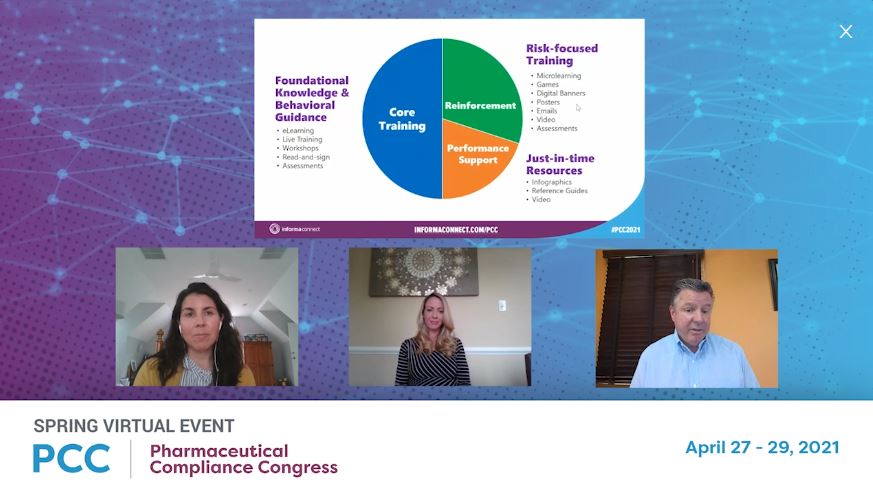
I may be biased, but the discussion about the risk-frequency framework by Dan O’Connor in the State-of-the-Art Compliance Training mini summit is “can’t miss” conference viewing. If you did miss it, let me know, and I will be happy to coordinate a brief review of the concept with Dan. The framework is a great starting point for evaluating the appropriate mix of training based on the riskiness of the activity and the frequency at which that activity occurs. Ours is not a one-style-of-training fits all world and the framework is a good way to look at your curriculum and make adjustments in the tools and techniques to address risk accordingly.
Emphasize a culture of integrity, not just compliance.
Those of us who have been working in life sciences compliance for a long time know the industry has been touting the need to shift away from a rules-based approach to compliance to one based on values and ethics. That shift is in process and was best summarized by a presenter in the Integrating Ethics and Compliance session when she said she finds the word “compliance” to be limiting and she prefers the word “integrity” to emphasize that how one does something is as important as what someone does. Or, as another presenter in the same session said, “now is the time to create a culture where people are comfortable speaking up.” That’s the language of a values-based approach and it certainly seems like it’s here to stay. Does your training incorporate these themes?
The core rules still apply.
While COVID-19 has changed the way in which business is conducted and how interactions occur, the core principles of compliance still apply. In fact, as multiple regulators and industry professionals were quick to note, “COVID is not an excuse for non-compliance.” Some of the details may have changed, but speaker programs need to be monitored, speakers need to be trained, reps need to stay on-label, federal regulations still apply, and state disclosure laws need to be followed.
More risk is okay if you have a strong foundation to manage that risk.
Many years ago, when I started working in compliance training, I could not have imagined someone being bold enough to publicly say more risk is okay. But there I was in the CCO Fireside Chat, when I heard a presenter confidently say, “striking a balance between the legal environment and business goals is key.” To my surprise, he followed up by saying, “and to help the business be more risk tolerant you need training that is sticky and impactful.” The assessment is an honest and refreshing one, and hearing the word “sticky” used in reference to compliance training brings music to the ears of someone who has been part of a team encouraging the industry to do that for 15 years. The future may be filled with more engaging and dynamic training after all.
This is the third and final post in a series covering the compliance training lessons learned at the 2020 Virtual Pharmaceutical Compliance Congress. Throughout the conference, regulators and industry professionals stressed the need for constant evaluation and modification of all aspects of a compliance program, including the training program. The successful mitigation of risk in a program requires continual careful documentation and evaluation of training topics, audiences, and deployment frequency, as well as the effectiveness of the tools utilized to deploy the training.
We’ll see you back in Washington D.C. for PCC2021!
To say 2020 has been an eventful and tumultuous year for the life sciences industry is an understatement. The COVID-19 pandemic has forced sudden change in the way in which business is conducted and created a milieu of unforeseen compliance concerns. Those issues were certainly not lost on the presenters at the 2020 Virtual Pharmaceutical Compliance Congress as timely suggestions for managing the “new normal” were blended with more traditional content related to building and managing an effective compliance program. One presenter summarized it interestingly when she said, “the plan you prepared in January does not make sense with what you need to focus on now.”
The need for on-going risk assessment was repeated throughout the conference, beginning in the Enforcement Docket Deep Dive session with one U.S. Attorney commenting, “programs must be updated over time to align with changes in the business and changes in settlements.” That risk assessment includes the on-going analysis and evaluation of a training curriculum, particularly as the way in which the industry interacts with each other and with HCPs continues to evolve.
A Rush to Roll Out New Training
The rush to cover new topics based on updated policies for virtual interactions can lead to a convoluted curriculum and do more harm than good. Regularly scheduled, comprehensive curriculum analysis helps ensure ongoing training covers existing and new topics with the right audiences, at the right level of detail, with the proper frequency based on the level of risk – and that analysis should not be pushed aside solely for the sake of expediency.
A “risk level” analysis has always been a foundational step in identifying content gaps and the need for updates in the topics covered. 2020 is no exception as the pandemic has forced a change in the way field teams interact with HCPs and conduct support programs. During the session, Look at How In-House Legal and Compliance Departments are Evolving in 2020 to Help Address Business Challenges, one compliance officer succinctly put it, “The way in which we do business has changed, so policies need to be more precise and training must be more engaging.”
Curriculum analysis begins with documenting a detailed list of topics covered in current training materials versus those required by the shift to virtual engagements. (Incidentally, PhRMA’s Statement on Application of PhRMA Code Section 2 During Emergency Periods is a good starting point for those changes). Your documentation should specifically include the target audience for each topic and indicate the level of risk each topic represents for each audience, as well as the frequency and level of detail at which each topic is presented.
Following the documentation phase, an analysis is necessary to determine whether the level of training versus the risk for the audience is sufficient. As a final step, solutions to address gaps and redundancies can be planned as new topics are added to the curriculum.
Increasing Retention and Enhancing Learning
An effective training curriculum also requires ongoing “engagement evaluation” to ensure learning is maximized. Let’s face it, the sudden onslaught of new and updated policies on virtual interactions is causing confusion. During the Candid Conversations on Key Themes and Industry Insights session of the conference, more than one panelist cited the movement to virtual programs as the topic keeping them up at night. The variables abound, and just updating foundational training programs with new policies is risky and flawed. More novel methods of training (quizzes, gamification, microlearning, etc.) offer opportunities to integrate nuggets of information into the curriculum and cut through the clutter of change to help raise engagement levels.
One industry speaker highlighted this best when he said, “You need to give them the tools to deal with awkward situations in this new way of conducting business, like how to respond to off-label questions.” That tool list begins with updated training components deployed repeatedly and strategically across the learner’s timeline. The changes wrought by COVID-19 only heighten the need to evaluate your curriculum for its power to change individual behavior – especially with updates to policies and changes in SOPs happening at such an unforeseen rate.
Unsolicited Change
The unknown can be daunting. The writer and poet Raheel Farooq once wrote, “The greatest fear in life is not of death, but unsolicited change.” We, as an industry, a country, and a world, have certainly seen our share of unsolicited change this year and it wasn’t lost on the presenters at this year’s conference. Panelists were quick to admit they didn’t have all the answers in terms of how training, and compliance in general, should be managed in these tumultuous times, but that’s okay. I’m confident most attendees would agree that the opportunity to share concerns, questions, and ideas was worthwhile, valuable, and reassuring. Kudos to all the presenters and conference organizers for making the 2020 Pharmaceutical Compliance Congress such a success under such difficult circumstances. I look forward to attending the 2021 conference “live and in-person,” as I am sure do you.
Part I: A Conference Overview and What It All Means for Your Training
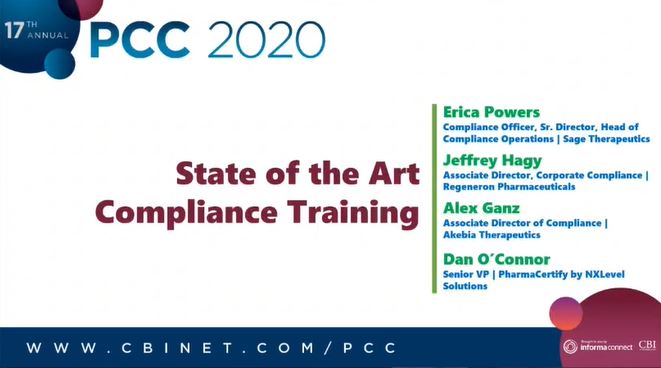
State of the Art Compliance Training, with Dan O’Connor of PharmaCertify, was just one of the 14 on-demand sessions at PCC2020.
Welcome to the first in this multi-part series based on CBI’s recent Pharmaceutical Compliance Congress! For obvious reasons, the conference went virtual this year, yet it offered an impressive lineup of industry professionals, vendors, and government officials offering compelling tips and guidelines for building and maintaining an effective compliance program in the life sciences industry. In addition to the live presentations, organizers offered 14 “on-demand” presentations covering an impressive array of topics, so from a content perspective, the virtual format created even more opportunities for learning.
Over the next month, I will touch on some of the thoughts shared by presenters related to topics like speaker programs, patient programs, risk assessments, third-parties, patient advocacy groups, transparency, and strategies for field team compliance, to name a few. And since the mission of this blog, and the PharmaCertify team, is to help you reduce risk and strengthen your compliance culture through training, I will include suggestions for growing and modifying your compliance training practices and curriculum in response to the information shared during the conference.
Kudos to the team at CBI/Informa for their diligent efforts to replicate the learning and networking experience of the live conference. PCC 2020 was a busy conference, with an impressive volume of content scheduled throughout the week and in the on-demand sessions. If you attended and did not have the opportunity to review the on-demand sessions, I have been told these will remain available until September 14th. You will especially want to review the State-of-the-Art Compliance Training session, where my colleague Dan O’Connor and compliance professionals from Sage Therapeutics, Regeneron, and Akebia Therapeutics share creative approaches for increasing training engagement and adoption. You don’t want to miss that one!
While some of the topics were familiar to anyone who has attended the conference in recent years, the “elephant in the room” was not ignored, as a multitude of presenters addressed the overwhelming challenges of keeping an entire organization focused on conducting business in a compliant manner during these unprecedented times. The result was an interesting blend of traditional and familiar compliance conference topics and guidance on navigating the risk associated with conducting business in a highly regulated industry during a pandemic, or at least as much guidance as can be expected at this time.
From a high-level training standpoint, the presentations at the conference affirm the need for a more dynamic and blended curriculum, with microlearning and other components delivered across your learners’ timelines. The method by which life sciences employees conduct their daily activities has suddenly changed, and the level of risk and potential for violations has grown exponentially with that shift.
One of the more compelling presentations was the “Criticality of Compliance” session with John Crowley of Amicus Therapeutics. John shared his family’s moving story and his incredible journey as he pushed for the development of a product to help his two children (did you know his story was the basis for the feature film, Extraordinary Measures?). As he spoke, John reflected on what the commitment means to the patients battling the rare diseases his company’s products treat, “as life sciences professionals, we are an extension of the oath that doctors and nurses have taken, and it is a solemn oath,” he said, “if there is a compliance violation, everything we hoped for in the next several years is threatened.” It is a laudable approach to building a culture of compliance at Amicus and one worthy of emulation.
I look forward to sharing more ideas from the conference, as well as subsequent training suggestions you can utilize to strive toward similar ideals and goals in your organization.
Thanks for reading!
Sean Murphy
PharmaCertify By NXLevel Solutions
Coming Up: Speaker Programs and Patient Support Programs
As you may have expected, CBI’s Pharmaceutical Compliance Congress is going virtual in 2020. Whether presented live or online, the conference remains one of the few opportunities for those in life science compliance to interact with their peers and learn tips, suggestions, and best practices from industry leaders and government representatives. Live panels and on-demand presentations spread across the agenda represent a wide variety of the topics important to anyone striving to build and maintain a strong and effective compliance program and ethical culture. Here are a few of the presentations I am particularly looking forward to.
On-Demand Presentations
To provide an extensive range of content, organizers have made some sessions available on demand. Or, as they say it on the website, “on-demand content is available anytime, to accommodate your needs and schedule.”
On-demand titles range from Strategies for Field Team Compliance, to Best Practices Around the World for Global Compliance Management, and Hub and Specialty Pharmacy Contract Oversight and Risk Assessment, to name just a few. Make sure you watch the State-of-the-Art ComplianceTraining panel discussion being hosted by my colleague from PharmaCertify, Dan O’Connor. Dan will be joined by Alex Ganz of Akebia Therapeutics, Jeffrey Hagy of Regeneron, and Erica Powers of Sage Therapeutics for a deep dive into practical and innovative training approaches that you can apply immediately. I’ve seen the notes on this one, trust me, you don’t want to miss it. The full list of on-demand sessions is on the conference website homepage: https://informaconnect.com/pcc/.
Day 1: Monday August 10
After opening remarks and the video review of the year in compliance, James Stansel, Executive Vice President and General Counsel of PhRMA, will present the organization’s annual address, Healthcare Policy Update – Current State of Regulatory Reform Driving Innovation and Access. Then Gary Cantrell, Deputy Inspector General for Investigations at OIG, will deliver the annual OIG/HHS Update.
The panel presentation from the U.S. Attorneys’ offices typically offers a revealing look into the trends and topics currently in focus for the government. This year, Enforcement Docket Deep Dive – Analysis of Recent CIAs and Settlement Trends features representatives from offices around the country, including New Jersey, Southern New York, Nevada, and Massachusetts. Expect patient assistance programs to be at or near the top of the list this year – and, on this note, PharmaCertify will soon offer a new eLearning module covering patient programs. Send me a note if you’d like to preview the content outline.
From 3:00 pm to 3:45 pm, participants choose between two live Q&A sessions, Boot Camp Q&A, with Perri Pomper from Clinical Genomics, Ed Sleeper from Esperion, and Daniel Kracov and Mahnu Davar, both of Arnold & Porter; and Primer Q&A with Rahul Khara of Acceleron Pharma, and Seth Lundy from King & Spalding.
The Opening Night Networking Happy Hour follows the Q&A sessions, and when I preview the live conferences, this is where I typically suggest attendees not miss this great opportunity to interact with peers in one-to-one conversations. There is no reason to believe the virtual networking won’t be as valuable, as attendees and presenters clearly look forward to these rare chances to exchange experiences “face-to-face.” My colleagues and I will be there!
Day 2: Tuesday August 11
The opening session on Day 2 is compelling for its title, When Drug Research is Personal: Fireside Chat with Amicus Therapeutics’ CEO and CRO on the Criticality of Compliance in Advancing Lifesaving Therapies. For those of us who work in compliance training, making that training more meaningful to the individual learner is one of our persistent goals. If our clients can communicate the importance of the training to the careers of the learners, and the lives of the patients, learning is enhanced. I am looking forward to hearing John Crowley and Patrik Florencio describe how the “criticality of compliance in advancing lifesaving therapies” is put into practice at Amicus Therapeutics.
Scanning the agenda for the rest of Day 2, anytime the words “digital revolution” appear in a session title, I am intrigued. So, I will be curious to hear Chad Morin of bluebird bio. and Brian Berry of Vertex Pharmaceuticals describe that revolution in the Patient Centricity and Compliance in the Digital Revolution session.
From 3:00 pm to 3:45 pm, attendees choose from one of four hot topic roundtables. The roundtables are diverse and compelling, depending on your objectives. As always, I recommend dividing with colleagues, or even sharing notes with a new friend you meet in the networking session, to conquer and gather as much information as possible.
Two of the roundtables jump off the screen for me. The word “checklist” in any title always catches my eye. Calling All Emerging Biotechs – Pre-commercial Compliance Considerations and Checklist with Tiago Garrido of Verastem Oncology, Rupa Cornell of Takeda, and Trish Dring of MacroGenics looks to be an interesting primer for anyone in the unique position of preparing a product launch. And, since our training is so often targeted to field teams and the risks they encounter in interactions with HCPs, the Strategies for Field Team Compliance, with Erica Powers of Sage Therapeutics, Patrick Mooty of Sumitomo Dainippon Pharma America, and Julianne Brierley of Novartis will be on my list.
Day 3, Wednesday August 12
Wednesday’s agenda begins with the CCO Showcase: Cutting-Edge and Proactive Models Driving Compliance and Transcending Silos Across the Business. Kudos to conference organizers for scheduling such an impressive lineup of chief compliance officers: Daryl Kreml from Sage Therapeutics, Beth Levine from Regeneron, Jill Macaluso from Novo Nordisk, Bryant Aaron from Novartis, Tina Beamon from Karyopharm Therapeutics, and Joshua Marks from Boehringer Ingelheim. Dedicating time for follow up Q&A after the presentation is a great idea since the interaction with the audience usually offers some of the most interesting exchanges of ideas.
Following the DOJ and SEC Insights session from 2:00 pm – 2:45 pm (e.g., the U.S Attorneys session is always worthwhile) attendees are encouraged to participate in “peer-to-peer networking time.” Each attendee will have his or her own virtual meeting room for what is described as a “streamlined networking opportunity.” It’s another attempt by organizers to provide for personal interaction, and regardless of the outcome, they should be applauded for the effort. Think speed dating without the detail about long walks on the beach and pina coladas.
Day 3 closes with additional roundtable discussions intended to foster small group discussions. Rather than dedicate Wednesday’s roundtables to specific topics, I have been informed the focus will be on “thoughts from the day and conference so far.” I like it!
Day 4, Thursday August 13
Thursday’s agenda kicks off with what should be a worthwhile discussion about navigating the sea of life sciences compliance challenges in the crazy year that is 2020 with a session titled, A Look at How In-House Legal and Compliance Departments are Evolving in 2020 to Help Address Business Challenges. John Oroho from Porzio will moderate the panel joined by Tara D’Orsi of Kyowa Kirin, Michael Clarke of ConvaTec, and Michael Hercz of Sentynl Therapeutics.
Following a late morning session focused on emerging risk areas from industry advisors (hey, how come I wasn’t invited?!) and a lunch break, the day continues with a Small Group Interaction Hosted by Track Presenters, then into the series of live hot topic roundtables from 3:45 pm to 4:30 pm.
Two roundtables stand out for me based on the hot topics in compliance training: Speaker Programs – Current Enforcement Trends, Best Practice Benchmarks and Future Fate with Peter Agnoletto from Sanofi, John Knighton from TherapeuticsMD, Jennifer DeVincenzo of Sobi, and Charlene Davis of Aerie Pharmaceuticals; and Zero-In on Compliant Patient Interactions, with Terra Buckley of Mesoblast, Rahul Khara of Acceleron Pharma, Laurie Durousseau of Rigel Pharmaceuticla, and Christie Camelio from TG Therapeutics.
Day 4, Thursday August 13
The conference closes with two sessions sure to draw a large audience of attendees. First up is, Anti-Kickback Accusations and the Aftermath — An Inside Look at Sales and Marketing Practices Under Fire with Jonathan Roper, a former district sales manager for Insys Therapeutics. The Insys case obviously holds a deep cauldron of lessons learned in every aspect of compliance, and its impact continues to reverberate across the industry.
Finally, conference organizers could not have picked a better session to close with than Empowerment, Diversity and Inclusion. Sujata Dayal of Medline Industries, Jim Massey, formerly of AstraZeneca, Maggie Feltz of Purdue Pharma, and Veleka Peeples-Dyer from Baker & McKenzie LLP will delve into what is certainly a timely and important topic in today’s world.
See You at the Conference
The logistics involved in the transition to a virtual conference must be daunting. CBI, Informa Connect, and all the speakers, are to be congratulated on their efforts and dedication to bringing so much critical content to the agenda. It looks to be a fantastic five days of learning and I hope this information provides you with more context on some key topics that caught my interest.
If you’re attending the conference, I hope to see you in the virtual PharmaCertify booth, where you can learn more about our training products and services and share thoughts about the conference. If you have not yet registered, we still have $500 sponsor discount registration certificates available. Contact us at info@pharmacertify.com to take advantage of this opportunity to join us.
Thanks for reading. I will see you online at the conference!
Sean Murphy
Product & Marketing Manager
PharmaCertify by NXLevel Solutions
Welcome to “Dear Connie, the Compliance Training Specialist,” where we answer questions about compliance training topics and present solutions for strengthening your compliance culture and reducing risk.
This week: Don’t forsake the fundamentals when building return-to-work policy training.
—————————————————————————————————
Dear Connie,
As my company considers reopening our offices under the threat of COVID-19, I’ve been asked to create training based on our new back to work policy. The policy covers precautionary measures (wearing a mask, hygiene, social distancing, etc.) as well as the potential risk factors (international travel, living with someone who has tested positive, sore throat, shortness of breath, etc.).
What type of training do you recommend based on this unique content? Obviously, face-to-face training is not plausible right now, but is one eLearning module enough for a topic this important?
Signed,
Cautious in California
Dear Cautious,
Great question! As the life sciences industry, and the country in general, plans a careful return to work, now is the time to finalize a training and communication plan to help maximize the safety and well-being of employees. A topic this important deserves not to be rushed and framing the challenge within the context of the ADDIE model is important.
Analysis
You don’t want to miss any instructional challenges on a topic like this one. For example, what are the different roles of the learners? Do you have to consider different training tools for office staff versus lab employees? How about field employees? What pre-existing knowledge does each group bring to the training? Only after you’ve established the learner groups and identified the challenges of reaching each of those groups, can you start to design the proper training.
Design
Now you need to establish the learning objectives and think about how the content will be structured and what tools will be utilized. I would certainly consider a campaign approach, perhaps starting with an eLearning module, followed by other learning nuggets, to make it more memorable and engaging. You may want to also consider on-site posters to reinforce key messages, like the need for employees to follow the rules on washing hands and not touching their faces.
Development
In a case like this, development extends well beyond just creating a storyboard for an introductory eLearning module. The content needs to be organized in a manner that maximizes the engagement for each group, as determined in the design phase. The tools and media utilized to emphasize key messages are important. Animated video, for example, is a popular trend, but you need to be careful the animation doesn’t present such serious content in an inappropriate or humorous manner.
Implementation
Don’t fall into the trap of thinking that since this is critical to their safety and well-being, the learners are going to welcome the training with open arms and dive in enthusiastically. Implementing the training in a manner that optimizes retention is critical, perhaps more than ever. Consider the way in which lessons are “chunked” and delivered across each learner’s timeline.
Evaluation
Training intended to help employees learn the rules of returning to work during the COVID-19 crisis should be evaluated and adjusted accordingly. Gather feedback from the learners through surveys and personal outreach. You need to know it’s working, and you need to answer the learners’ questions. Consider sending out short updates as the Centers for Disease Control (CDC) issues new guidance. Don’t let the training get stale!
Summary
The COVID-19 pandemic has changed the life sciences industry, but the fundamentals of memorable and effective training stay the same. Now is not the time to abandon those principles and practices to expedite the development and launch of new policy training. In fact, when faced with the challenges of ensuring the health and safety of employees, just the opposite is true.
My friends at NXLevel Solutions have over 15 years of experience developing policy training that improves retention of content and changes learner behavior. Contact Dan O’Connor at doconnor@nxlevelsolutions.com to ask how they can help ensure your “Return to Work” training helps maximize the safety of your company’s employees during these uncertain and crazy times.





 Compliance Training Intelligence