Social media compliance training can be tricky. On the one hand, you want your employees to follow your company’s official social media channels and share their enthusiasm for your company online.
On the other hand, you don’t want employees accidentally sharing confidential company information, unintentionally engaging in inappropriate product promotion, or otherwise presenting themselves as official company spokespersons when posting on their personal social media accounts.
If your training comes across too heavy-handed, your employees might be too scared to ever like a company post. But if your training is too vague, you could leave them confused, or worse, they could feel like they can post or comment on just about anything.
So how do you hit the sweet spot? Here are a few tips.
1) Know your audience. If your social media training is being assigned to all your employees, don’t weigh it down with rules that only apply to the people who can post to your company’s official social media channels. Handle their training needs separately. Your employee-wide training should focus more on the do’s and don’ts of personal social media use.
2) Include lots of examples. Be sure to include enough examples to illustrate your social media rules. Are there some company posts that employees can comment on and others they should not? Show at least one realistic example of each.
3) Explain the “why.” Remind employees why your company has a social media policy in the first place. It’s not just because regulations apply to the information your company shares. Patients, healthcare professionals, investors, job candidates, and other stakeholders rely on accurate and clear information about your products and your company.
4) Tell them who to ask. No matter how great your training is, people will have questions. Make it clear who employees can reach out to with questions.
5) Take a continuous learning approach. Just like any training, your social media training won’t stick without some sort of reinforcement. Consider sending out short follow-up videos or occasional email blasts that reinforce key guidance.
I’m sure you’ve noticed that all these rules apply to any training subject. But social media training can be a slippery slope, partly because it addresses non-work activities and partly because government and industry guidance is not as robust as it is for other areas.
To help your employees understand how they can appropriately engage with company-related social media content, NXLevel Compliance has just released a new training module, Social Media Matters. If you are interested in more information about this module, contact us at info@nxlevelsolutions.com.
In the meantime, we hope you find these tips helpful as you continue your journey as a compliance training hero!
With the new year now having gained full momentum, many compliance teams are looking ahead to one or more large-scale meetings later this year where they have been granted a precious agenda slot to conduct some form of compliance training. Maybe it’s an hour at a national sales meeting or 30 minutes wedged into a POA. Whatever it is, it’s an opportunity not to be wasted.
If this is the challenge your team is facing, you probably realize that simply presenting compliance guidance using a slide deck is not the answer. Instead, you might be thinking about using a game or some other activity to create a meaningful learning experience that will engage the meeting attendees and help them connect compliance with the situations they encounter on their jobs.
If so, here are some questions to consider when deciding what type of activity to use and how to plan for its success.
What do you want the attendees to take away from your session? Remember, they are likely processing a lot of other information during the meeting, and your time is limited. Trying to cover too much will dilute the impact of whatever activity you choose. For example, focusing on speaker programs, conference attendance, and joint interactions all in one session is likely too much. Always highlight where people can go for more information or if they have questions.
Who are the attendees? Several questions are rolled into this one. How many people will be in attendance? What are their roles and experience relative to the content you want to cover? Are there logical team structures you can leverage during the session? The answers will help you determine how to achieve a high level of engagement for everyone and the amount of technical and facilitation support you may need.
How can you integrate your activity with the rest of the meeting? You don’t want your activity to feel like it’s disconnected from the rest of the meeting (any more than you want employees to feel like compliance is disconnected from their work). Consider how your content, tone, and visuals can be aligned with the larger meeting in which you are taking part.
How much time do you have for your session? More complex activities can take more time. You need to account for setup, instruction, the activity itself, and any feedback or additional insight you want to provide. We recommend a dry run before the meeting to help you recognize just how much you can realistically accomplish in the time you have.
What is the meeting format? Will attendees be in-person, virtual, or a blend of both? For in-person attendees, what will the room layout be? What tool will virtual attendees be using to connect? Many activities can work for either in-person or virtual attendees with the proper design. But that’s not something you want to figure out on the day of the meeting.
What are your technology needs? Understand the technical needs of any activity you are considering and the resources you will have available. For example,if you want to conduct an in-person activity that relies on each person using a Wi-Fi connected device, what’s the capacity of the room’s Wi-Fi? What devices will people have with them? Are there any URLs, settings, etc. that need to be cleared with IT prior to the activity? Is each facilitator comfortable with the technology? Having technical support on standby can reduce any down time, and if a production company is involved, they can potentially help handle some tech needs. Again, a dry run ahead of time can uncover potential issues.
How will you evaluate the results? Conducting a training session at a large meeting presents an opportunity to gain valuable information about the learning needs of your audience and the impact of your training efforts. While games typically provide a score, more sophisticated tools can provide you with analytics that allow you to drill down to individual question and learner results. You may also consider conducting pre- and/or post-activity surveys/assessments and looking for evidence of behavior change (eg, examining changes in help desk calls, reported violations, etc.).
How much time and what resources do you have for development? Having less of either does not necessarily mean you have to settle for less impact. Off-the-shelf solutions can take less time and fewer resources to implement, but still create a high level of engagement. Likewise, when more time and/or resources are available, you can consider custom solutions that speak more uniquely to the specific challenges your employees face.
This is by no means an exhaustive list, but hopefully this has given you food for thought. You can also reach out to us at NXLevel Compliance to leverage our 20 years of experience helping biopharmaceutical and medical device compliance teams make the most of their moments at the next big meeting.
“What are other people doing?” It’s a question we’ve been asked by almost every client. They know that we work with dozens of life sciences companies each year, many of which have the same compliance risks and face similar training challenges.
And while no two clients, or the solutions we create for them, are exactly alike, we noticed eight common trends this year. So, here’s what “other people” were doing in 2023.
Delivering shorter and sharper training. Across the board, clients turned towards shorter, leaner training solutions. Whether that meant trimming down longer modules or creating a series of shorter modules, clients embraced solutions that minimized learner fatigue and established more realistic learning goals. An important principle to remember is to suit the length of the training to the content. For example, if the complexity of a topic truly requires a 20-minute module, then don’t break the module into two parts just to have shorter modules. Your learners might find this more annoying than simply having a single, longer module to complete. A more meaningful way clients reduced training length was by …
Targeting training by role. Coupled with the goal of shorter training, we were able to create better compliance training solutions for clients because those solutions were targeted to specific roles and/or risk areas. In some cases, this meant designing a series of micro-modules that focused on specific types of interactions with healthcare professionals. For other clients, we included role selectors inside modules, so learners received instruction tailored to their job. This went a long way to …
Making it more engaging. Life sciences employees must navigate a deluge of information and many of them spend a significant amount of time working outside of the office, where distractions increase. Getting and keeping their attention is an ongoing challenge. In 2023, our clients continued to embrace new visual and instructional designs approaches, while employing games, interactive activities, and video to grab learners’ attention and help them make meaningful connections between their jobs and critical compliance principles. And once learners were engaged in the process of learning, our clients focused on …
Keeping it going. All our clients (and the OIG) recognized the need to sustain learning. That’s why they increasingly followed a foundational training experience with reinforcement and refresher activities over the course of the year, including microlearning modules, videos, intranet banners, and emails. They also spaced out training on new topics, which built a regular rhythm of learning and increased retention. A key to sustaining learning momentum is recognizing that sometimes the best solution is …
Not creating training. Formal training is not always the answer. Sometimes what’s needed is a job aid, a refresher video, or even a simple email reminder. We helped clients use these solutions to augment or replace formal training activities. Ultimately, this helped support the next trend we saw, which was …
Looking at the big picture. Our clients increasingly looked at training from a curriculum perspective, mapping out yearly training plans to address their key risk areas. We were rarely asked to design a learning solution in a vacuum. More often, we were asked to design a full curriculum instead of just one course. Along with enabling the trends mentioned above, this allowed us to step back and consider where each organization was on its journey and chart a compliance training path that supported their employees going forward. Of course, no compliance team can properly grasp the bigger picture without …
Partnering with the business. We were impressed by how many compliance teams collaborated with their business colleagues as true partners. Many training projects had a larger goal of empowering business areas to take more ownership over reducing their compliance risk, instead of just relying on Compliance for all the answers and initiative. Working more closely with the business also reinforced the importance of …
Remembering patients. Clients continually reminded their learners that compliance is ultimately about helping patients, that healthcare laws and regulations exist to help ensure medical decisions are made in the best interest of the patient. To motivate employees to be compliant, training needs to be focused more on patient care than penalties.
These are just some of the trends that stood out in 2023 and have us looking forward to more creative, impactful, and exciting trends in the year to come.
In our last post, we covered the training highlights found in the OIG’s new General Compliance Program Guidance and noted the agency’s suggestion that “education should not be limited to annual formal training requirements.” In this post, we dive into detail about the different solutions you can use to build a curriculum that addresses the OIG’s guidance and effectively battles the “forgetting problem” inherent with a one-and-done approach to compliance training.
Reinforcement Staples
Micro-Modules Deploying microlearning modules to reinforce on topics previously covered in foundational training is a great start toward an optimized curriculum. For example, if MSL and commercial interactions are a particular cause for confusion, a short module with fresh content, or even content repurposed from foundational training, keeps critical points fresh in the learner’s mind and helps reduce the risk those interactions present.
Reinforcement Videos A range of modern software programs allow for the rapid and efficient development of high-quality, animated videos ideal for reinforcing key concepts across your organization. For example, a 90-second reminder on good communication practices can be delivered through a link in an email, or it can be playing on monitors in public spaces located across your company. We’re creating a library of videos for a number of our clients, which they can deploy strategically and provide as references on their intranet.
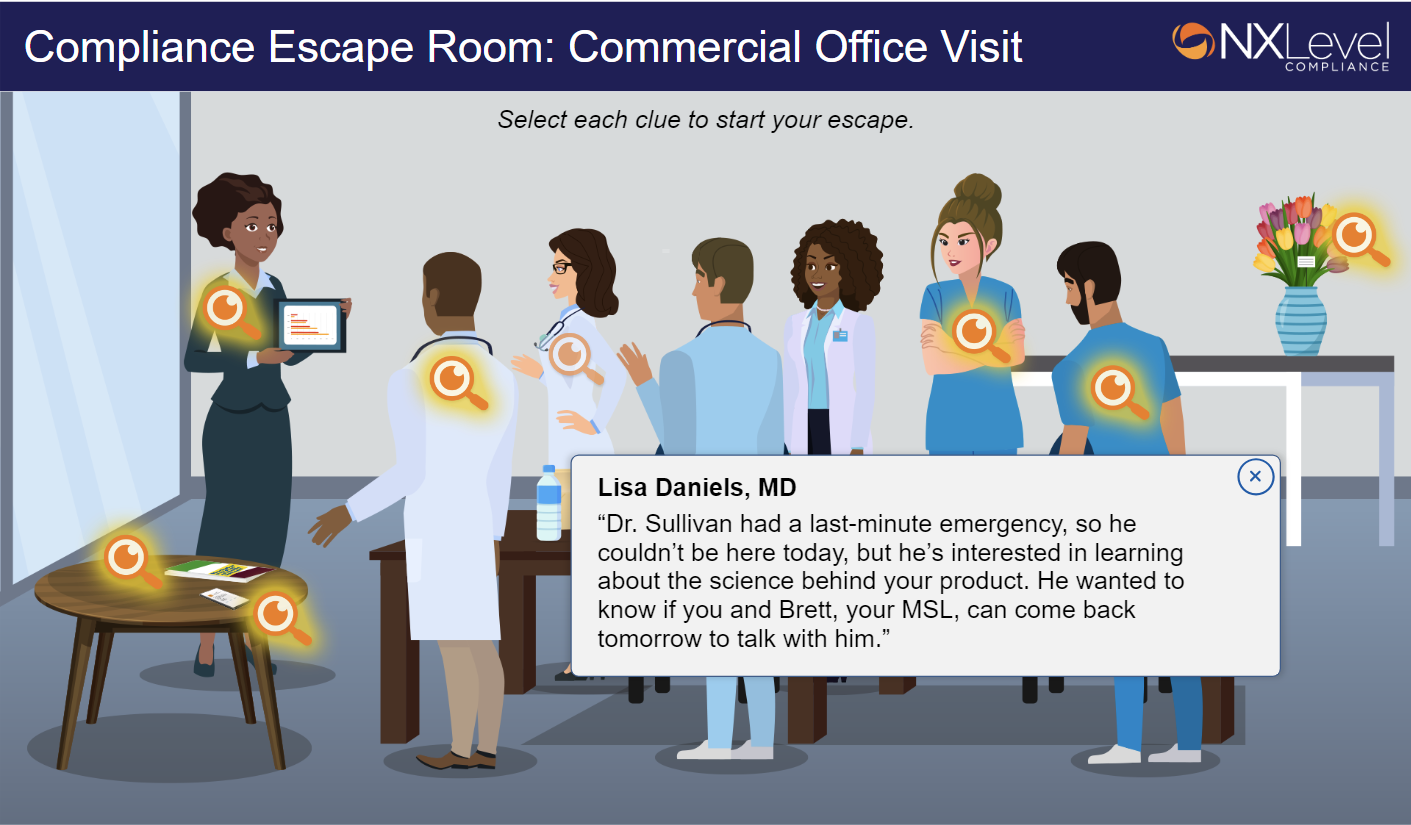
Creative Workshops Whether delivered in-person or virtually, a creatively designed workshop brings compliance guidelines to life and lets your learners practice applying their knowledge in a “safe” environment. Two of our favorites are our Compliance Reality Challenge and Compliance Escape Room workshops, where individuals and teams explore real-life scenarios and compete against one another using online, interactive tools.
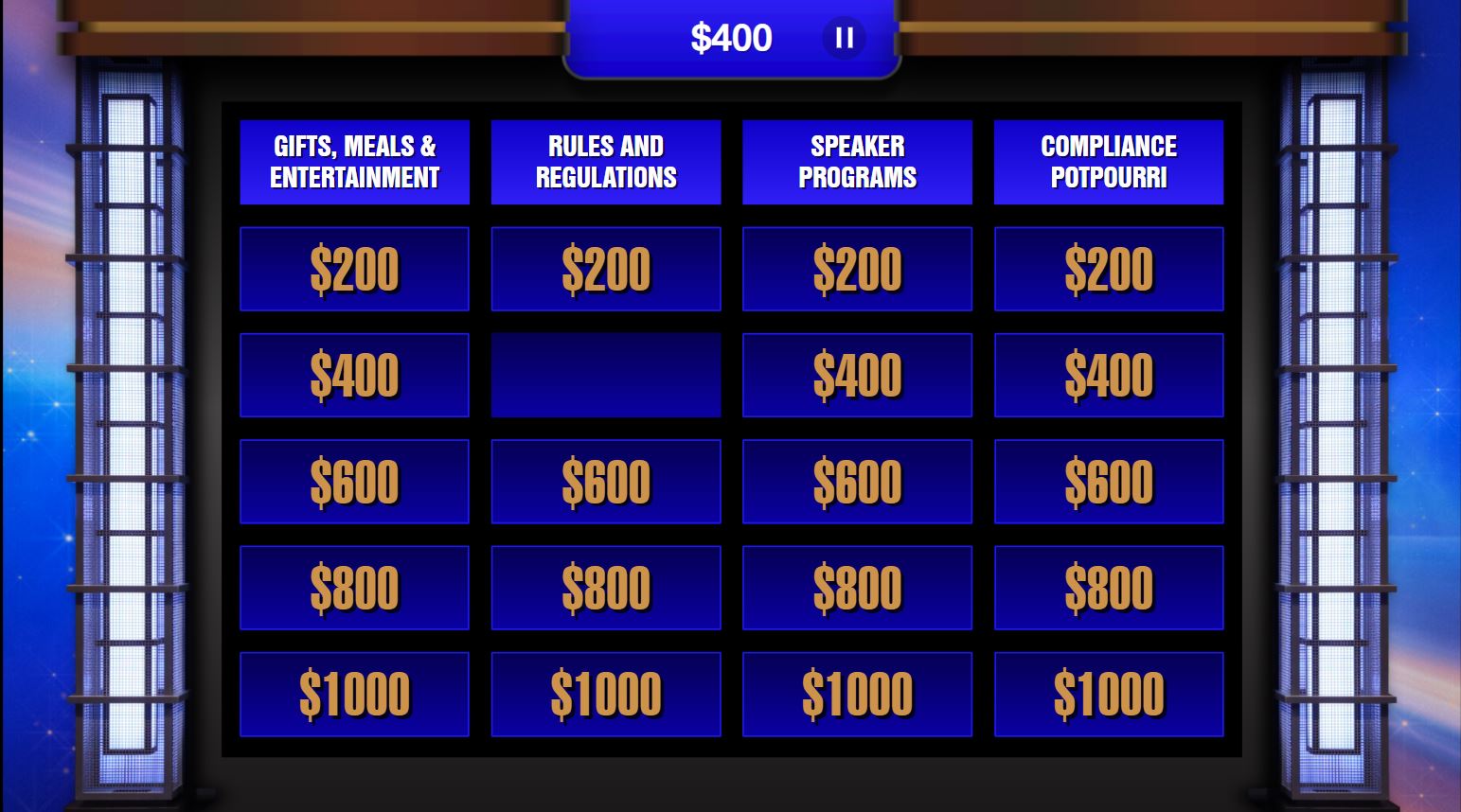
Compliance Games If you want your learners to remember their training, play a game. When deployed in a live/virtual setting, or through an online system, well-designed games are yet another tool to help reinforce critical compliance guardrails. Keep the gameplay fun and, if possible, keep it familiar. Our Compliance JEOPARDY! game, for example, is the only officially licensed JEOPARDY game on the market and features immediately recognizable graphics and music to pull participants into the learning.
Think Outside the Box
Enhanced learning can be supported by a wide range of creative solutions – not just the more common ones mentioned above. And making training stick isn’t always about creating more training. The right communication tools can reinforce key concepts and messages.
Comic Strips A number of our clients have used comic panels as a fun way to carry messages across different formats and support their unique company and compliance culture. If, for example, you create characters as part of a theme for your code of conduct training, why not recreate illustrated versions of those same characters in print? The comic panels can be displayed on posters or digitally on company platforms, and you can even create graphic novels that can be distributed to employees.
Digital Banners Banners posted across electronic platforms such as your intranet can help reinforce training messages and remind learners of key events. Have you stressed a “speak up” culture in your core compliance training? Add digital banners across different platforms to boost that message using the same visual design employed in the training. Do you celebrate Compliance & Ethics Week with live events? A digital banner can remind attendees of the dates.
Compliance Avatars and GIFs A common refrain heard at compliance congresses is the need to boost the perception of compliance as a business partner. Creating avatar versions of key compliance personnel is a fun way to “put a face” on compliance and make compliance seem less intimidating. You can even develop GIFs with messaging using these avatars and push them out through internal messaging platforms like Slack.
Keep it Continuous and Keep it Fluid
A truly effective continuous compliance training curriculum is a journey, not a destination. Successful companies are always looking for ways to enhance their curricula with solutions that creatively extend learning beyond a yearly event, and we have only touched on a few ideas. Keep an eye on our LinkedIn showcase page for examples of the tools we help our clients utilize to reduce their compliance risk.
Like many of you, we’ve been reading the new General Compliance Program Guidance the OIG released this week. And of course, we jumped right to the section on training! Before we discuss the OIG’s new training guidance, we should note that this guidance applies to the healthcare industry as a whole, not pharmaceutical manufacturers specifically. However, the OIG has announced its intent to continue to publish separate guidelines for specific industry sectors and we can expect to see new and revised versions of those guidelines in the future.
With that caveat in mind, how does the training guidance in the OIG’s new General Compliance Program Guidance compare to what’s stated in the OIG’s existing Compliance Program Guidance for Pharmaceutical Manufacturers? Essentially, the message is the same, but there are new points of emphasis.
One of the most striking statements in the new guidance is, “Education should not be limited to annual formal training requirements. The compliance officer should seek and develop opportunities to provide education on compliance topics and risks throughout the year.”
This follows a trend many companies have already embraced. More companies are supplementing their formal compliance training events with micro-modules, short videos, brief communications, games, quick reference guides, and other less formal solutions that are deployed over the course of the year. The result is a learning ecosystem designed to reinforce and reenergize key compliance behaviors and messages. The OIG guidance calls out examples such as those mentioned above.
Other new points in the guidance jump out as well. The document:
Explicitly states that compliance officers should develop annual training plans that include the training topics to be delivered and the target audience for each topic
Provides a list of suggested topics to cover when training employees on your company’s compliance program
Emphasizes the need to provide targeted compliance training to board members
Stresses that compliance training should be made accessible to all learners (for example, by making it available in different languages)
Provides guidance on allowing training waivers for contractors
Obviously, there’s more than just training guidance to be found in the OIG’s new document, and we’ll be combing over it looking for more nuggets to share here and on the NXLevel Compliance LinkedIn page. In the meantime, feel free to reach out to info@nxlevelsolutions.com to learn how we can help you reduce risk and be a compliance hero!
Don’t forget to visit the crazy NXLevel Compliance team at their booth to talk training and see demos!
This year’s conference is October 25-27 and NXLevel Compliance will be there, as usual. We’re excited to see our clients and colleagues and discuss how we can help reduce risk through better compliance training.
Also, Dan O’Connor, our senior VP, will be moderating a panel of CCOs on the topic of developing compliance leaders at 8:00 AM on Thursday the 26th. Grab your coffee and breakfast and join them for ideas and practical approaches you can use to help develop your team and yourself.
Here are ten other sessions we find to be compelling, especially from a training perspective:
Mini Summit 1: Compliance Primer and How to Make the Most of Your Time at the PCF Congress Although this session is tilted those new to life sciences compliance, expect it to be valuable for everyone as Terra Buckley shares tips for maximizing your learning and networking time at the conference.
Mini Summit 3: Insights from Medical Device Corporate Integrity Agreements Corporate integrity agreements are sure to hold keys for the expectations of regulatory bodies such as the OIG and point to the appropriate focus for any medical device compliance training curriculum.
Mini Summit 5: The Latest in Social Media Enforcements If you’re concerned about what your company’s employees might be posting or sharing (and you should be), you don’t miss this one. Side note: stop by our booth to see a demo of our new Social Media Matters Compliance Foundations module.
11:50 am Networking Luncheon In Exhibit Hall And Luncheon Mini Summits You don’t want to miss the opportunity to network with the vendors, especially at Booth 212, where we’ll be sharing demos of our newest compliance training solutions, including our Compliance QuickTakes. Then head into Luncheon Mini Summit 23: Is the “No Patient Left Behind” Approach to Patient Support Programs Viable? to hear the tips for safeguarding against the risks inherent with patient programs.
Keynote: OIG Update This year, Mary E. Riordan, Senior Counsel for the OIG, is joined by Robert K. DeConti, Chief Counsel to the Inspector General, so the annual look back at recent settlements and preview of the agency’s 2024 workplan should be even more enlightening.
US DOJ Keynote Lisa Miller, Deputy Assistant Attorney General for the Criminal Division of the Department of Justice, is up next and just like the OIG presentation, this is a can’t miss session for anyone interested in knowing where the DOJ’s attention is focused, especially considering the updates to the agency’s Evaluation of Corporate Compliance Programs guidance in March of this year.
Prosecutor’s Roundtable The prosecutor’s roundtable never disappoints in terms of the tips and suggestions panelists share regarding the government’s focus and what the industry should expect on the enforcement front.
Mini Summit 31: Annual FCPA Update All is quiet on the FCPA front…or is it? Mark this one in your calendar to hear the latest in enforcement and trends, then plan to modify your 2024 global anti-corruption training accordingly. (We have a training module for that!)
Mini Summit 51: Compliance Experts Address Concerns on Emerging Risk Areas We’re fast approaching the end of 2023 and the start of a new year of compliance training. New risks are emerging. This session should be a great starting point for your review process as panelists discuss the new topics you’ll want to emphasize in your curriculum.
Mini Summit 52: Compliance Considerations for Rare Disease Sessions targeted to this growing segment of the industry can offer valuable content related to the training needs of that segment. Expect Tiffany Damiani from Insmed and Michael Hercz of Sentynl to do just that for the rare disease group.
Conference Registration Discount We’ve only scratched the surface of the fifty-three mini summits and multiple plenary sessions in the agenda. The Pharmaceutical and Medical Device Ethics and Compliance Congress remains one of the few opportunities for you to network with leaders in the field as they share their experiences and best practices building and maintaining an effective compliance program. No matter your industry or your company’s product focus, you’ll want to be there. If you haven’t already registered, contact us at info@nxlevelsolutions.com for our sponsor discount.
Thanks for reading, we hope to see you in Maryland!
“Lately it occurs to me, what a long, strange trip it’s been.” Truckin’, The Grateful Dead
In case you haven’t heard, I’m trading the canal towpath alongside NXLevel’s headquarters for the beach, where I will be contemplating the meaning of life and writing about something besides life sciences compliance. In other words, I’m retiring.
While I will still be “virtually” hanging around NXLevel Compliance on a part-time basis and even contributing to this blog, my journey in the world of life sciences’ compliance training is coming to an end. And it has certainly been a long, interesting trip.
That’s 16 years of custom and off-the-shelf eLearning modules and a plethora of workshops and games all intended to help companies reduce risk and help their employees conduct business in a more compliant manner. Some were produced by us at NXLevel, some by in-house resources at industry companies, and some, based on the quality of the work, by vendors who had no business developing training, let alone expecting clients to pay for it.
So, the time has come to pack my bags and to ruminate on the evolution of compliance training I have witnessed during my professional journey. I leave impressed with the progress (albeit not always with the pace of that progress) and hope for a brighter future of reduced risk through better training.
Where We’ve Been
All those years ago, when I first joined NXLevel Compliance (then known as PharmaCertify), compliance training was somewhat in its infancy. To be more exact, “effective” compliance training was in its infancy. Slots reserved for compliance during POA meetings were often filled with representatives of the compliance department speaking to a PowerPoint deck. And even if the slides were created with some sense of creativity and imagination, little to no thought was given to engagement and instructional design…or heaven forbid, fun! After all, this was compliance, we had to be serious. Fortunately, that notion has faded.
Online eLearning offered opportunities to raise the engagement level and impact of the learning, but off-the-shelf “industry-generic” modules from large vendors were commonplace back then, and nothing will send a life sciences learner into a haze of disinterest more quickly than seeing an ethics scenario featuring characters from an insurance company. When modules were targeted to the industry, they were often developed by vendors whose primary business was focused on consulting, and they lacked the instructional and visual design necessary to improve the retention of policies and key concepts.
Not all training was dark, dreary, and dull back then though. There were leaders on the industry side who recognized early on that training needed to do more than just check-the-box in case the regulators came calling. As a vendor, I had the opportunity to call a number of these individuals my clients, and their steadfast commitment to raising the training bar was refreshing and presented us with a welcomed challenge.
Where We Are Now
Eventually, that commitment started to permeate the industry and the light at the end of the learning tunnel grew brighter. Instructional design concepts like adult learning principles became more than a buzz phrase and companies realized that training needed to be relevant to be effective.
Today, our clients come to the table knowing that training, whether off-the-shelf or custom, needs to be targeted to a learner’s role and feature up-to-date content designed in a manner that optimizes learning. Even the government is getting on board, with recent guidance highlighting the need for “shorter, relevant” training programs.
The bar has been raised on design as well. Simply put, it’s easy to see that compliance training looks better across the life sciences landscape. Many of our clients are even asking for more thematic training, with the imagery and verbiage being carried across the entire curriculum and the communications plan. (By the way, you really should contact my colleague, Dan O’Connor, to see examples of the award-winning “pulp magazine” concept we helped one client create and execute. It’s cool stuff they’re using to great success.)
And fun is no longer a dirty word! In addition to asking us to develop bolder concepts for online training, clients utilize our workshop frameworks like the Compliance Escape Room, and the series of games we offer through the Training Arcade, including the always popular JEOPARDY! game (check out the demo here).
At long last, compliance training industry professionals seem to finally be catching up with the colleagues on the sales training side of the business in terms of creativity, engagement, and instructional design. It was a tall hill to climb, and we are getting there. The future looks bright, now all we need to do is mix a little science into the formula.
Where We Are Going (Or Should Be Going)
“Science is magic that works.” Kurt Vonnegut
A few years back, I wrote on this blog about the German scientist, Herman Ebbinghaus, and his well-established “forgetting curve,” which essentially demonstrates that the amount of information humans remember after a learning event drops precipitously after the completion of the of that event. Our colleague, Steven Just, Ed.D., a leader in the field of learning science explains Professor Ebbinghaus’ theory this way, “The secret to long-term learning is to retrieve the memory from long-term memory, bring it into working memory, process it, and then re-encode it into long-term memory.”
So, the future of training isn’t virtual reality, as the faddists would have you believe, it’s in the continuous reinforcement of key concepts and the on-going delivery of training no matter the format. And for the compliance professionals wise enough to understand that reviewing training materials at regular intervals (spaced repetition) leads to better learning, the future is now.
Beware though, micro doesn’t just mean shorter. In addition to mini modules, learning nuggets like quizzes and gaming, deployed over time all heighten retention as well. Spacing the delivery of those components is the key to ensuring the proper guidance and best practices remain top of mind as employees conduct their business. It’s why the team at NXLevel Compliance emphasizes the use of foundational, or core, training, reinforcement solutions (quizzes, games, assessment, etc.) and performance support tools (interactive PDFs, posters, videos, etc.) to continuously “encode” concepts into the learners’ memories. Continuous learning leads to lasting results. It’s not magic, it’s science.
That’s a Wrap!
Over the last 16 years, I have had the pleasure of working with great clients, subject matter experts, and associates. I have learned from all of you. As you continue your compliance journey, I urge you to keep reading this blog and even more so, stay in touch with my colleagues at NXLevel. I know I am biased, but they truly are at the cutting edge of training design, and they bring a sense of professionalism and dedication to every project, no matter how large or small. I have been fortunate to work with them.
Thanks for reading everyone. I will see you down the road!
In the final installment in this series, we look at the E in ADDIE and discuss a less obvious, but effective, way to evaluate the effectiveness of your compliance training.
The last “E” in ADDIE, evaluation, is often the most overlooked. With so many demands on your time, it’s easy to feel that evaluation is a form of looking back, a luxury that you don’t have the time for. The truth is evaluation is all about the future and focusing on how to make your next training program more effective.
Most compliance training includes an assessment at the end that is meant to measure how well the learner achieved the objectives of the training. But as we know, measuring learning objectives immediately after training is completed is not a good indicator of how well the learner will transfer that training to their job. The forgetting curve slope can be fast and steep.
A better way to evaluate the effectiveness of a training program is to assess your learners a few weeks or even a few months after they have completed the training. But most learners view assessments with the same level of joy as a visit to the dentist, and not all assessments provide useful information. So how to assess learning without using an assessment? Play a game!
Recently, NXLevel worked with a client to evaluate the effectiveness of their annual compliance training by using the JEOPARDY! game from our suite of compliance training games.
JEOPARDY! is a proven and popular learning format employees are genuinely excited to play, and our version provides detailed reporting that allows you to drill down to see how employees responded to individual questions. It’s also the only licensed JEOPARDY! game on the market, so it features the same graphics, music, and gameplay as the television version.
Working with the client, we developed a series of role-specific JEOPARDY! games with questions that focused on critical topics pulled from their current compliance training. We configured each game so learners could play it on their own in about 10-15 minutes.
The client identified a representative subset of employees for each role and emailed each of them a link to their game.
No one was required to play, but employees could earn points towards their company’s rewards program for completing the game and more points for being high scorers. Through their company’s rewards program, employees redeem points for merchandise, gift cards, and other items.
The games were a big success! Employees appreciated that they were short, fun, and engaging. More importantly, the client obtained valuable data on how employees responded to each question, and they are now using that data to help determine how to revise their compliance training. By looking at questions where employees scored well, where employees seemed to struggle, and which incorrect answers were chosen, the client has a clearer picture of their compliance learning needs. Such practices also align well with the DOJ’s increased emphasis on a data-driven approach to compliance.
And with that, we’ve returned to the first step in ADDIE, analysis. We’re ending this blog series on using the ADDIE model where we began, because learning never ends and each step in the ADDIE model informs and interacts with the others.
Thanks for reading. We hope you’ve found the entire series informative and helpful. As always, any and all feedback is welcome!
For this installment of our series on using ADDIE to build better compliance training, I interviewed one of NXLevel’s Senior Project Managers, Pam Dorini, to hear her tips and suggestions for successfully implementing a compliance training program. According to Pam, a successful launch is built around one idea: begin with the end in mind.
Here are the highlights of our conversation.
As a project manager for custom and off-the-shelf compliance training projects, when do you start thinking about implementation?
Absolutely from the start of the project. The instructional designers, writers, and clients need to think about what we want the learners to know and be able to do as a result of the training. Then, we need to proactively think about the factors that are going to contribute to the learners doing that.
There are so many components to a successful launch, and so many stakeholders that need to be involved, implementation has to be a critical part of the plan from the start of the project. And how well that implementation goes is ultimately driven by the earlier steps in ADDIE – analysis, design, and development.
What do you see clients overlooking or underestimating in terms of implementation?
We are all pressed for time, so I think where clients go amiss is that they want to get going, get the training done, meet the immediate needs, and move onto the next project. If you don’t take the time to think through all the issues at the start, you’ll run into problems at implementation because that is where it all comes together. The time it takes to implement the training is usually quite short compared to the other stages, but implementation is where all those other stages come together, and it has to be planned as carefully.
Often, the analysis, design, and development stages are driven by the implementation date and that can lead to issues, especially when that development window is compressed, and clients are rushed to meet the deadline.
What is important for clients to consider regarding their LMS?
They need to think about the obvious and the not-so-obvious technical specifications. I will ask the client lead if he or she has released something on their LMS that is similar to what we are developing, and in most cases, we prefer to deliver a protype module for testing.
Time allocation needs to be top of mind. For example, does the LMS team have enough time to complete testing and remediation?
When we are working with a new LMS or authoring tool, testing conducted in tandem with module development is a good practice that has helped us avoid pitfalls or delays late in the process (i.e., implementation). As a company, we have integrated training into just about every LMS imaginable and there are idiosyncrasies from one to another. In some cases, we even uncover things we couldn’t have anticipated otherwise, like a font that doesn’t display correctly in a client’s system.
Are some timeframes better than others for launching compliance training?
They can be. Keeping the needs of learners at the forefront of decision making is critical. Timeframes need to be considered in correlation to the amount of time learners are given to complete the training and what other training is expected of them during that same period. Many of our clients tend to avoid launching big training initiatives over July and August because that’s when employees are often on vacation. Another challenging time can be late Autumn into the end of year as holidays and company shutdowns approach. We seem to get a lot of requests for launches in the Spring or in September and early October.
Can you share an example of a client who you think does a really good job with the implementation of training and talk about why?
I am thinking of one in particular who takes the time to understand all the various organizational goals. We always spend a lot of time planning with her and her team. She understands the capabilities and limitations of her LMS, and she engages with the business to get input on what they feel their learners need. She also understands the need for consistent communication with internal stakeholders and with us. By the time we get to the implementation point, everyone knows what to expect.
What type of changes have you seen in recent years related to implementation?
While the LMS is still the primary modality for compliance training, our clients are delving into other formats to better provide ongoing learning, reinforcement, and performance support. In addition to modules, we are developing infographics, quick reference guides, digital assets, games, and videos, which are made available in various ways. As an example, I’ve seen several clients build a library of compliance micro videos and set them up on their company SharePoint or intranet platform, then announce and link to them via email.
Conclusion
As Pam emphasized throughout our discussion, the implementation stage of compliance training drives all stages of a project. Always considering who will be taking the training, how they will be taking it, and when they will be taking it is key to making your training more effective. To roll out training that reduces risk across your company, begin with the end in mind, and keep it in mind from project start to finish.
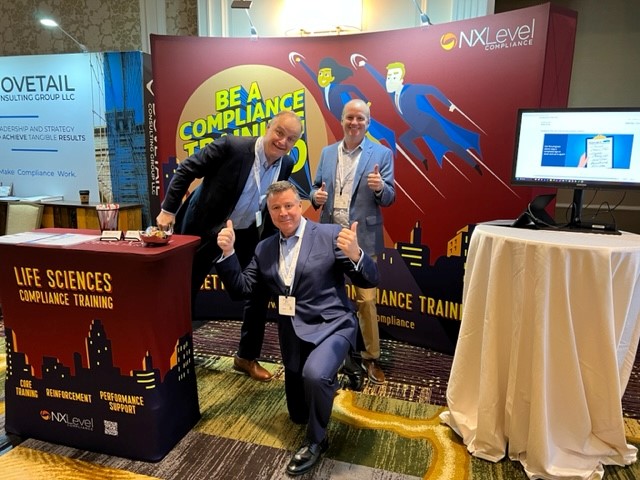
Sean Murphy, Dan O’Connor, and Paul Nash entertaining colleagues, clients, and themselves at the NXLevel Compliance booth.
I begin with a personal note. After attending the Pharmaceutical Compliance Congress (PCC) for the last 15 years, the 2023 conference will most likely be my last. For those who have not heard, I plan to retire at the end of June (at least from a full-time position) to spend more of my days visiting my kids in Virginia and California, reading, and writing about something other than life sciences compliance.
With my pending departure from the world of life sciences compliance in mind, I approached the conference sessions with a different mindset. I listened carefully for the concerns and issues that truly stood out as being something “new,” something that compliance professionals should be aware of as they build and update their compliance training curricula.
This year’s conference didn’t disappoint, revealing surprises and twists on some of the common themes we’ve heard about over the years. And so, for the final time, (I think), I present my list of training considerations based on statements I heard at the 2023 PCC. Let me know what you think…but make it quick, the beach awaits!
“Now that you’ve earned a seat at the table, you need to add value.”
After introductory remarks and the annual video review of compliance news, the conference kicked into gear with the Chief Compliance Officer Luminary Panel. (Side note: I am somewhat disappointed that I am exiting this career without ever officially being part of a “luminary” anything. Oh well.)
Anyone who has attended a compliance congress in the last ten years has likely heard the phrase, “seat at the table.” We all know the importance of being present with the business and the risks of the compliance department operating in a silo, separate from the business. But once you’re at that table, what next? Luminaries to the rescue! As one presenter noted, “We’ve been at the table long enough to do more than just listen.” Another continued by stressing the need to “know what the business needs and come to the table with solutions.”
In terms of training, that means partnering with the business on the planning, development, execution, and measurement of the curriculum. What risks do the commercial teams and others need to understand? What does mastery of compliant behavior look like? What topics require reinforcement to help learners reach mastery? How can the training (live and online) help ensure “everyone at the company understands the value of operating with integrity?” When you’re prepared to engage in those discussions and build out a plan to help accomplish the goals and learning objectives, you’re on your way to bringing training value to the table.
“Most people come to work wanting to do the right thing.”
This one came from the same CCO panel. As one presenter sees it, part of the compliance department’s job is to “make it easy for everyone on the commercial team to follow through on their commitment to do the right thing.” Clear, easy-to-understand policies, appropriate and up-to-date technology, and data-tracking platforms are just a few examples referenced for accomplishing that goal.
I couldn’t help but think the same goes for the idea of deploying training that helps them carry through on their instinct to do the right thing. Have you analyzed the topics to determine which ones are confusing or tend to raise more questions? If, for example, “interactions in an HCP office” is a topic rife with questions, consider a follow-up “compliance escape room” workshop or eModule built around common scenarios reps face. In addition, performance support tools like interactive PDFs effectively remind them of key concepts and best practices in the field, when they need it most. In more cases than not, your learners are indeed bringing a sense of integrity to their roles in your company. It’s a great starting point, and now your challenge is to offer them the knowledge and tools necessary to fulfill that mission.
“Self-disclosure truly makes a difference.”
To no surprise, the comments concerning self-disclosure were espoused during the Keynote Enforcement Panel, which featured representatives of the Department of Justice and a representative from the US Attorney’s Office for the District of Massachusetts. It was actually one of the more compelling discussions I’ve heard as to why companies should consider reporting potential compliance violations. The benefits related to the ultimate outcome and possible settlements seem significant and worth noting when violations are identified internally.
The conversation started me thinking about the need for a “spirit of self-disclosure” in training. Have you established a “speak up” culture in your organization and does your training reflect that culture? Simply including a non-retaliation statement in your training is not enough. Adding real-life scenarios to online training, with characters who are rewarded for self-reporting compliance concerns, brings the concept to life. Those same scenarios can also be incorporated into live workshops and games. These are the opportunities to remind learners that the compliance department isn’t there to lord over their every action and mete out punishment for every potential violation. Compliant companies foster just the opposite.
“How can I make my compliance program fit with this product?”
Any regular readers of this blog probably know that I find conference sessions dedicated to small and emerging companies to be among the most valuable from a training information standpoint. Smaller compliance departments are challenged with accomplishing the same objectives and goals as their compatriots from larger companies, with significantly fewer resources and budgets. The panel discussion focused on smaller companies provided valuable tips and suggestions on this topic.
This time, the conversation around the need to “fit” the compliance program to the needs of a new product being launched was especially compelling. In such scenarios, you need to understand the unique areas of risk the commercial team faces for that product. For example, is it a product that involves a patient advocacy group and the potential risks those groups inherently present?
The same need holds true for your training. Your compliance risks are unique to your company’s product(s) and the activities associated with their promotion. Your training needs to be built to fit those risks. Have you conducted the analysis necessary to properly evaluate them? At NXLevel Compliance, we work with clients to map the levels of risk per activity and the frequency with which each activity occurs, to determine the proper level of training necessary to mitigate that risk. It doesn’t have to be a complicated process, but it’s a critical step toward ensuring the effectiveness of training.
“Creating a brand is one way to become a trusted partner for the business.”
When I saw the title for the Novel Approaches to Embedding Compliance into the Business session, I knew it held the potential for something new and exciting. The panelist who recommended the brand idea discussed how it helped create a more proactive relationship in his compliance department as they partnered with the business to reinforce key concepts and messaging. And, of course, creating a brand for the compliance program helps reinforce the messages across the company.
The same is true for a training curriculum. Emphasizing your compliance brand in your curriculum presents opportunities to connect learning to your mission and your company’s values and culture. Look for opportunities to integrate the compliance brand into training components. This isn’t to say all training needs to be built from the ground up. Even the right off-the-shelf compliance training can be customized to incorporate graphics and language reflective of your brand. When your overall program and your training align, retention rises, and learning sticks.
“Make people surprised this is coming from compliance.”
Let’s be honest, life sciences compliance hasn’t exactly been considered a bastion of unexpected creativity throughout the years. I don’t think employees traditionally have waited with bated breath for the rollout of new online compliance training or the hour-long lecture by their chief compliance officer during the annual POA. Fortunately, the industry continues to evolve away from such mundane approaches and the presentation titled, Building a Compliance Program from the Ground Up, showcased exciting examples of that evolution.
Panelists from Sage Therapeutics and Alnylam Pharmaceuticals covered the plethora of methods they use to make their compliance programs, policies, and training more memorable, and it is impressive. As was suggested during the presentation, “You have to challenge yourself to think outside the box.” Sage, for example, actively seeks ways to raise the level of creativity in their training with novel scriptwriting and branding to help learners relate to the content. The themed training materials are clever and engaging and characters appear across different modalities to convey a sense of familiarity. Above all, messaging in the training programs and the other communication reinforce the idea that “they are there to help the employees succeed.” That’s a powerful mission that makes a difference in the uptake and retention of training.
“The updated DOJ guidance calls for tailored and more targeted training programs.”
Not surprisingly, the March 2023 DOJ updates to its guidance on corporate compliance programs were referenced early in the Update on Recent DOJ Pronouncements Affecting Compliance Programs session.
The revised guidance suggests that a well-designed compliance program should include “appropriately” tailored training and communications (something most worthwhile instructional designers and developers should have been recommending for years). If you are not already familiar with the recommendations, it’s worth your time to dig into the details: https://www.justice.gov/criminal-fraud/page/file/937501/download
Suffice it to say the DOJ is expanding its evaluation, and its expectations, of what can be considered effective and engaging compliance training. As an example, the guidance now suggests that effective training includes a process by which employees can ask follow-up questions, no matter the format. The bottom line is that your compliance training needs to evolve ahead of government expectations to be considered effective. Consistent evaluation of the curriculum is necessary to know that you are taking every opportunity to target the training to the risks inherent to your company and its products; to find innovative solutions that continually raise the retention and application of policies and best practices; and to solicit the feedback necessary to address the concerns and questions from your learners.
“What keeps me up at night is what I don’t know.”
The final day of the conference featured the Compliance Across the Organization session, in which members of Sentynl’s Compliance and Commercial areas discussed ideas for how both sides can partner more successfully. They began with a brief conversation about the topics that most concern them and the comment above is an ideal segue for the close of this post.
Anyone tasked with developing an effective compliance training curriculum faces a daunting challenge – building and continually updating that curriculum with the foundational training, reinforcement solutions, and performance support tools necessary to reduce risk across the organization on an ongoing basis. That goal can’t be accomplished in a vacuum, especially considering the life sciences compliance environment is ever-changing and evolving with new policies, guidance, and regulations. It’s enough to keep anyone up at night.
The overarching and perhaps unintended theme of Informa’s 2023 Pharmaceutical Compliance Congress seemed to be one of collaboration. In one session after another, presenters stressed the necessity for compliance professionals to partner with their commercial colleagues and others in their companies to accomplish the goal of creating, optimizing, and maintaining a modern compliance department.
But the need to collaborate and learn from one another doesn’t end within the walls of a company. Conferences such as the PCC offer invaluable opportunities to keep up with enforcement trends and to learn the methods and best practices necessary to succeed. You won’t find a better place to hear from government officials and industry leaders, or to network with your peers, than this conference and PCF’s Compliance Congress in the Fall. And though you may not see me there busily taking notes, my colleagues will continue to be on stage and in the exhibit hall, sharing ideas and our growing array of solutions to help you reduce compliance risk with better training.







 Compliance Training Intelligence