Training Takeaways from the OIG Update at the PCF Compliance Congress

For life science compliance professionals, one message came through clearly during Mary Riordan’s Annual OIG Update at the 27th Annual Pharmaceutical and Medical Device Ethics and Compliance Congress: Compliance programs are under increasing pressure as challenges grow and government expectations rise.

Ms. Riordan, Senior Counsel with the OIG, covered recent enforcement actions, Corporate Integrity Agreements (CIAs), compliance guidance, and areas receiving increased scrutiny.

Across those topics, a common theme emerged: effective compliance requires active monitoring, strong governance, relevant training, and a willingness to look beyond the usual risk areas.

Following is NXLevel Compliance’s synopsis of key messages, with an emphasis on potential implications for compliance training.

Compliance Risks Aren’t Limited to Sales

Kickbacks continue to be a major focus, with recent enforcement actions involving specialty pharmacies, patient assistance foundations, speaker programs, consulting arrangements, meals, travel, and other HCP interactions.

But compliance teams also need to think more broadly about who creates risk.

Recent CIAs have expanded the focus from traditional sales representatives to “field personnel,” including other employees who also interact with HCPs, healthcare organizations, and formulary decision-makers. A recent settlement between DOJ and Veloxis, for example, included alleged misconduct involving Market Access activities.

For compliance training, that’s an important reminder. Training shouldn’t be one-size-fits-all or focused primarily on sales. Market Access and other field-based teams encounter different compliance situations and need training tailored to those real-world risks.

Policies Are Only the Starting Point

Ms. Riordan highlighted recent enforcement cases that show what can happen when companies have rules, but employees find ways around them.

They included examples of employees manipulating expense reports to stay within meal limits, paying for inappropriate travel and entertainment, and paying consulting invoices for work that wasn’t performed.

That’s why monitoring matters. Compliance teams need to look at everything from HCP call notes and electronic communications to consulting agreements, advisory board records, meals, and travel. Field ride-alongs can provide an additional window into what’s really happening.

Training can be another important part of that equation. Rather than simply explaining policies and spending limits, effective training can put employees into realistic scenarios and challenge them to recognize the risks, make the right decisions, and know when to ask for help.

Just as importantly, monitoring results can help inform future training. If audits or field monitoring uncover recurring areas of confusion, those findings can become the basis for targeted education and reinforcement.

AI Is Joining the Compliance Conversation

Generative AI is also showing up in recent CIAs. Organizations and Independent Review Organizations may be required to disclose certain uses of generative AI and independently verify the accuracy of AI-generated output.

Even for companies that aren’t operating under a CIA, there’s a useful takeaway: employees using AI need to understand the related compliance expectations, including the importance of human review and accountability.

Compliance Needs a Seat at the Table

The OIG is also continuing to emphasize compliance independence and authority. Principles from its 2023 General Compliance Program Guidance are appearing in newer CIAs, reinforcing expectations around direct access to senior leadership and boards, compliance officer independence, and meaningful oversight by compliance committees and directors.

That same philosophy applies to training. Training shouldn’t exist simply to check an annual requirement off the list. It should support the risks the compliance program is actually identifying and help employees put policies into practice.

From Knowing the Rules to Applying Them

Perhaps the biggest takeaway from the OIG update is that effective compliance is increasingly concerned about what happens in the real world.

Policies and training provide the foundation, but organizations should be asking deeper questions: Does our training reflect the situations employees actually encounter? Are we reaching all the people who create or manage compliance risk? Can employees recognize a problem when there isn’t an obvious right answer?

Ultimately, good compliance training should help people recognize risk and make better decisions when it counts.

Thanks for reading!

-Paul Nash

pnash@nxlevelsolutions.com

NXLevel Compliance
The Cognitive Load Compliance Training Can’t Ignore

When someone is drowning, the last thing they need is more water. Yet when compliance training ignores how much information employees are already trying to process, that’s exactly what it can feel like. Little is learned, and the water level just keeps rising.

Our colleague Liberty Clearwater, NXLevel’s VP of Strategic Design & Innovation, recently lead a workshop on cognitive load and behavior-focused learning at LTEN 2026, an industry conference for life science learning professionals. It offered an important reminder for anyone involved in training: your employees’ capacity for learning is compromised by a demanding and distracting world.  

Employees come to training with full calendars, overflowing inboxes, constant notifications, business pressures, and personal responsibilities already occupying their attention. Research suggests that employees face hundreds of digital interruptions per day, and many report they do not have even one uninterrupted hour to focus. In that environment, expecting learners to absorb new compliance lessons seems daunting.

The concept of cognitive load helps explain why. Humans have a limited amount of working memory available at any given moment. Traditional cognitive load theory explains the demand that learning places on working memory in terms of three types of cognitive load:

  • Intrinsic Load: The inherent complexity of the learning content itself.
  • Extraneous Load: Cognitive effort created by how learning material is designed.
  • Germane Load: The effortful processing that builds real understanding and lasting memory.

One of Liberty’s workshop’s most compelling ideas was the recognition of a fourth type of cognitive load: environmental load. Employees begin each learning experience already carrying this fourth load in the form of the emails, notifications, and other pressures mentioned above. Environmental load recognizes that learning doesn’t happen in a vacuum.

What does this mean for compliance training? First, extraneous load in each learning activity needs to be minimal. No “nice to know” information or distracting graphics. Anything not supporting the learning objectives needs to be left out.

Second, you need to meet employees where they are. Consider their environmental load when designing training. Longer training events may not be practical. Even shorter ones might present challenges. Perhaps a just-in-time resource might be the best answer. Conversely, it might also mean that you need to carve out a specific time for learning, like a workshop, where employees can temporarily block out some of their environmental load and allow deeper learning to take place.

Obviously the right solution varies depending on the learning need and your employees’ circumstances. But we can’t expect compliance training to be effective if we ignore the environmental load that employees are already carrying. Doing so risks turning that training into just more water.

Thanks for reading!

-NXLevel Compliance

Plan Now for Compliance & Ethics Week!

Compliance & Ethics Week  will be here before you know it. It’s the perfect opportunity to shine a spotlight on your compliance program, reinforce the right behaviors, and remind employees that compliance isn’t just a department—it’s everyone’s responsibility. The challenge, of course, is finding ways to make compliance memorable, engaging, and maybe even a little fun. If you’re looking for fresh ideas this year, NXLevel Compliance can help you create experiences that capture attention, spark conversation, and raise awareness of the importance of making ethical decisions every day.

Want employees to put on their detective hats? Our Compliance Reality Challenge places learners in the middle of a realistic compliance scenario where they uncover clues, identify red flags, and decide what actions to take.

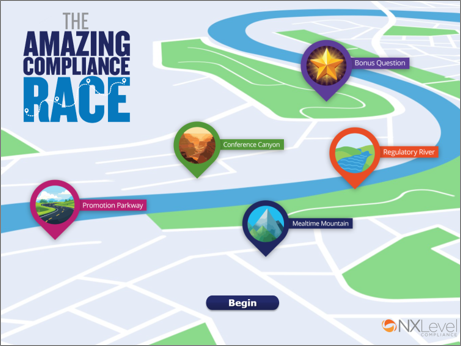
Or challenge employees with our Compliance Escape Room, where compliance traps and hidden clues are woven into an immersive virtual environment. And for something brand new, check out The Amazing Compliance Race, an interactive game that sends employees on a compliance-themed journey filled with real-world scenarios and opportunities to demonstrate their knowledge.

We can also help spread the compliance message through eye-catching posters, banners, digital signage, GIFs, intranet graphics, and other creative communications that keep compliance top of mind before, during, and after Compliance & Ethics Week. Whether you want to reinforce a speak-up culture, highlight reporting resources, promote policy awareness, or simply remind employees to pause and think before acting, we can help bring your vision to life.

Or do you have a homegrown activity in mind but could use some help with content creation, graphics, or programming? Reach out to us, tell us what you have in mind, and ask us how we can help.

The best Compliance & Ethics Week programs don’t happen at the last minute. Now is the perfect time to start planning so you can focus on your strategy while we handle the creative heavy lifting.

Let’s make compliance impossible to ignore—in the best possible way. Contact NXLevel Compliance today to explore ideas and create a customized campaign for Compliance & Ethics Week.

Thanks for reading!

NXLevel Compliance